


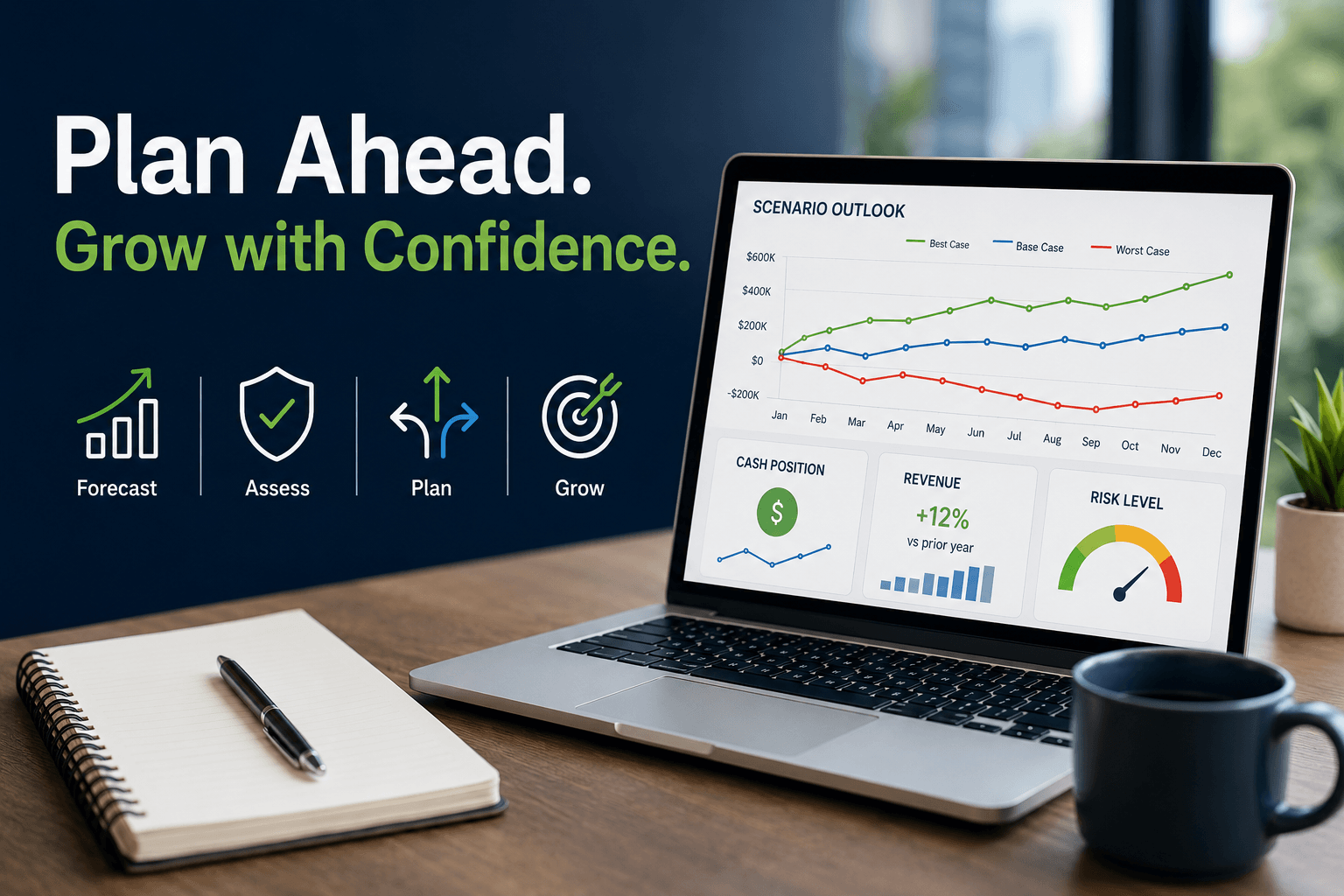
Financial Scenario Planning Tools for SMBs:
Smarter Forecasts
Financial scenario planning tools help SMBs model multiple financial futures, test assumptions, and build forecasts that withstand market volatility. These powerful platforms combine cash flow analysis, risk assessment, and sensitivity testing to give small businesses the same predictive capabilities once reserved for Fortune 500 companies. You’ll discover which tools deliver real results, how to implement them without breaking your budget, and why scenario planning separates thriving businesses from those merely surviving.
I’ve guided over 350 SMBs through financial uncertainty as CEO of Complete Controller, and here’s what I know: businesses using proper scenario planning tools make decisions 40% faster and with twice the confidence—while those stuck in spreadsheet purgatory keep reacting to problems they should have seen coming.

What are financial scenario planning tools and why do SMBs need them?
- Financial scenario planning tools are software platforms that model multiple business futures through cash flow forecasting, sensitivity analysis, and risk assessment capabilities
- Cash flow forecasting features predict payment timing, revenue fluctuations, and expense patterns across 13-week to multi-year horizons
- Sensitivity analysis shows exactly how changes in pricing, costs, or sales volume impact your bottom line
- Risk assessment modules identify threats before they materialize and quantify their potential financial damage
- Integration capabilities connect with QuickBooks, Xero, and other accounting systems for real-time data accuracy
Core Components of Effective Financial Scenario Planning Tools
Budgeting forecasting software capabilities
Modern budgeting forecasting software transforms static spreadsheets into dynamic financial models that adjust automatically as conditions change. SMBs facing seasonal swings or unpredictable client payments need systems that anticipate cash gaps weeks before they threaten operations. The biggest pitfall? Tools offering only rigid templates that break when reality doesn’t match your original assumptions.
Smart implementations combine monthly budget-to-actual comparisons with variance analysis that flags emerging trends. You’ll need this flexibility when expanding into new markets, onboarding major clients, or navigating industry disruptions that make last year’s budget obsolete overnight.
Cash flow forecasting functionality
Effective cash flow forecasting for liquidity ratios projects both timing and amounts of cash movements across multiple scenarios. Business owners can spot potential shortfalls 30-60 days out instead of discovering empty accounts when payroll comes due. The critical mistake many make is assuming revenue equals cash—ignoring the 45-day gap between invoicing and payment that kills otherwise profitable businesses.
Best-in-class tools provide 13-week rolling forecasts for immediate decisions paired with annual projections for strategic planning. This dual view proves essential during growth phases when new clients bring revenue but also strain working capital through extended payment terms.
Risk analysis tools for proactive decision-making
Risk analysis platforms quantify threats through statistical modeling that transforms vague concerns into actionable intelligence. Finance teams gain ammunition to justify contingency investments or prepare specific responses to identified vulnerabilities. Generic risk reports that list obvious threats without connecting them to your specific operations waste everyone’s time.
Effective risk scoring prioritizes threats by combining probability assessments with potential financial impact calculations. When considering market expansion or major capital investments, these tools reveal which risks could derail your plans versus those you can safely accept.
Implementing Financial Scenario Planning Tools Effectively
Financial modeling best practices for SMBs
Creating flexible financial modeling frameworks means building systems that accommodate variable inputs without complete reconstruction every quarter. Entrepreneurs testing expansion scenarios or acquisition opportunities need models that quickly show outcomes across optimistic, realistic, and pessimistic assumptions. Models failing to validate against historical performance or making unrealistic growth projections destroy credibility with investors and teams alike.
Documentation becomes critical—every assumption needs clear explanation so team members understand the logic driving projections. This transparency proves invaluable during funding rounds when investors probe the reasoning behind your forecasts.
Integrated financial planning (xFPM) adoption
Integrated financial planning and managing business accounting systems connect previously siloed functions into unified frameworks. Growing SMBs crossing the $5M revenue threshold often discover their spreadsheet collection can’t handle multi-department coordination anymore. The danger lies in selecting solutions that create new complexity rather than simplifying planning processes.
Implementation typically requires 3-6 months accounting for data migration, user training, and process adaptation. Success depends on phased rollouts that prove value department by department rather than forcing organization-wide adoption overnight.
Strategic planning analytics for long-term success
Strategic planning analytics transform raw financial data into visual insights that guide major decisions. Leadership teams aligning financial performance with market positioning need dashboards showing both historical trends and predictive indicators. Analytics focused solely on past performance miss the forward-looking intelligence that drives competitive advantage.
The most valuable implementations blend financial KPIs with operational metrics, creating holistic views of business health. This integration becomes crucial when developing 3-5 year strategic plans or evaluating market position relative to competitors.
Turn uncertainty into opportunity. See how Complete Controller helps businesses forecast smarter and plan with confidence.
Advanced Financial Scenario Planning Tools
Sensitivity analysis techniques
Sensitivity analysis in financial modeling measures how individual variable changes impact overall outcomes while holding other factors constant. CFOs identifying which levers most affect profitability gain precision in resource allocation decisions. Analysis manipulating multiple variables simultaneously creates confusion rather than clarity about cause-and-effect relationships.
Clear documentation showing which inputs changed and resulting impacts enables teams to understand model behavior. This transparency proves essential when evaluating pricing strategies or assessing vulnerability to specific cost increases.
Stress test scenario planning implementation
Stress testing models for financial resilience planning simulate extreme but plausible scenarios revealing business breaking points. Owners preparing for economic downturns or industry disruptions need realistic assessments of survivability under severe conditions. Scenarios so catastrophic they lack credibility fail to produce actionable contingency plans.
Testing frequency should match industry volatility—quarterly for high-risk sectors, biannually for stable industries. Regular stress testing becomes mandatory when taking on debt, entering volatile markets, or facing industry-specific threats requiring detailed contingency planning.

Financial Resilience Through Effective Scenario Planning
Long-term financial projections framework
Multi-year long-term financial projections incorporating market trends and strategic initiatives communicate realistic growth trajectories to stakeholders. Business leaders need credible forecasts balancing ambition with market realities when approaching investors or planning succession. Projections ignoring competitive dynamics or assuming endless growth destroy credibility faster than conservative estimates.
Annual refresh cycles with quarterly checkpoints ensure projections stay grounded in actual performance. This discipline proves invaluable during investment rounds when sophisticated investors scrutinize every assumption.
Financial decision support tools for everyday use
Practical financial decision support tools help managers evaluate daily choices with full visibility into financial implications. Operations teams considering equipment purchases or staffing changes need quick answers without waiting for financial analysis. Tools requiring CFO-level expertise create bottlenecks that delay time-sensitive decisions.
User-friendly interfaces providing clear cost-benefit analysis empower front-line managers to make smart choices independently. This democratization of financial intelligence accelerates decision-making while maintaining fiscal discipline.
Real-World Application: SMB Retail Success Through Scenario Planning
A $2.5M specialty retailer facing 45-day supply chain delays during peak season used scenario modeling to navigate crisis. Analysis revealed a 22% revenue drop would exhaust operating reserves within 60 days. Armed with this insight, management implemented conservative inventory strategies based on worst-case scenarios while maintaining customer service standards. The result? They preserved liquidity through the disruption and captured 8% additional market share as competitors faltered (US Chamber of Commerce, SMB Resilience During Supply Chain Crisis 2025).
Building Your Complete Financial Planning System
Capital planning and forecasting integration
Capital planning and forecasting requires separating growth investments from operational needs in your models. Business owners evaluating expansions or equipment purchases often blur these distinctions, creating unrealistic financing expectations. Forecasts assuming unlimited capital access ignore the reality of SMB financing constraints.
Successful implementations clearly delineate operational cash requirements from growth capital needs. This separation becomes critical when approaching lenders who want assurance that loans fund growth, not cover operational shortfalls.
Automated forecasting and planning evolution
Automated forecasting and planning beyond spreadsheets uses historical patterns to generate baseline projections while allowing manual adjustments. Businesses with consistent patterns save hours of manual work through automation. Fully automated systems ignoring unique circumstances or market shifts create false confidence in flawed projections.
The sweet spot blends automation efficiency with human judgment for optimal accuracy. This hybrid approach works particularly well when scaling operations or entering new product lines where historical patterns provide limited guidance.
Conclusion
Implementing robust financial scenario planning tools transforms uncertainty from a threat into strategic advantage. Start with cash flow forecasting as your foundation—it’s the lifeblood that keeps everything else running. Layer on stress testing and sensitivity analysis as complexity grows, but don’t wait for perfect conditions to begin. I’ve watched too many smart business owners delay implementation until crisis forced their hand. The SMBs thriving today started scenario planning when times were good, giving them confidence and clarity when markets turned volatile. Visit Complete Controller to discover financial planning solutions designed specifically for growing businesses ready to take control of their financial future.

Frequently Asked Questions About Financial Scenario Planning Tools
What are the most cost-effective financial scenario planning tools for small businesses?
Excel remains viable for businesses under $1M revenue, but cloud-based solutions like Float, Jirav, or Planful offer superior functionality starting around $200-500 monthly. The real cost consideration is time saved—automated tools typically reduce planning time by 70% while improving accuracy.
How do I choose between standalone scenario planning tools and integrated financial planning platforms?
Standalone tools work best for specific needs like cash flow forecasting, while integrated platforms suit businesses needing comprehensive planning across departments. Consider your current tech stack, team size, and whether you need real-time data integration with existing accounting systems.
Can financial scenario planning tools integrate with my existing accounting software?
Most modern planning tools offer native integrations with QuickBooks, Xero, NetSuite, and other major accounting platforms. Look for tools with API connections or pre-built integrations to ensure real-time data flow without manual imports.
What’s the difference between sensitivity analysis and stress testing in financial planning?
Sensitivity analysis measures how individual variables affect outcomes (like a 10% price increase impact), while stress testing simulates extreme scenarios affecting multiple variables simultaneously (like a recession combining reduced sales, payment delays, and cost increases).
How often should SMBs update their financial scenarios and forecasts?
Monthly updates for short-term cash flow forecasts, quarterly for annual projections, and immediate revisions when major changes occur. High-growth or volatile businesses may need weekly cash flow updates during critical periods.
Sources
- US Chamber of Commerce. “SMB Resilience During Supply Chain Crisis.” Small Business Trends, 15 Mar. 2025, www.uschamber.com/co/run/finance/small-business-financial-planning-tools.
- Controllers Council. “Best Practices for Conducting Financial Stress Testing.” Controller’s Resource, 22 Jan. 2026, controllerscouncil.org/best-practices-for-conducting-financial-stress-testing/.
- Meegle Technologies. “Scenario Planning For Small Businesses.” Strategic Planning Insights, 10 May 2026, www.meegle.com/en_us/topics/scenario-planning/scenario-planning-for-small-businesses.
- re:cap Financial Services. “Stress Test Your Business.” Financial Resilience Guide, 8 Apr. 2026, www.re-cap.com/help-center/stress-test-your-business.
 About Complete Controller® – America’s Bookkeeping Experts Complete Controller is the Nation’s Leader in virtual bookkeeping, providing service to businesses and households alike. Utilizing Complete Controller’s technology, clients gain access to a cloud platform where their QuickBooks™️ file, critical financial documents, and back-office tools are hosted in an efficient SSO environment. Complete Controller’s team of certified US-based accounting professionals provide bookkeeping, record storage, performance reporting, and controller services including training, cash-flow management, budgeting and forecasting, process and controls advisement, and bill-pay. With flat-rate service plans, Complete Controller is the most cost-effective expert accounting solution for business, family-office, trusts, and households of any size or complexity.




 Brittany McMillen
Brittany McMillen
Brittany McMillen