


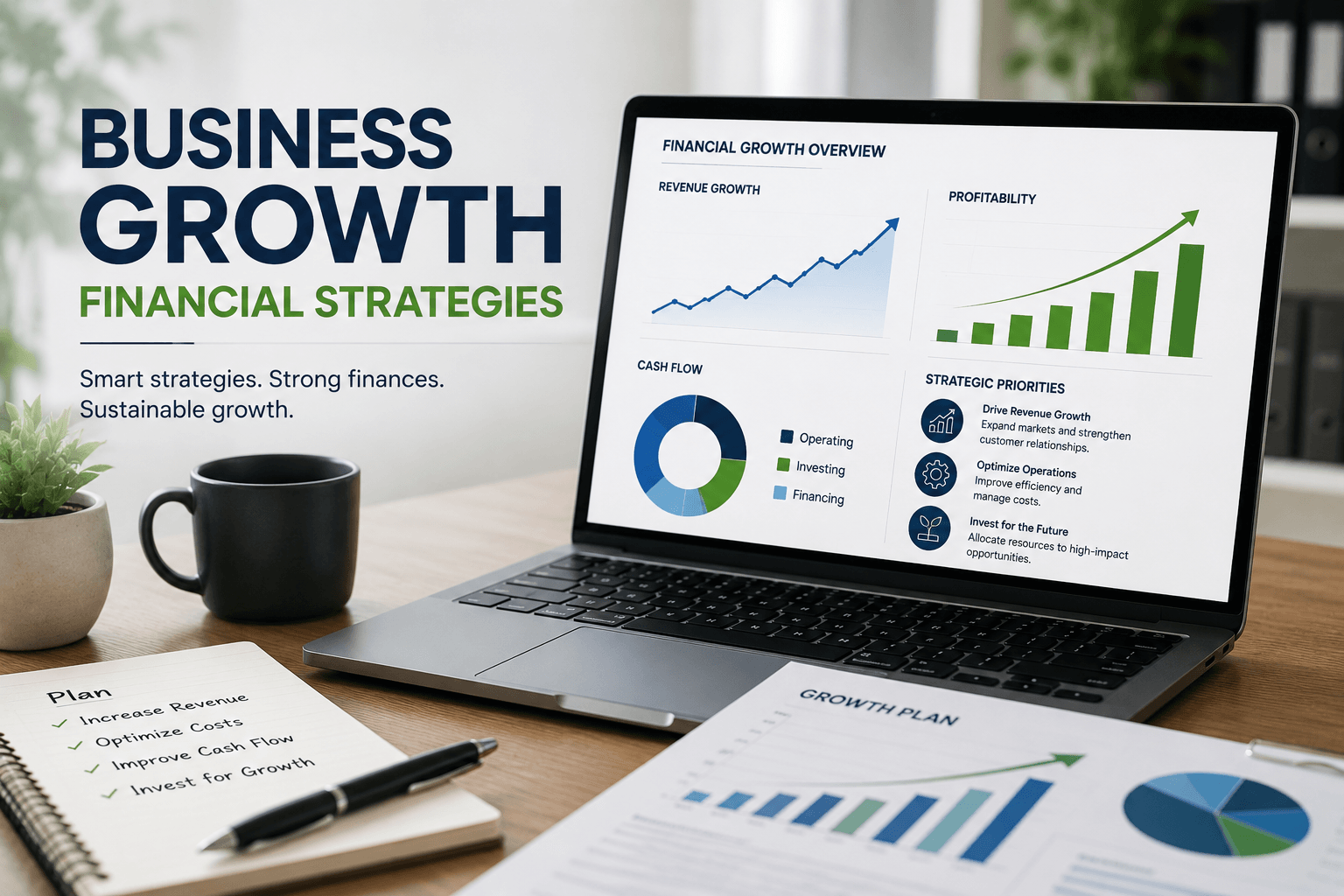
Business Growth Financial Strategies:
Smart Money Moves That Actually Scale Your Company
Business growth financial strategies are the systematic approaches companies use to manage cash flow, optimize profits, and allocate resources for sustainable expansion—including cash flow management, budgeting and forecasting, investment planning, and strategic cost reduction. If you’re running a business without a clear financial roadmap, you’re essentially driving blindfolded toward a cliff. The good news? Smart financial planning isn’t rocket science—it’s about making intentional money decisions that align with your growth goals while protecting your business from common pitfalls that sink 82% of small companies.

What are business growth financial strategies and how do you get them right?
- Business growth financial strategies include cash flow management, profit optimization, budgeting, investment planning, and risk management
- Cash flow management keeps money flowing predictably through accounts receivable optimization and expense timing
- Profit optimization focuses on improving margins through pricing strategy and operational efficiency
- Budgeting and forecasting create financial roadmaps that anticipate challenges before they become crises
- Investment planning determines where to allocate resources for maximum growth return
Why Most Small Businesses Get Financial Planning Wrong
Here’s what nobody tells you about business growth strategies: most entrepreneurs treat financial planning like a yearly dental cleaning—something they know they should do but keep postponing. According to a U.S. Bank study, 82% of business failures tie directly to poor cash flow management or not understanding cash flow basics. That’s not a typo. Eight out of ten businesses fail because they can’t manage the money they already have.
The problem starts with mindset. Too many business owners think financial strategy means “make more sales” or “cut more costs.” But real financial strategies go deeper. They’re about creating systems that turn every dollar into a growth engine while building protective barriers against market volatility.
The hidden cost of financial procrastination
When businesses delay implementing proper financial strategies for small businesses, they typically face:
- Emergency borrowing at premium rates
- Missed growth opportunities due to cash constraints
- Stress-driven decisions that sacrifice long-term gains
- Tax surprises that could have been planned for
- Vendor relationships damaged by payment delays
Building Your Cash Flow Management Foundation
Cash flow management isn’t sexy, but it’s the oxygen your business breathes. Without it, even profitable companies suffocate. The key lies in understanding that profit on paper doesn’t equal money in the bank—a lesson many learn too late.
Start by mapping your cash conversion cycle. How long does it take from spending a dollar to getting it back with profit? Most businesses have no idea. Track these metrics religiously:
- Days sales outstanding (how fast customers pay)
- Inventory turnover (how quickly products move)
- Days payable outstanding (how long you take to pay)
- Operating cash flow ratio (cash from operations vs. current liabilities)
Creating cash flow buffers that save your business
Smart cash flow management strategies for business growth include building multiple safety nets. Apple mastered this approach early, accumulating $155.2 billion in cash reserves by 2014 through disciplined spending and margin protection. While your business might not need billions, the principle remains: cash reserves equal options.
Consider implementing:
- Accelerated collection strategies: Offer small discounts for early payment
- Strategic payment timing: Negotiate longer terms with understanding vendors
- Revenue diversification: Multiple income streams reduce dependency
- Line of credit establishment: Secure financing before you need it
Mastering Profit Optimization Without Sacrificing Quality
Profit optimization doesn’t mean squeezing every penny until your business becomes a joyless operation. Instead, focus on value creation that justifies premium pricing while eliminating waste that adds no customer benefit.
The most effective financial strategies for margin improvement often hide in plain sight:
- Pricing Psychology Adjustments: Small price increases (3-5%) rarely impact demand but significantly boost margins. Test incremental changes rather than dramatic shifts.
- Operational Efficiency Gains: Automate repetitive tasks that drain time without adding value. Every hour saved is profit earned.
- Vendor Relationship Optimization: Renegotiate contracts annually. Loyalty should flow both ways.
The compound effect of margin improvements
A 1% margin improvement might seem insignificant, but across a year of sales, it transforms bottom lines. Focus on sustainable improvements rather than one-time cuts that damage long-term growth potential.
Growth needs a plan. Complete Controller can help.

Strategic Budgeting and Forecasting for Real Growth
Budgeting and forecasting for sustainable business growth requires abandoning the “set it and forget it” mentality. Dynamic businesses need dynamic budgets that adapt to changing conditions while maintaining core financial discipline.
Build budgets that breathe by incorporating:
- Scenario planning: Best case, worst case, and most likely outcomes
- Rolling forecasts: Update projections monthly, not annually
- Key performance indicators: Track leading metrics, not just results
- Variance analysis: Understand why reality differs from projections
Making financial forecasts that actually help
Traditional budgeting often becomes an exercise in wishful thinking. Instead, create forecasts grounded in historical data enhanced by market intelligence. Use these budgeting and forecasting tools to anticipate problems months before they materialize.
Smart Investment and Capital Allocation Strategies
Investment planning separates growing businesses from stagnant ones. But throwing money at problems rarely solves them. Strategic capital allocation requires ruthless prioritization based on return potential and risk tolerance.
The Federal Reserve Bank of New York reported U.S. households held $1.7 trillion in credit card debt in 2023—a 12.3% jump from the previous year. This cautionary tale applies to businesses too: high-cost debt for low-return investments destroys companies.
Evaluating growth investments like a CFO
Before committing capital, evaluate every investment and capital allocation strategy for growth through three lenses:
- Return on Investment (ROI): Will this generate more than it costs?
- Payback Period: How quickly will you recover the investment?
- Strategic Alignment: Does this move you toward long-term goals?
Build an investment scorecard that ranks opportunities objectively. Emotion-driven spending kills more businesses than market downturns.
Managing Financial Risk Without Paralysis
Financial risk management for scaling a business walks a tightrope between protection and progress. Over-caution stifles growth; recklessness invites disaster. The sweet spot lies in calculated risks backed by contingency plans.
Effective risk management strategies include:
- Diversification across revenue streams: Never let one customer represent over 20% of revenue
- Insurance optimization: Cover catastrophic risks, self-insure minor ones
- Contract protection: Include termination clauses and payment terms
- Market hedging: Use financial instruments to protect against volatility
Building financial resilience into your DNA
Business scalability depends on financial flexibility. Create systems that expand and contract based on conditions without breaking core operations. This means maintaining variable cost structures where possible and avoiding long-term commitments that limit agility.
Creating Your 90-Day Financial Transformation Plan
Stop waiting for the “perfect time” to implement proper business growth financial strategies. Start where you are with what you have. Your first 90 days should focus on:
- Days 1-30: Conduct a complete financial audit. Understand exactly where money flows in and out. No assumptions, only data.
- Days 31-60: Implement cash flow management tools and create your first rolling forecast. Start negotiating better terms with vendors and customers.
- Days 61-90: Develop your investment criteria and begin optimizing operations for margin improvement. Build your first scenario-based budget.
Remember, long-term profitability comes from consistent application of sound financial principles, not magic bullets or get-rich-quick schemes. Every successful company started with basic financial discipline and built from there.
The path to sustainable growth isn’t mysterious—it’s methodical. By implementing these financial strategies, you’re not just improving numbers on a spreadsheet. You’re building a business that thrives through any economic weather while competitors scramble for survival.
Ready to transform your financial operations but feeling overwhelmed by the complexity? The team at Complete Controller pioneered cloud-based bookkeeping and controller services specifically to help growth-focused businesses implement these strategies without the enterprise-level costs. Visit us to discover how expert financial guidance can accelerate your business growth journey.

Frequently Asked Questions About Business Growth Financial Strategies
What’s the most important financial strategy for a small business just starting to scale?
Cash flow management takes priority over everything else—you need predictable money movement before optimizing profits or making major investments, since 82% of business failures stem from cash flow problems.
How much should I budget for growth investments versus keeping in reserves?
Maintain 3-6 months of operating expenses in reserves first, then allocate 10-20% of profits toward growth investments, adjusting based on your industry’s volatility and seasonal patterns.
When should I hire a CFO or financial controller for my growing business?
Consider financial leadership when you hit $1-2 million in revenue or find yourself spending over 10 hours weekly on financial tasks—fractional CFO services offer enterprise-level expertise without full-time costs.
How do I improve profit margins without losing customers to cheaper competitors?
Focus on value differentiation rather than price competition by improving customer experience, adding premium service tiers, and communicating unique benefits that justify higher prices.
What financial metrics should I track daily versus monthly for optimal growth?
Track cash position and sales daily; monitor accounts receivable, profit margins, and burn rate weekly; review full financial statements, budget variances, and ROI metrics monthly.
Sources
- Hagen, Jessie. “U.S. Bank study reveals why small businesses fail.” U.S. Bank (via US Bank blog), April 12, 2016. https://www.usbank.com/about-us-bank/company-blog/article-library/us-bank-study-reveals-why-small-businesses-fail.html
- Federal Reserve Bank of New York. “Quarterly Report on Household Debt and Credit: 2023:Q4.” Center for Microeconomic Data (New York Fed), February 6, 2024. https://www.newyorkfed.org/microeconomics/hhdc
- Apple Inc. “Form 10-Q for the quarterly period ended June 28, 2014.” U.S. Securities and Exchange Commission (EDGAR), July 23, 2014. https://www.sec.gov/Archives/edgar/data/320193/000119312514277160/d757469d10q.htm
 About Complete Controller® – America’s Bookkeeping Experts Complete Controller is the Nation’s Leader in virtual bookkeeping, providing service to businesses and households alike. Utilizing Complete Controller’s technology, clients gain access to a cloud platform where their QuickBooks™️ file, critical financial documents, and back-office tools are hosted in an efficient SSO environment. Complete Controller’s team of certified US-based accounting professionals provide bookkeeping, record storage, performance reporting, and controller services including training, cash-flow management, budgeting and forecasting, process and controls advisement, and bill-pay. With flat-rate service plans, Complete Controller is the most cost-effective expert accounting solution for business, family-office, trusts, and households of any size or complexity.




 Brittany McMillen
Brittany McMillen
Brittany McMillen