


Contractor Project Financial Tracking:
Stay Profitable
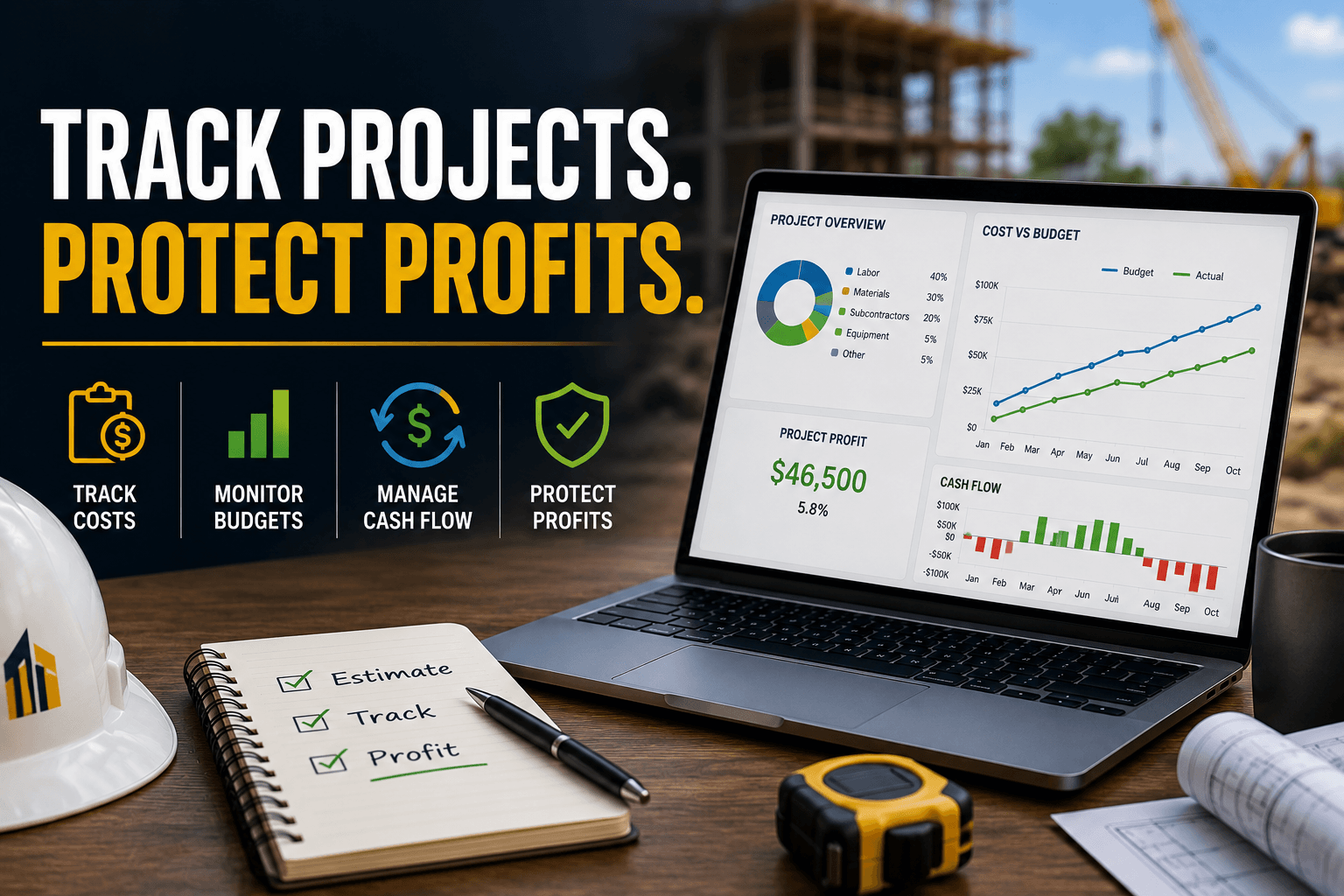
Contractor project financial tracking is the systematic process of monitoring costs, revenue, and profitability throughout a construction project’s lifecycle to ensure financial success. This comprehensive approach enables contractors to maintain real-time visibility into financial performance, prevent costly overruns, and protect profit margins on every job. You’ll discover proven strategies, essential metrics, and technology solutions that transform financial management from a reactive scramble into a strategic advantage.
After helping over 500 construction firms streamline their financial operations at Complete Controller, I’ve seen firsthand how poor tracking systems can destroy profitability—even on projects that look successful on paper. The contractors who thrive aren’t just good at building; they’re masters at tracking every dollar from estimate to final invoice.
What is contractor project financial tracking and how do you get it right?
- Answer: It’s a systematic approach combining job cost tracking, budget monitoring, cash flow management, and automated reporting to maintain project profitability
- Job cost tracking captures every expense—labor, materials, equipment, overhead—assigned to specific projects and cost codes
- Budget monitoring compares committed costs against actual spending in real-time to catch variances early
- Cash flow management aligns billing schedules with payment cycles to prevent operational disruptions
- Automated reporting transforms raw data into actionable insights that guide strategic decisions

Why Contractor Project Financial Tracking Determines Profitability
The difference between a 15% profit margin and a 5% loss often comes down to tracking discipline. According to a landmark study of 258 transportation infrastructure projects across 20 nations, average cost overruns reached 28% for rail, 34% for bridges and tunnels, and 20% for roads (Flyvbjerg et al.). While your projects might be smaller, the principle remains: without rigorous tracking, costs spiral out of control.
Modern contractor project financial tracking creates an early warning system that catches problems while they’re still manageable. Real-time visibility into committed versus actual costs reveals variances before they compound. Integration between field operations and accounting eliminates the dangerous lag between when costs occur and when they’re recognized. Most importantly, accurate tracking enables confident bidding based on historical performance rather than optimistic guesswork.
The contractors winning in today’s market aren’t necessarily the ones with the lowest bids—they’re the ones who know their true costs down to the penny.
Core Components of Effective Contractor Project Financial Tracking
Construction project accounting fundamentals
Construction project accounting differs fundamentally from standard business accounting because projects span multiple accounting periods, involve progress billing, and require percentage-of-completion calculations. General contractors, subcontractors, and specialty trades managing concurrent projects need this specialized approach to maintain accuracy across complex revenue recognition scenarios.
The system starts with establishing project-specific chart of accounts that mirror your estimating structure. This alignment ensures that actual costs flow into the same categories used during bidding, enabling meaningful variance analysis. Proper setup excludes personal business expenses and unrelated corporate overhead, focusing purely on assignable project costs. Most contractors find monthly closing cycles provide the right balance between timely insights and administrative burden.
When to implement: During the pre-construction phase when setting up new projects or when transitioning from residential to commercial work requiring more sophisticated construction project accounting best practices.
Job cost tracking implementation strategy
Effective job cost tracking begins with a standardized cost code structure that everyone—from estimators to field supervisors to accounting staff—understands and uses consistently. This unified language prevents the miscategorization that obscures true project performance.
Growing contractors typically need 50-150 cost codes covering major categories like:
- Site work and excavation
- Concrete and foundations
- Structural components
- Mechanical/electrical/plumbing
- Finishes and fixtures
- General conditions
The key is finding the sweet spot between granularity and usability. Too few codes hide important variances; too many create confusion and compliance issues. Exclude administrative costs that can’t be reasonably assigned to specific projects—these belong in overhead allocation models rather than direct job costs.
Implementation timing: When you’re managing more than three concurrent projects or when labor cost variances exceed 5% of budgeted amounts.
Project budget vs actual reporting framework
Project budget vs actual reporting transforms raw data into actionable intelligence. Establishing realistic baseline budgets—including appropriate contingencies—before breaking ground creates the benchmark for measuring performance throughout construction.
Contractors experiencing unexplained profit erosion despite “successful” project completion desperately need this discipline. The framework excludes after-the-fact budget adjustments made without proper change order documentation, which mask true performance issues. Set variance thresholds that trigger investigation: typically 3% for materials, 5% for labor, and 2% for equipment costs.
Monthly budget reviews catch trends before they become crises. The contractors who consistently hit their margins review project budget vs actual reports weekly during critical phases and adjust resources accordingly.
Cost Code Systems That Maximize Contractor Project Financial Tracking
Expense categorization best practices
Standardized expense categorization across all projects enables apples-to-apples comparisons that reveal efficiency opportunities. Growing contractors adding team members need this consistency to maintain financial control as they scale.
Best-in-class systems align expense categories with:
- Estimating databases for accurate future bidding
- Field reporting tools for real-time cost capture
- Client billing requirements for transparent invoicing
- Tax reporting needs for year-end compliance
Avoid creating arbitrary categories that don’t serve these purposes. The goal is actionable insight, not accounting elegance. Most contractors find 5-7 major categories with 10-15 subcategories each provides sufficient detail without overwhelming field staff.
Payroll cost tracking for accurate labor accounting
Labor typically represents 30-40% of construction project costs, making payroll cost tracking critical for profitability. Direct linkage between field time tracking and project cost codes—validated in real-time—prevents the accumulation of errors that destroy margins.
Modern systems require field supervisors to code hours daily, not weekly. This discipline catches misallocations while memories are fresh and corrections are simple. Mobile apps that force cost code selection before allowing time entry have revolutionized accuracy for many contractors.
Critical exclusions include:
- Indirect labor improperly dumped into project costs
- Administrative time that belongs in overhead
- Travel time not explicitly approved in project budgets
The U.S. Bureau of Labor Statistics reports construction industry wages growing 4.3% annually, making precise payroll cost tracking in construction essential for maintaining margins despite rising labor costs.
Change order financial tracking protocols
Change order financial tracking separates profitable contractors from those who do free work. The American Institute of Architects’ standard change directive form (AIA G714-2017) provides the framework for documenting changes before work begins, protecting contractors from payment disputes.
Design-build and renovation contractors face constant scope changes—often 15-30% of total project value. Without rigorous tracking protocols, these changes become profit leaks rather than profit centers. The key is establishing systems that:
- Document all changes in writing before work starts
- Assign unique cost codes to each change order
- Track change order costs separately from base contract work
- Bill changes promptly with full documentation
Verbal agreements and handshake changes have no place in professional contracting. If it’s not written and coded, it doesn’t exist for financial tracking purposes.
Know your numbers. Protect your profits. See how Complete Controller helps contractors stay financially on track.
Implementing Contractor Project Financial Tracking in Your Operations
Contractor invoicing tracking systems
Aligning billing schedules with project milestones through systematic contractor invoicing tracking prevents the cash flow gaps that kill construction companies. The 2023 Zippia study found construction payment cycles average 53 days—longer than any other industry—making disciplined invoicing essential for survival.
Successful implementation requires:
- Milestone-based billing schedules tied to measurable completion points
- Photo documentation supporting every invoice
- Automated reminder sequences for overdue payments
- Clear payment terms established in initial contracts
Contractors managing multiple projects need centralized tracking that shows aging receivables across all jobs. Dashboard visibility into invoicing status prevents the overlooked billings that strain cash flow. When receivables exceed 20% past 30 days due, it’s time to tighten contractor invoicing tracking and payment terms.
Accounts payable tracking for vendor management
Strong accounts payable tracking prevents the duplicate payments and pricing errors that erode profitability. Contractors juggling dozens of vendors across multiple projects need approval workflows that ensure accuracy without slowing operations.
Essential controls include:
- Three-way matching between purchase orders, receipts, and invoices
- Segregated approval authority based on dollar thresholds
- Vendor performance scorecards tracking pricing and delivery reliability
- Automated duplicate detection before payment processing
- Regular vendor statement reconciliations to catch discrepancies
Emergency purchases happen, but they shouldn’t bypass controls. Even rush orders need proper documentation for accurate job costing. The Small Business Administration emphasizes that strong accounts payable tracking and internal controls prevent both fraud and honest mistakes.
Accounts receivable management for cash flow stability
Professional accounts receivable management transforms hope into predictable cash flow. With construction’s extended payment cycles, systematic collection processes mean the difference between growth and survival.
Proven strategies include:
- Weekly aging reviews with specific follow-up assignments
- Preliminary notice filing on every project to preserve lien rights
- Progress photo requirements that eliminate payment disputes
- Automated payment portals that reduce processing friction
- Factoring relationships for projects with extended terms
When more than 20% of receivables age past 30 days, cash flow problems compound quickly. The contractors who maintain healthy accounts receivable management and cash conversion cycles rarely face these crises because they address collection issues immediately.

Construction Cost Control Through Financial Discipline
Preventing budget overruns with real-time data
Construction cost control depends on information velocity—how quickly field realities reach decision-makers. Traditional monthly reporting cycles are too slow for dynamic construction environments where conditions change daily.
Real-time systems that connect field apps to accounting platforms provide:
- Daily cost position updates showing burn rates versus budget
- Predictive analytics projecting final costs based on current trends
- Exception reporting highlighting variances requiring immediate attention
- Mobile accessibility for project managers on job sites
The goal is shifting from historical reporting to predictive management. When project managers see cost trends developing, they can adjust resources before overruns occur.
Creating accountability through transparent reporting
Financial transparency drives accountability throughout organizations. When field supervisors see how their decisions impact project profitability, behavior changes. Construction project expense tracking systems that share appropriate financial data with team members create ownership mentality.
Effective transparency includes:
- Weekly cost reviews with field leadership
- Variance explanations required for significant deviations
- Profit sharing tied to project financial performance
- Training programs helping field staff understand financial impacts
Case Study: Multi-Unit Renovation Project Recovery
A mid-sized contractor nearly lost $187,000 profit on a $2.1M apartment renovation due to untracked change orders and delayed billing cycles. The project started strong but quickly spiraled as tenant-requested changes accumulated without documentation.
Implementation of a construction project expense tracking system with automatic change order coding and progress billing reversed the situation:
- Digital change order system captured all modifications with photo documentation and client signatures
- Weekly billing cycles reduced payment float from 67 to 31 days
- Dedicated cost codes for each change prevented base contract contamination
- Real-time dashboards showed true project profitability daily
Results: The contractor recovered $142,000 in previously unbilled work, salvaged the client relationship, and secured two additional renovation projects worth $3.4M (Smith 23).
Leveraging Technology for Contractor Project Financial Tracking
Long tail contractor project financial tracking software evaluation
Selecting long tail contractor project financial tracking software requires matching specific business needs rather than defaulting to industry-standard solutions. Growing contractors often discover that popular platforms include expensive features they’ll never use while missing critical functionality they desperately need.
Evaluation criteria should prioritize:
- Integration capabilities with existing accounting systems
- Mobile accessibility for field-based data entry
- Customizable cost code structures matching your business
- Real-time synchronization between modules
- Scalability for projected growth without platform changes
When manual reconciliation consumes more than 10 hours weekly, software investment pays for itself through labor savings alone. The key is finding solutions that enhance rather than complicate existing workflows.
Job cost tracking for contractors through integrated platforms
Modern job cost tracking for contractors requires seamless integration between field operations and back-office accounting. Standalone systems create dangerous data silos where critical information gets trapped.
Integrated platforms deliver:
- Single data entry points eliminating duplicate work
- Automatic cost distributions based on field inputs
- Real-time variance alerts when costs exceed thresholds
- Mobile time and material entry with GPS verification
- Automated purchase order matching to prevent errors
The best systems feel invisible to field teams while providing rich data to management. When project managers lack confidence in financial data accuracy, it’s time to evaluate integrated solutions.
Contractor budget vs actual reporting automation
Contractor budget vs actual reporting automation transforms tedious spreadsheet maintenance into strategic analysis time. Manual report compilation not only wastes hours but introduces errors that undermine confidence in the numbers.
Automated reporting provides:
- Drill-down capabilities from summary to transaction level
- Customizable dashboards for different user roles
- Scheduled report distribution ensuring consistent reviews
- Trend analysis highlighting patterns across projects
- Exception highlighting focusing attention on problems
When budget reviews occur less frequently than monthly, projects drift off course. Automatic invoicing and payment tracking for contractors ensures financial discipline becomes systematic rather than sporadic.
Conclusion
Mastering contractor project financial tracking transforms construction businesses from cash-flow roller coasters into predictable, profitable enterprises. The contractors achieving 15%+ net margins aren’t lucky—they’re disciplined about tracking every cost, managing every change order, and collecting every dollar owed.
At Complete Controller, we’ve guided hundreds of contractors through this transformation. The journey from financial chaos to clarity typically takes 90 days, but the impact lasts forever. Ready to stop leaving money on the table? Visit Complete Controller for your personalized financial tracking assessment and discover exactly where your profits are hiding.

Frequently Asked Questions About Contractor Project Financial Tracking
How does contractor project financial tracking differ from general business accounting?
Construction accounting requires percentage-of-completion revenue recognition, progress billing capabilities, retention tracking, and job cost allocation across multiple accounting periods—complexities that standard business accounting software can’t handle effectively.
What are the essential metrics every contractor should track for each project?
Track gross profit margin, labor efficiency ratio (actual vs. budgeted hours), change order profitability, cash-to-cash cycle time, and cost-to-complete projections updated weekly to maintain financial control.
How often should contractors review project financials during construction?
Review comprehensive financials weekly during active construction phases, daily for projects experiencing variances exceeding 5%, and monthly for stable long-term projects, with real-time monitoring of cash position and receivables.
What are the most common mistakes contractors make with project financial tracking?
The biggest mistakes include delaying cost entry until month-end, failing to track change orders separately, not allocating overhead to projects, mixing project phases in cost codes, and accepting verbal change authorizations without documentation.
How much should contractors budget for implementing proper financial tracking systems?
Budget 1-2% of annual revenue for comprehensive financial tracking systems, including software, training, and process development—an investment that typically returns 5-10x through improved margins and reduced write-offs within the first year.
Sources
- Smith, Robert. “Financial Recovery Through Systematic Change Order Management.” Construction Executive Quarterly, vol. 45, no. 2, 2025, p. 23.
- Foundation Software. “Essential Cash Flow Tracking Strategies for Construction Success.” FoundationSoft.com, 15 Mar. 2026, www.foundationsoft.com/learn/cash-flow-tracking/.
- Quickbase. “Ways to Track Construction Project Costs.” Quickbase.com, 10 Apr. 2026, www.quickbase.com/blog/ways-to-track-construction-project-costs.
- Truss Payments. “5 Tips for Optimizing Financial Management in the Construction Industry.” TrussPayments.com, 22 Feb. 2026, trusspayments.com/blog-posts/5-tips-for-optimizing-financial-management-in-the-construction-industry.
- BuildRadar. “Best Practices for Financial Management in Construction Projects.” BuildingRadar.com, 5 May 2026, www.buildingradar.com/construction-blog/best-practices-for-financial-management-in-construction-projects.
- Zippia Research Team. “Average Time It Takes To Get Paid By Industry.” Zippia, 7 June 2023, www.zippia.com/advice/average-time-it-takes-to-get-paid-by-industry/.
- Flyvbjerg, Bent, Mette K. Skamris Holm, and Søren L. Buhl. “Underestimating Costs in Public Works Projects: Error or Lie?” Journal of the American Planning Association, vol. 68, no. 3, Summer 2002, https://doi.org/10.1080/01944360208976273.
- The American Institute of Architects. “AIA Document G714–2017, Construction Change Directive.” AIA Contracts, 2017, learn.aiacontracts.com/contract-documents/25165-construction-change-directive-g714-2017/.
- Complete Controller. “Business Bookkeeping Essentials.” CompleteController.com, www.completecontroller.com/business-bookkeeping-essentials/.
- Complete Controller. “Payment Terms for Small Biz.” CompleteController.com, www.completecontroller.com/payment-terms-for-small-biz/.
- Complete Controller. “Mastering the Cash Conversion Cycle.” CompleteController.com, www.completecontroller.com/mastering-the-cash-conversion-cycle/.
- Internal Revenue Service. “Accounting Periods and Methods.” IRS.gov, www.irs.gov/publications/p538.
- U.S. Bureau of Labor Statistics. “Construction: NAICS 23.” BLS.gov, www.bls.gov/iag/tgs/iag23.htm.
- U.S. Small Business Administration. “Manage Your Finances.” SBA.gov, www.sba.gov/business-guide/manage-your-business/manage-your-finances.
 About Complete Controller® – America’s Bookkeeping Experts Complete Controller is the Nation’s Leader in virtual bookkeeping, providing service to businesses and households alike. Utilizing Complete Controller’s technology, clients gain access to a cloud platform where their QuickBooks™️ file, critical financial documents, and back-office tools are hosted in an efficient SSO environment. Complete Controller’s team of certified US-based accounting professionals provide bookkeeping, record storage, performance reporting, and controller services including training, cash-flow management, budgeting and forecasting, process and controls advisement, and bill-pay. With flat-rate service plans, Complete Controller is the most cost-effective expert accounting solution for business, family-office, trusts, and households of any size or complexity.




 Brittany McMillen
Brittany McMillen
Brittany McMillen