


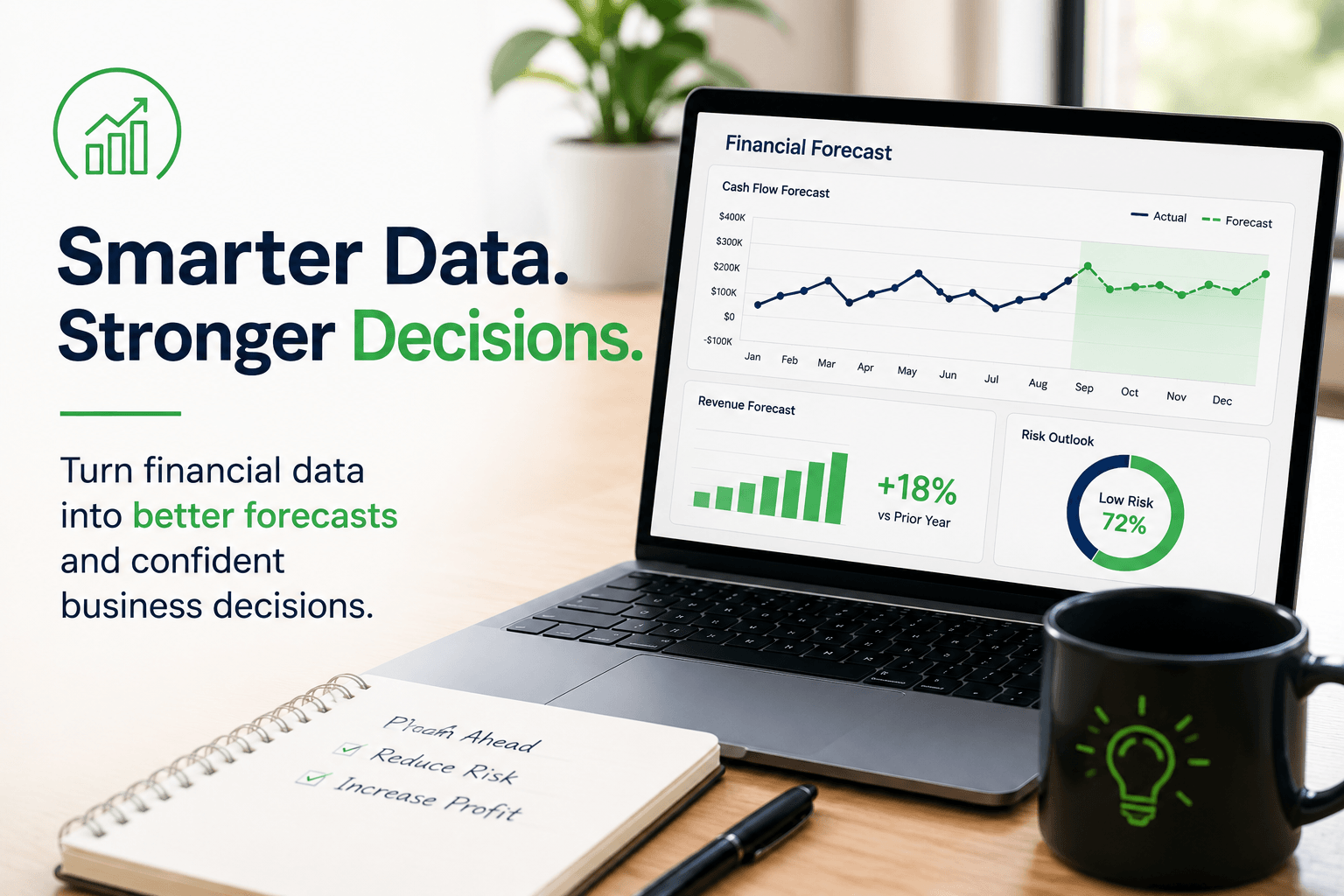
Machine Learning Financial Forecasting:
How Smart Businesses Predict What’s Next
Machine learning financial forecasting uses algorithms trained on historical data—like sales, market prices, and economic indicators—to predict future financial outcomes such as cash flow, stock returns, demand, and risk with far greater accuracy than traditional spreadsheet models. Instead of drawing a straight line through last year’s numbers, machine learning finds the hidden, nonlinear patterns your data has been trying to tell you about all along.
Here’s what I’ve learned after two decades helping businesses take control of their finances: the companies that win aren’t the ones with the most data. They’re the ones who use it. A 2022 Bank of England and FCA survey found that 72% of UK financial firms were already using or developing machine learning—and the median firm expected its ML applications to more than triple within three years. This isn’t a trend you can afford to watch from the sidelines. It’s the new baseline.
What is machine learning financial forecasting and how does it work?
- Machine learning financial forecasting is the practice of training predictive models on historical financial data to project future outcomes like cash flow, stock prices, demand, and risk—more accurately than traditional linear methods.
- It works by learning patterns: algorithms study past data, identify relationships humans miss, and apply those patterns to new information.
- It outperforms old methods: research shows ML models beat traditional linear models at predicting stock returns because markets behave in nonlinear ways.
- It requires good inputs: clean data, smart feature engineering, and proper validation determine whether your forecast is gold or garbage.
- It has limits: models fail when markets shift suddenly—which is why human judgment and governance still matter.

Why Machine Learning Beats Traditional Forecasting Models
Traditional forecasting assumes the future looks like a tidy extension of the past. Markets laughed at that assumption a long time ago.
The evidence is compelling. In a landmark study of U.S. stock returns from 1957 to 2016, researchers Gu, Kelly, and Xiu found that machine learning models consistently beat traditional linear models in predicting expected returns. Using 94 firm characteristics, they proved something practitioners have felt in their gut for years: financial markets are packed with nonlinear patterns that regression models simply can’t capture.
What machine learning sees that spreadsheets don’t
Regression models draw straight lines. Machine learning draws whatever shape the data actually takes. That means it can catch things like seasonal demand spikes interacting with interest rate changes, or how customer payment behavior shifts when inflation ticks up. That flexibility is the whole game—and it sets the stage for where these tools shine brightest.
Where Machine Learning Financial Forecasting Delivers Real Results
You don’t need a hedge fund budget to put predictive analytics to work. Here’s where I see the biggest wins for real businesses:
- Stock market analysis: Predictive models for stock market trends power everything from institutional trading desks to the apps in your pocket. Tools built for stock price prediction now put market monitoring and analytics in the hands of everyday investors.
- Cash flow forecasting: This one’s my favorite, because cash flow is where businesses live or die. Using machine learning to predict cash flow helps you spot liquidity crunches weeks before they hit—so you’re making moves, not making excuses.
- Demand forecasting: ML handles long tail forecasting beautifully, predicting demand even for low-volume products with irregular sales histories.
- Portfolio optimization: Applying machine learning models for risk and return estimation helps investors evaluate diversification opportunities with data instead of hunches.
Each of these applications depends on one thing: feeding your model the right ingredients. Let’s talk about that next.
Building a Forecasting Model: Data, Features, and Training
A model is only as smart as what you teach it. Building reliable long-term financial forecasting using ML follows a clear sequence:
- Gather quality data. Start with your own financials, then enrich them with macroeconomic indicators. Free resources for financial time series analysis like FRED give you credible data on interest rates, employment, and inflation.
- Engineer your features. Feature engineering—transforming raw data into meaningful inputs like moving averages, payment lag ratios, or seasonality flags—is where forecasting accuracy is truly won.
- Train the model. During model training, the algorithm learns relationships between your features and outcomes, adjusting itself to minimize prediction error.
- Validate honestly. This step separates professionals from pretenders, and it deserves its own spotlight.
How to Validate Financial Forecasts Without Fooling Yourself
Here’s a trap I see constantly: teams test their models using random data splits, accidentally letting the model “peek” at the future. In financial time series analysis, that’s called data leakage—and it makes a terrible model look brilliant right up until it loses you money.
The right way to test time-dependent data
The fix is time series cross validation, which trains models only on past data and tests them only on future data—exactly how they’ll be used in the real world. If your model can’t predict forward, it can’t predict at all. And even a well-validated model carries risk, which brings us to the lesson too many companies learn the hard way.
The Risks: What Zillow’s $304 Million Mistake Teaches Us
Let me be blunt: forecasts fail. In 2021, Zillow shut down its home-buying program, Zillow Offers, after its pricing and demand forecasts missed the market—resulting in a $304 million inventory write-down and plans to cut roughly 25% of its workforce. That wasn’t a small startup with a sloppy spreadsheet. That was a data-rich tech company betting big on a model that couldn’t handle a shifting market.
The takeaway isn’t “don’t forecast.” It’s govern your models like the powerful, imperfect tools they are. The Federal Reserve’s guidance on risk modeling lays out the gold standard: validate independently, monitor continuously, and never let a model make decisions no human has sanity-checked. Pair machine intelligence with human judgment, and you get the best of both.
Conclusion: Forecast Smarter, Not Harder
Machine learning financial forecasting isn’t magic—it’s math with muscle. It outperforms traditional models because it captures the messy, nonlinear reality of markets. It transforms cash flow planning, demand forecasting, and investment decisions. And yes, it carries real risk when you skip validation and governance—just ask Zillow.
You need a system that fits your business, backed by clean books and expert guidance. That’s exactly what my team and I have built at Complete Controller, where we pioneered cloud-based bookkeeping and controller services. Visit Complete Controller for expert advice on turning your financial data into your competitive advantage.

Frequently Asked Questions About Machine Learning Financial Forecasting
What is machine learning financial forecasting?
It’s the use of algorithms trained on historical financial data to predict future outcomes like cash flow, stock returns, and demand—capturing patterns traditional models miss.
Is machine learning better than traditional forecasting methods?
Often, yes. Research in The Review of Financial Studies showed ML models beat linear models at predicting stock returns because they capture nonlinear market patterns.
Can small businesses use machine learning for cash flow forecasting?
Absolutely. Cloud accounting platforms increasingly build in predictive analytics, so you don’t need a data science team to forecast liquidity.
What data do I need to build a financial forecasting model?
Clean historical financials, plus enriching inputs like macroeconomic indicators from sources such as FRED, transformed through thoughtful feature engineering.
What are the biggest risks of relying on ML forecasts?
Model error during sudden market shifts and overreliance without human oversight—Zillow’s $304 million write-down is the cautionary tale.
Sources
- Bank of England. (October 11, 2022). Machine Learning in UK Financial Services. Bank of England and Financial Conduct Authority. https://www.bankofengland.co.uk/report/2022/machine-learning-in-uk-financial-services
- The Review of Financial Studies. (May 2020). Empirical Asset Pricing via Machine Learning. Shihao Gu, Bryan Kelly, and Dacheng Xiu. https://academic.oup.com/rfs/article/33/5/2223/5758276
- Zillow Group Investor Relations. (November 2, 2021). Zillow Group Reports Third-Quarter 2021 Financial Results. Zillow Group. https://investors.zillowgroup.com/investors/news-and-events/news/news-details/2021/Zillow-Group-Reports-Third-Quarter-2021-Financial-Results/default.aspx
- Complete Controller. Stock Markets and Mobile Applications. https://www.completecontroller.com/stock-markets-and-mobile-applications/
- Complete Controller. Efficient Business Finance Management. https://www.completecontroller.com/efficient-business-finance-management/
- Complete Controller. How to Streamline Your Investment Portfolio. https://www.completecontroller.com/how-to-streamline-your-investment-portfolio/
- Scikit-learn. TimeSeriesSplit. https://scikit-learn.org/stable/modules/generated/sklearn.model_selection.TimeSeriesSplit.html
- Federal Reserve Bank of St. Louis. FRED Economic Data. https://fred.stlouisfed.org/
- Federal Reserve. (April 4, 2011). SR 11-7: Guidance on Model Risk Management. Board of Governors of the Federal Reserve System. https://www.federalreserve.gov/supervisionreg/srletters/sr1107.htm
 About Complete Controller® – America’s Bookkeeping Experts Complete Controller is the Nation’s Leader in virtual bookkeeping, providing service to businesses and households alike. Utilizing Complete Controller’s technology, clients gain access to a cloud platform where their QuickBooks™️ file, critical financial documents, and back-office tools are hosted in an efficient SSO environment. Complete Controller’s team of certified US-based accounting professionals provide bookkeeping, record storage, performance reporting, and controller services including training, cash-flow management, budgeting and forecasting, process and controls advisement, and bill-pay. With flat-rate service plans, Complete Controller is the most cost-effective expert accounting solution for business, family-office, trusts, and households of any size or complexity.



 Brittany McMillen
Brittany McMillen
Brittany McMillen