


Intelligent Financial Data Extraction:
How Smart Businesses Turn Paper Chaos Into Clean Data
Intelligent financial data extraction is the use of AI, machine learning, and OCR technology to automatically pull transaction details, amounts, dates, and vendor information from invoices, receipts, bank statements, and contracts—then convert that information into clean, structured, usable data. No more typing numbers into spreadsheets line by line. The software reads the document, understands it, and delivers accounting-ready data in seconds.
Here’s the truth nobody wants to say out loud: if your team is still manually keying in financial data, you’re paying skilled people to do work a machine does better, faster, and without the 3 p.m. typo. I’ve spent over two decades helping business owners modernize their books, and I can tell you—automated data capture isn’t a luxury anymore. It’s the difference between closing your books in days versus weeks. McKinsey estimated that 42% of finance activities can be fully automated, with another 19% mostly automatable. That’s not a trend. That’s a mandate.
What is intelligent financial data extraction and how does it work?
- Intelligent financial data extraction combines OCR, machine learning, and validation rules to automatically capture, interpret, and structure financial data from documents—reducing manual entry, errors, and processing time.
- OCR for finance reads text from scanned or digital documents, even messy receipts and multi-page statements.
- Machine learning models handle entity recognition in finance—identifying vendors, amounts, dates, and account categories in context.
- Data validation and cleansing rules check extracted data against expected formats and existing records before it enters your books.
- The result is structured data conversion—raw documents become clean datasets your accounting software can actually use.

From Manual Entry to Machine-Readable: A Quick History
Finance has been inching toward machine-readable data for years. In 2018, the SEC adopted rules requiring companies to use Inline XBRL for financial statement data—a clear signal that regulators expect financial information to be readable by machines, not just humans. You can see the SEC’s ongoing work on structured data conversion for yourself.
But here’s the gap: while public filings went digital, the everyday documents flooding your business—vendor invoices, expense receipts, loan agreements—remained stubbornly unstructured. That’s exactly where intelligent document parsing earns its keep.
Why the old way fails
Manual entry isn’t just slow. It’s error-prone, expensive, and impossible to scale. Every keystroke is a chance for a transposed digit that throws off reconciliation for weeks. You deserve better, and so does your team.
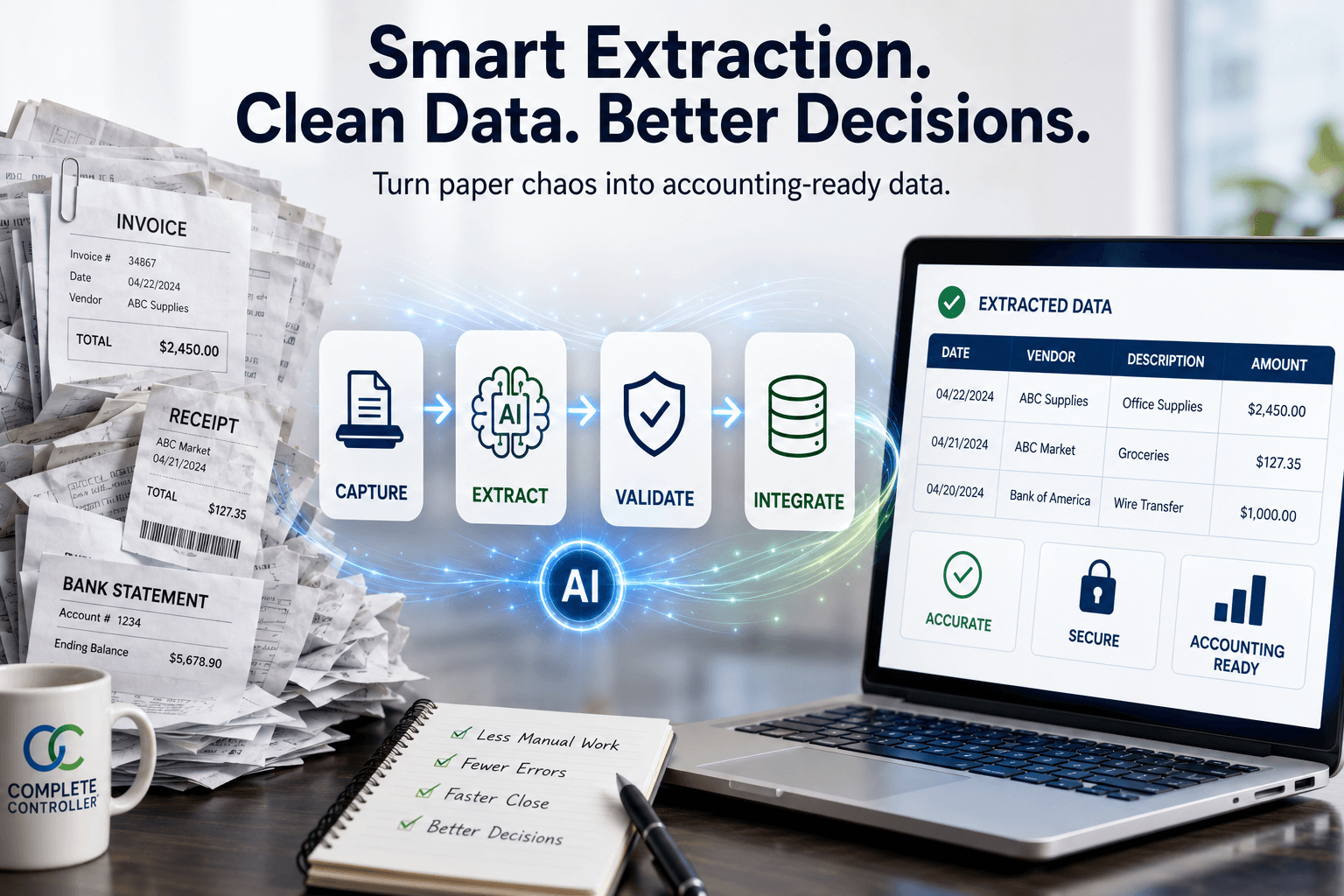
How AI OCR Extraction Actually Processes Your Documents
Think of AI OCR extraction for invoices and statements as a four-stage pipeline, and the order matters:
- Capture – Documents arrive via scan, email, or upload, and the system ingests them automatically.
- Recognition – OCR converts images to text while ML models identify what each field means.
- Validation – The system cross-checks totals, flags anomalies, and verifies data against existing records.
- Integration – Clean, structured data flows directly into your accounting system, tagged and ready.
This is the heart of intelligent document processing—and it’s why paperless finance operations consistently outperform their paper-bound competitors. The document doesn’t just get stored. It gets understood.
Real-World Wins: What Extraction Looks Like at Scale
Skeptical? Consider JPMorgan Chase. The bank built a contract intelligence platform called COiN to review commercial loan agreements. Bloomberg reported the software completed in seconds what had taken lawyers and loan officers 360,000 hours a year. That’s not incremental improvement—that’s an entirely different operating model.
What this means for small businesses
You don’t need JPMorgan’s budget to get JPMorgan’s advantage. Modern extraction tools bring financial document data parsing using machine learning to businesses of every size. At Complete Controller, we pioneered cloud-based bookkeeping precisely because we saw this shift coming—small businesses running on clean, automated data make faster, smarter decisions than competitors drowning in paper.
Less manual work. Cleaner data. Smarter decisions. See what Complete Controller can do.
Accuracy First: Validation, Cleansing, and Reconciliation
Extraction is only half the job. Trust me on this—I’ve seen “automated” systems dump garbage data into ledgers because nobody built a review step. The extraction and validation of structured financial datasets must include human-checkpoints and reconciliation routines.
Strong data validation and cleansing practices—including regular reconciliation of your accounting statements—catch what the machine misses. Automation should amplify accuracy, never replace accountability. Set confidence thresholds, route low-confidence extractions to human review, and reconcile monthly without exception.
Governance, Compliance, and Audit-Ready Records
Smart extraction isn’t just about speed—it’s about defensibility. The IRS expects businesses to maintain accurate, accessible financial records, which makes compliance-ready data extraction a genuine business protection strategy, not just an efficiency play. Every extracted transaction should link back to its source document, creating an audit trail that works for you.
On the AI governance side, the NIST framework for responsible AI-powered finance analytics offers a practical roadmap for deploying these tools without introducing new risks. Bold adoption and careful governance aren’t opposites—they’re partners.
Getting Started: Building Your Extraction Strategy
You don’t need to overhaul everything overnight. Start where the pain is loudest—usually accounts payable—and expand from there. Pick tools that integrate with your existing accounting stack, insist on validation workflows, and measure your before-and-after processing times.
The businesses winning right now are pairing extraction with broader AI-powered finance analytics to turn clean data into forward-looking insight. Once your data is structured and trustworthy, forecasting, cash flow analysis, and strategic planning all get sharper. That’s the real prize: not just faster bookkeeping, but better decisions.
Conclusion
Intelligent financial data extraction transforms the slowest, most error-prone part of finance—manual data entry—into an automated, validated, audit-ready pipeline. From OCR capture to structured data conversion to compliance-ready records, the technology exists today, and businesses that adopt it gain speed, accuracy, and clarity their competitors simply can’t match. I’ve watched this transformation change companies from the inside, and I promise you: the freedom on the other side of automation is worth the effort.
Ready to put your financial data to work? Visit Complete Controller for expert guidance from the team that pioneered cloud-based bookkeeping and controller services. Your books—and your future self—will thank you.

Frequently Asked Questions About Intelligent Financial Data Extraction
What is intelligent financial data extraction?
It’s the use of AI, machine learning, and OCR to automatically capture data from financial documents—like invoices and bank statements—and convert it into structured, accounting-ready information.
How accurate is OCR for financial documents?
Modern AI-enhanced OCR typically achieves 95%+ accuracy on clear documents, and validation rules plus human review of low-confidence items push reliability even higher.
Can small businesses afford intelligent document processing?
Yes. Cloud-based tools have made automated data capture affordable at nearly every scale, and the labor savings usually pay for the software quickly.
Is extracted financial data safe to use for tax and compliance purposes?
When your system links each extraction to its source document and follows IRS recordkeeping guidelines, extracted data is fully audit-ready.
What documents can intelligent extraction handle?
Invoices, receipts, bank and credit card statements, contracts, purchase orders, and loan agreements—essentially any financial document, scanned or digital.
Sources
- McKinsey & Company. (2018, January). Bots, algorithms, and the future of the finance function. Frank Plaschke, Ishaan Seth, and Rob Whiteman. https://www.mckinsey.com/capabilities/strategy-and-corporate-finance/our-insights/bots-algorithms-and-the-future-of-the-finance-function
- Bloomberg. (2017, February 28). JPMorgan Software Does in Seconds What Took Lawyers 360,000 Hours. Hugh Son. https://www.bloomberg.com/news/articles/2017-02-28/jpmorgan-software-does-in-seconds-what-took-lawyers-360-000-hours
- U.S. Securities and Exchange Commission. (2018, June 28). SEC Adopts Rules to Require Inline XBRL, Improve Disclosure for Investors. https://www.sec.gov/news/press-release/2018-117
- Complete Controller. Efficient Paperless Office Solutions. https://www.completecontroller.com/efficient-paperless-office-solutions/
- Complete Controller. Accounting Innovations and Trends. https://www.completecontroller.com/accounting-innovations-trends/
- Complete Controller. The Importance of Reconciling Your Accounting Statements Regularly. https://www.completecontroller.com/importance-of-reconciling-your-accounting-statements-regularly/
- U.S. Securities and Exchange Commission. Structured Data. https://www.sec.gov/structureddata
- National Institute of Standards and Technology. AI Risk Management Framework. https://www.nist.gov/itl/ai-risk-management-framework
- Internal Revenue Service. Recordkeeping. https://www.irs.gov/businesses/small-businesses-self-employed/recordkeeping
 About Complete Controller® – America’s Bookkeeping Experts Complete Controller is the Nation’s Leader in virtual bookkeeping, providing service to businesses and households alike. Utilizing Complete Controller’s technology, clients gain access to a cloud platform where their QuickBooks™️ file, critical financial documents, and back-office tools are hosted in an efficient SSO environment. Complete Controller’s team of certified US-based accounting professionals provide bookkeeping, record storage, performance reporting, and controller services including training, cash-flow management, budgeting and forecasting, process and controls advisement, and bill-pay. With flat-rate service plans, Complete Controller is the most cost-effective expert accounting solution for business, family-office, trusts, and households of any size or complexity.



 Brittany McMillen
Brittany McMillen
Brittany McMillen