


Cloud Security for Financial Data:
How to Protect What Matters Most
Cloud security for financial data means protecting your sensitive financial information in cloud environments through encryption, access controls, multi-factor authentication, continuous monitoring, and compliance with standards like PCI DSS and SOC 2. Done right, it makes your books safer in the cloud than they ever were in a filing cabinet or on a dusty office server.
Here’s what most business owners don’t realize: the biggest threat to your financial data isn’t a hoodie-wearing hacker in a dark basement. It’s a weak password, an untrained employee, and a business owner who assumed “the cloud company handles all that.” I’ve spent over two decades pioneering cloud-based bookkeeping, and I can tell you—security isn’t something you buy once. It’s something you build. Let me show you how.
What is cloud security for financial data and how do you get it right?
- Cloud security for financial data combines encryption, identity management, monitoring, and compliance to keep financial records safe from breaches, fraud, and loss.
- Encryption protects your data at rest and in transit, making stolen files useless to attackers.
- Access control and MFA ensure only the right people touch your financial systems—no exceptions.
- Monitoring and audit logs catch suspicious activity early, before it becomes a five-figure problem.
- Compliance frameworks like PCI DSS, SOC 2, and GDPR give you a proven roadmap instead of guesswork.

Why Financial Data Protection Starts With Encryption
Encryption is your non-negotiable foundation. It scrambles your financial data so that even if someone intercepts it, they get gibberish instead of your general ledger.
You need two layers working together: encrypted data at rest (your stored files) and encryption in transit (data moving between your device and the cloud). Any reputable financial platform should offer AES-256 encryption at rest and TLS for data in motion. If your provider can’t confirm both, that’s your cue to leave.
The key management piece nobody talks about
Encryption is only as strong as the keys that unlock it. This is where secure key management and HSM practices come in—NIST’s guidance on cryptographic key lifecycles is the gold standard here, covering how keys should be generated, stored, rotated, and retired. Think of it this way: a deadbolt means nothing if you leave the key under the mat.
Access Control and Identity Management: Your Digital Front Door
If encryption is the vault, identity management is the guest list. Access control and identity management determine who gets in and what they can touch once they’re inside.
Here’s my rule after 20+ years serving thousands of small businesses: nobody gets more access than their role requires. Your bookkeeper doesn’t need admin rights to payroll. Your intern doesn’t need to see bank credentials. Role-based access limits the damage when—not if—a credential gets compromised.
Multi-factor authentication is not optional
Multi-factor authentication (MFA) blocks the vast majority of automated account attacks—Microsoft has reported that MFA can stop over 99% of credential-based compromise attempts. One extra tap on your phone versus a drained bank account? That’s the easiest math you’ll do all year.
Zero Trust Security for Finance: Assume Nothing, Verify Everything
The old model said, “If you’re inside the network, you’re trusted.” That model is dead. Modern financial security runs on zero trust—every user, device, and request gets verified every single time.
NIST’s framework on zero trust security for finance lays out the architecture: continuous verification, least-privilege access, and the assumption that a breach could already be underway. It sounds paranoid. It’s actually just professional. Financial firms adopting zero trust dramatically shrink their attack surface because a stolen password alone no longer opens the whole kingdom.
This matters doubly for remote and hybrid teams. When your staff logs in from home offices and coffee shops, following proven financial cybersecurity best practices keeps every access point locked down—no matter where your team works.
Protect your financial data with secure, cloud-based bookkeeping from Complete Controller. Get started today.
Audit Logs, Monitoring, and Catching Trouble Early
You can’t stop what you can’t see. Continuous monitoring and detailed audit logs create a permanent record of every login, edit, and export in your financial systems.
Why does this matter so much? IBM’s Cost of a Data Breach research puts the average breach at roughly $4.88 million, and breaches that take longer to detect cost significantly more. Speed of detection is everything. Strong audit logs and monitoring let you spot suspicious activity—an odd 2 a.m. login, an unusual vendor payment—before it becomes a crisis.
Bonus: audit trails also protect you internally. The Association of Certified Fraud Examiners estimates organizations lose about 5% of annual revenue to fraud, and much of it is internal. Visibility is your best deterrent.
Compliance and Regulatory Adherence: PCI DSS, SOC 2, and GDPR
Compliance isn’t red tape—it’s a battle-tested security checklist someone already wrote for you. If you handle cardholder data, compliance and regulatory adherence PCI DSS is mandatory, and the PCI Security Standards Council spells out exactly what’s required. SOC 2 validates your service providers’ controls. GDPR governs personal data for anyone touching European customers.
When you evaluate any cloud financial platform, ask for their compliance certifications in writing. A trustworthy provider will hand them over proudly. A vague answer is an answer.
Secure Backups, Disaster Recovery, and Ditching the Paper Trail
Security isn’t just about keeping bad actors out—it’s about making sure you never lose access either. Ransomware, hardware failure, hurricanes: your financial data needs to survive all of it.
Here’s your resilience playbook, in order:
- Automate encrypted backups daily to a separate, secured location.
- Test your restores quarterly—an untested backup is a hope, not a plan.
- Document a disaster recovery plan so your team knows exactly what to do in hour one.
- Tokenize sensitive data where possible, replacing account numbers with useless-if-stolen tokens.
And one more truth from the woman who built her company on going paperless: physical documents are a security liability. Moving to secure cloud storage with controlled digital access eliminates the risks of lost files, unauthorized copies, and unlocked filing cabinets.
Conclusion: Security Is a Strategy, Not a Setting
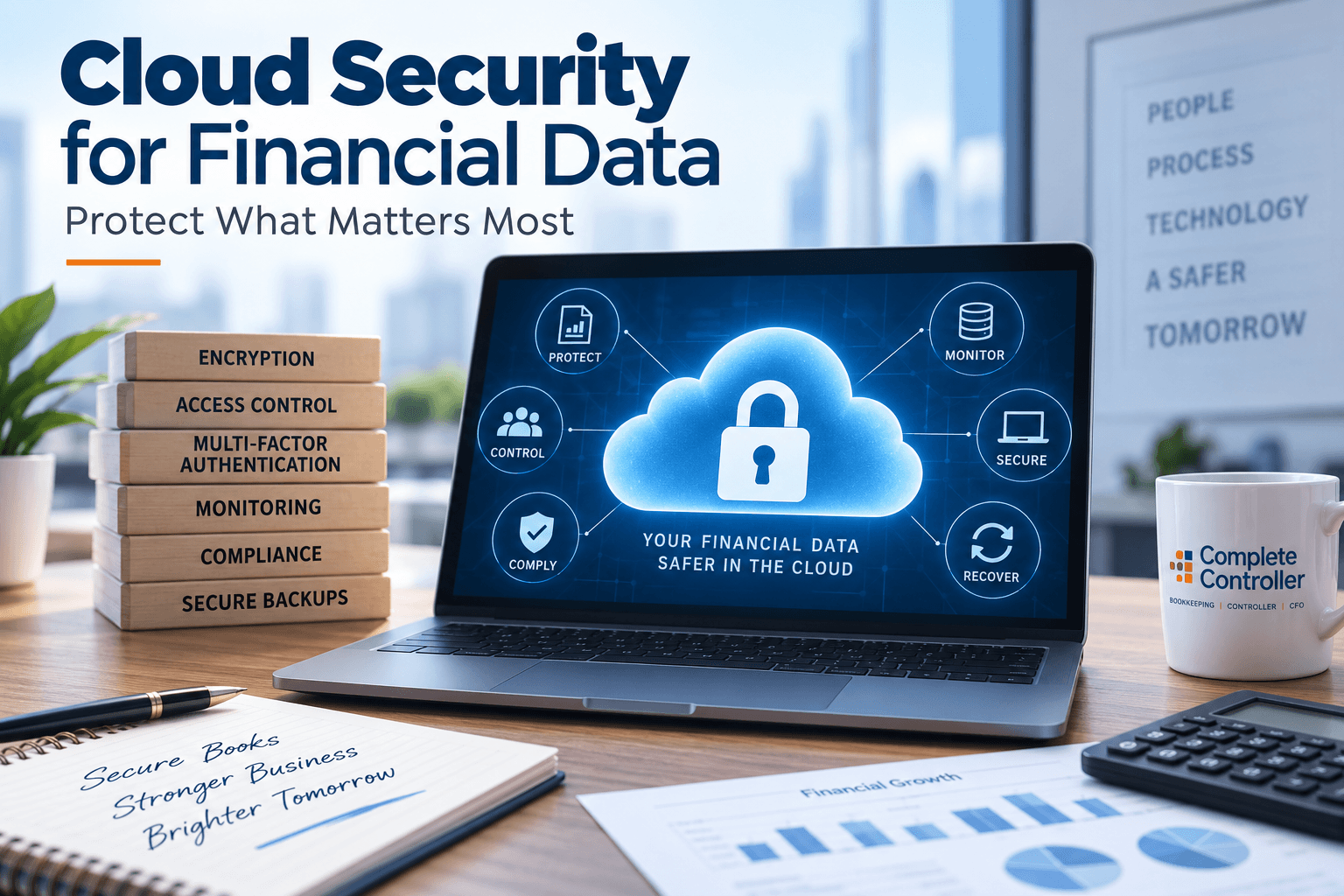
Protecting your financial data in the cloud comes down to layers: encryption at rest and in transit, MFA and identity management, zero trust verification, vigilant monitoring, compliance alignment, and tested backups. No single tool saves you—the system does.
I built Complete Controller on the belief that small businesses deserve enterprise-grade financial security without enterprise-grade headaches. You don’t have to figure this out alone. Visit Complete Controller and let the team that pioneered cloud-based bookkeeping and controller services help you build a financial system that’s secure, compliant, and ready to grow with you.

Frequently Asked Questions About Cloud Security for Financial Data
Is financial data safe in the cloud?
Yes—when properly configured, cloud platforms with encryption, MFA, and continuous monitoring are typically safer than local servers or paper records, which lack professional security teams and redundancy.
What is the most important security measure for financial data?
Multi-factor authentication delivers the biggest impact for the least effort, blocking over 99% of automated credential attacks. Pair it with encryption for a strong foundation.
What compliance standards apply to financial data in the cloud?
PCI DSS applies if you handle card payments, SOC 2 validates service provider controls, and GDPR governs personal data of EU residents. Requirements depend on your industry and customers.
What is zero trust security in finance?
Zero trust is a model where no user or device is automatically trusted—every access request is verified, and users get only the minimum permissions their role requires.
How often should I back up financial data?
Daily automated encrypted backups are the standard, with quarterly restore testing to confirm your backups actually work when you need them.
Sources
- Complete Controller. Remote Work Security Post-COVID: Financial Cybersecurity Best Practices. https://www.completecontroller.com/remote-work-security-post-covid/
- Complete Controller. Fraud Detection and Prevention: Audit Logs and Monitoring. https://www.completecontroller.com/fraud-detection-prevention/
- Complete Controller. Efficient Paperless Office Solutions: Secure Cloud Storage. https://www.completecontroller.com/efficient-paperless-office-solutions/
- National Institute of Standards and Technology (NIST). Special Publication 800-207: Zero Trust Architecture. https://csrc.nist.gov/pubs/sp/800/207/final
- National Institute of Standards and Technology (NIST). Special Publication 800-57 Part 1 Revision 5: Recommendation for Key Management. https://csrc.nist.gov/pubs/sp/800/57/pt1/r5/final
- PCI Security Standards Council. PCI DSS: Compliance and Regulatory Adherence. https://www.pcisecuritystandards.org/standards/pci-dss/
 About Complete Controller® – America’s Bookkeeping Experts Complete Controller is the Nation’s Leader in virtual bookkeeping, providing service to businesses and households alike. Utilizing Complete Controller’s technology, clients gain access to a cloud platform where their QuickBooks™️ file, critical financial documents, and back-office tools are hosted in an efficient SSO environment. Complete Controller’s team of certified US-based accounting professionals provide bookkeeping, record storage, performance reporting, and controller services including training, cash-flow management, budgeting and forecasting, process and controls advisement, and bill-pay. With flat-rate service plans, Complete Controller is the most cost-effective expert accounting solution for business, family-office, trusts, and households of any size or complexity.



 Brittany McMillen
Brittany McMillen
Brittany McMillen