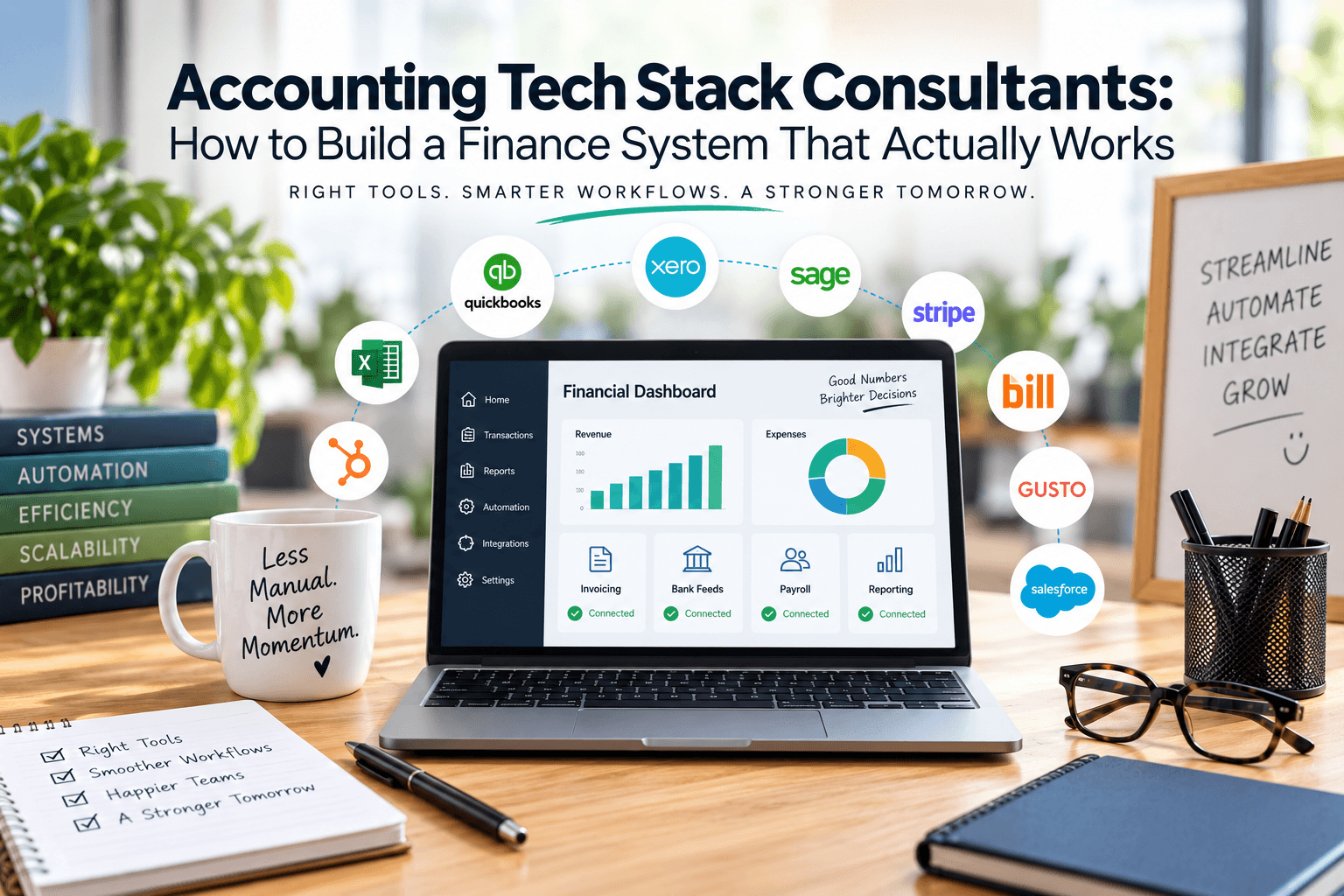
Accounting Tech Stack Consultants: How to Build a Finance System That Actually Works
Accounting tech stack consultants are specialists who evaluate, select, and integrate your accounting software—from general ledger and ERP systems to automation tools—so your financial operations run accurately, efficiently, and at scale. They bridge the gap between what your business needs and what technology can deliver.
Here’s what I’ve learned after two decades of pioneering cloud-based bookkeeping at Complete Controller: most businesses aren’t struggling because their people are bad at accounting. They’re struggling because their systems are working against them. Duct-taped spreadsheets, software that doesn’t talk to each other, manual data entry eating hours every week—sound familiar? That’s exactly the problem the right consultant solves.
What do accounting tech stack consultants do and why do you need one?
Accounting tech stack consultants assess your current systems, recommend the right software mix, integrate your tools, and redesign workflows so your finance function runs on automation instead of manual effort.
They handle accounting systems integration, connecting your ledger, payroll, billing, and reporting tools into one clean data flow.
They lead ERP accounting implementation projects, ensuring your enterprise system supports finance instead of frustrating it.
They design financial reporting automation so leadership gets accurate numbers fast—not two weeks after month-end.
They reduce risk by replacing fragile spreadsheets with controlled, auditable systems.
Why Businesses Hire Accounting Tech Stack Consultants
Demand for accounting talent is intense—and getting more so. The U.S. Bureau of Labor Statistics projects about 130,800 openings for accountants and auditors each year from 2023 to 2033. You can’t hire your way out of that squeeze. You need systems that multiply the capacity of the team you already have.
That’s the real value of accounting process consulting: it turns “we need three more bookkeepers” into “we need one smart workflow.” A consultant looks at your entire finance operation—chart of accounts, approval chains, reconciliation routines—and asks the question most teams never stop to ask: should we even be doing this step at all?
The hidden cost of a messy stack
Every disconnected tool creates a manual bridge someone has to maintain. Every manual bridge creates errors, delays, and burnout. General ledger optimization isn’t glamorous, but it’s the foundation everything else sits on. Once that foundation is solid, the next question becomes which platforms belong in your stack.
Choosing the Right Software: Cloud, ERP, and Everything Between
Selecting the right accounting software stack for your business starts with understanding your options. Modern cloud accounting solutions give you on-demand access to your books from anywhere—NIST’s own definition of cloud computing describes exactly why this model beats server-bound legacy software for growing businesses.
For companies with more complex operations, ERP accounting implementation connects finance with inventory, sales, and operations in one integrated platform. ERP systems are powerful, but here’s my honest take: they fail more often from poor implementation than poor software. A consultant who understands cloud ERP accounting integration services makes sure the finance module actually reflects how your business runs.
Matching tools to business size
A startup doesn’t need enterprise ERP, and a $50M company shouldn’t run on a starter ledger. The right consultant right-sizes your stack—no overbuying, no outgrowing your tools in eighteen months.
Stop wrestling with disconnected accounting tools. Let Complete Controller streamline your tech stack, automate workflows, and turn your financial data into smarter decisions.
Automating Bookkeeping Workflows That Steal Your Time
Once the platforms are chosen, the real transformation happens in the daily work. Smart bookkeeping workflow automation eliminates the repetitive tasks that drain your team—bank feed categorization, recurring invoices, receipt matching, and reconciliations.
The payoff is measurable. Thomson Reuters found that professionals expect AI to save about 4 hours per week within one year, rising to 12 hours per week within five years. That’s not a rounding error—that’s a full workday and a half, every single week, redirected from data entry to analysis and strategy.
Pair that with accounting workflow automation and process redesign—digitized documents, automated approval routing, paperless month-end close—and your back office stops being a bottleneck and starts being an asset.
Reducing Spreadsheet Risk and Strengthening Controls
I love a good spreadsheet as much as any finance nerd. But spreadsheets as systems of record? That’s where businesses get burned. A U.S. Senate investigation into JPMorgan Chase’s 2012 “London Whale” trading loss found that a key risk model relied on Excel spreadsheets, manual copy-and-paste steps, and a formula error. If manual workflows can contribute to billions in losses at a global bank, imagine what they’re quietly doing to your business.
Controlled systems give you what spreadsheets can’t:
Audit trails showing who changed what, and when
Role-based permissions protecting sensitive data
Automated validations catching errors before they compound
Single sources of truth ending the “which version is right?” debate
Strong controls also set the stage for the reporting layer—where your data finally starts working for you.
Financial Reporting Automation: From Data to Decisions
Clean systems mean nothing if leadership can’t see the numbers. This is where structured, machine-readable data changes the game. The SEC has championed financial reporting automation for accounting teams through structured data standards, and the same principle applies inside your business: standardized, automated reporting beats manually assembled reports every time.
Finance systems modernization means your dashboards update in real time, your month-end close shrinks from weeks to days, and your decisions rest on current data—not last quarter’s guesswork.
Working With a Consultant: What Great Engagements Look Like
The best engagements follow a clear sequence:
Assess your current stack, workflows, and pain points
Design the target system architecture and integration map
Implement in phases, protecting daily operations
Train your team so adoption actually sticks
Optimize continuously as your business evolves
Whether you’re a growing business or a CPA firm seeking technology consulting for your own practice, ongoing accounting technology consulting keeps you ahead of emerging tools, AI capabilities, and automation trends—so your stack improves with your business, not behind it.
Conclusion: Build a Finance System Worthy of Your Ambition
Your accounting technology should be your competitive advantage—not your Monday morning headache. Accounting tech stack consultants bring the experience to choose the right tools, integrate them cleanly, automate the busywork, and protect your business from spreadsheet-driven risk. I built Complete Controller on exactly this belief: modern businesses deserve modern financial systems.
Ready to stop fighting your software and start leveraging it? Visit Complete Controller for expert guidance from the team that pioneered cloud-based bookkeeping and controller services.
Frequently Asked Questions About Accounting Tech Stack Consultants
What does an accounting tech stack consultant actually do?
They evaluate your current financial systems, recommend the right software mix, integrate your tools, automate workflows, and train your team—turning disconnected apps into one efficient finance operation.
How much does accounting technology consulting cost?
Costs vary by scope, from a few thousand dollars for a stack assessment to larger investments for full ERP implementation. Most businesses recover costs quickly through time savings and error reduction.
When should a business hire an accounting tech stack consultant?
Key triggers include rapid growth, frequent reporting delays, heavy manual data entry, an upcoming ERP migration, or systems that don’t integrate with each other.
What’s the difference between an ERP consultant and an accounting tech stack consultant?
ERP consultants focus on one enterprise platform; accounting tech stack consultants optimize your entire finance ecosystem—ledger, bookkeeping tools, reporting, and integrations—regardless of vendor.
Can small businesses benefit from accounting systems integration?
Absolutely. Small teams often gain the most, since automation frees limited staff from manual work and cloud tools scale affordably as the business grows.
About Complete Controller® – America’s Bookkeeping Experts Complete Controller is the Nation’s Leader in virtual bookkeeping, providing service to businesses and households alike. Utilizing Complete Controller’s technology, clients gain access to a cloud platform where their QuickBooks™️ file, critical financial documents, and back-office tools are hosted in an efficient SSO environment. Complete Controller’s team of certified US-based accounting professionals provide bookkeeping, record storage, performance reporting, and controller services including training, cash-flow management, budgeting and forecasting, process and controls advisement, and bill-pay. With flat-rate service plans, Complete Controller is the most cost-effective expert accounting solution for business, family-office, trusts, and households of any size or complexity.
Jennifer BrazerFounder/CEO
Jennifer is the author of From Cubicle to Cloud and Founder/CEO of Complete Controller, a pioneering financial services firm that helps entrepreneurs break free of traditional constraints and scale their businesses to new heights.
Brittany McMillen is a seasoned Marketing Manager with a sharp eye for strategy and storytelling. With a background in digital marketing, brand development, and customer engagement, she brings a results-driven mindset to every project. Brittany specializes in crafting compelling content and optimizing user experiences that convert. When she’s not reviewing content, she’s exploring the latest marketing trends or championing small business success.