

Cloud Controller vs In-House Controller:
The SMB Guide to Choosing Right
Cloud controller vs in-house controller decisions come down to one question: does your business prioritize lower overhead and rapid deployment, or maximum control over infrastructure, data, and customization? For most SMBs, the cloud controller wins on simplicity and speed—but the right answer depends on your risk tolerance, technical capacity, and growth plans.
Here’s what nobody tells you when you’re shopping for network management: the subscription price is the least interesting number on the page. As Founder and CEO of Complete Controller, I’ve watched businesses choose a controller based on sticker price alone, then get blindsided by support fees, compliance gaps, staffing needs, and downtime costs. Let’s make sure that’s not you.
What is the difference between a cloud controller and an in-house controller?
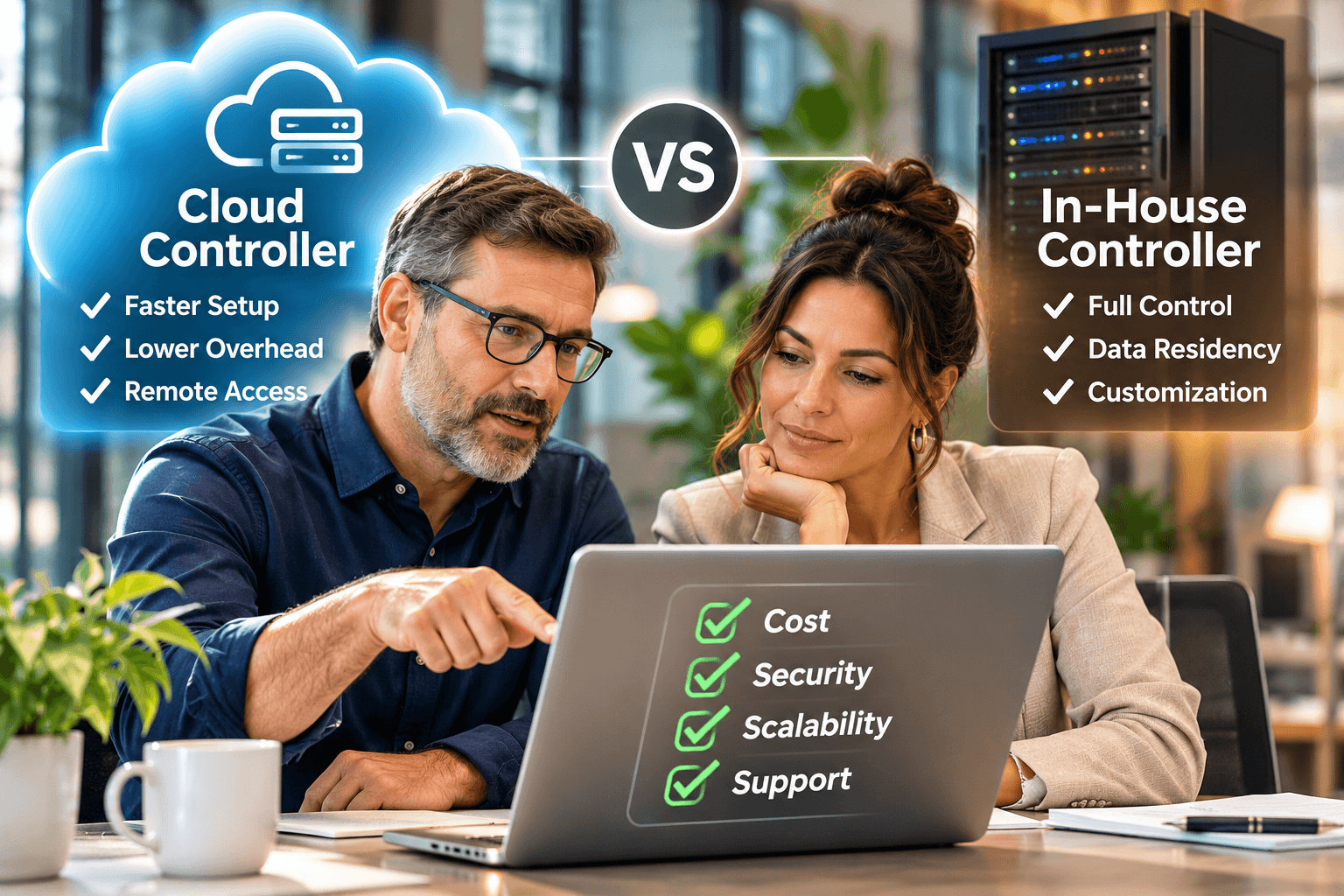
- A cloud controller is provider-hosted and best for simplicity, remote access, and fast deployment; an in-house controller is self-hosted and best for direct control, offline operation, and deep customization.
- A cloud-based device management platform shifts hosting, maintenance, backups, and upgrades to the provider.
- A self-hosted controller gives you full administrative control—but you own the hardware, security, availability, and recovery.
- A hybrid control plane can blend cloud visibility with on-premises policy enforcement.
- The smartest decision is based on total cost of ownership, never licensing price alone.

Cloud Controller vs In-House Controller: How the Architectures Differ
Before you compare prices, understand what you’re actually buying. Controller architecture describes the relationship among your management plane, control plane, data plane, APIs, and policy engines. Confusing centralized management with centralized traffic forwarding is one of the most common mistakes I see—and it leads to ugly surprises when the internet goes down.
The cloud controller
A cloud controller is a provider-hosted platform used to configure, monitor, and troubleshoot network devices remotely. NIST defines cloud computing as “ubiquitous, convenient, on-demand network access” to shared resources that can be quickly provisioned—which is exactly why cloud controllers slash local hosting and maintenance work (Mell & Grance, 2011). It’s ideal for distributed SMBs, lean IT teams, and remote workforces. The tradeoffs? Internet dependency, potential vendor lock-in, and limited access to underlying infrastructure. Review device counts, API access, retention periods, and service-level commitments before you sign.
The self-hosted controller
A self-hosted controller runs on company-owned servers, private cloud, or a colocation environment. It suits regulated organizations, mature IT departments, and businesses requiring local data residency. The classic pitfall? Underfunded maintenance and dependence on one overworked administrator. An in-house controller for enterprise environments demands enterprise staffing—buying the complexity without the governance is a recipe for trouble.
Cloud Controller vs In-House Controller: Cost and Total Ownership
This is where the spreadsheet gets honest. Comparing a subscription fee against hardware-only costs—while ignoring staff time, patching, and outage risk—is comparing apples to invoices. Model your three- to five-year total cost, including renewal increases, add-ons, and migration fees. The economics work a lot like outsourcing any business function: understanding true cloud controller pricing and features means weighing recurring expenses against internal labor and infrastructure.
Your deployment options matter here too—fully cloud-managed, on-premises, private-cloud, or hybrid. Whatever you choose, pilot it first. Require a documented rollback plan and acceptance criteria before touching revenue-producing networks.
And don’t underestimate the value of a single pane of glass. A centralized management platform gives you one interface for inventory, configuration, alerts, and role-based access—just verify that your hardware generations actually get feature parity across that pretty dashboard.
Cloud or in-house? Every business decision impacts your bottom line. Discover how Complete Controller helps small businesses gain financial clarity and grow with confidence.
Cloud Controller vs In-House Controller: Security and Compliance
Here’s a truth that applies to both models: your biggest risk isn’t the hosting location—it’s the humans. Verizon found that the human element was involved in 68% of breaches in its 2024 Data Breach Investigations Report. That makes multifactor authentication, least privilege, admin logging, and third-party access reviews non-negotiable whether your controller lives in a data center or a closet. Strong cloud-based device management practices protect remote access and administrator privileges across distributed teams.
If you self-host, let GitLab’s 2017 outage be your cautionary tale: a production database was accidentally deleted, several backup methods failed, and roughly six hours of data was lost (GitLab, 2017). Tested recovery plans aren’t optional. NIST’s Zero Trust guidance on secure deployment of network controller environments recommends segmentation, identity controls, and restricted administrative paths—make these mandatory before production rollout, not after your first incident.
Cloud Controller vs In-House Controller: Control, Support, and Scalability
Growing businesses eventually hit the automation question. A software-defined networking controller abstracts configuration and automates device behavior—powerful for repeatable policies and multi-site operations, but automation errors scale just as fast as automation wins. Test templates, stage your releases, and keep configuration exports.
Can’t tolerate total cloud dependence but still want remote oversight? A hybrid control plane combines cloud visibility with local enforcement and survivability. Just document—in writing—exactly which functions keep working during a WAN or provider outage. The benefits of cloud-based controller models (faster rollout, automatic updates, centralized visibility) are real, but “cloud-hosted” doesn’t automatically mean secure, cheaper, or feature-complete.
Case Study: Cloud Management for Distributed Sites
The Beutlhauser Group used Cisco Meraki to manage its network across multiple locations, gaining a single dashboard for switches, access points, security appliances, and users. Centralized visibility, automated policy replication, and SD-WAN connectivity reduced manual effort dramatically (Cisco, “Beutlhauser Group”). The lesson: cloud-based management can hand smaller sites enterprise-grade visibility without enterprise-grade overhead.
How to Choose: A Decision Framework That Actually Works
When I guide clients through a network controller comparison, order matters. Here’s the sequence:
- Document requirements—hardware, firmware, APIs, reporting, identity, backups, and offline operation.
- Calculate five-year ownership costs—acquisition, licensing, staffing, support, outages, and exit fees.
- Score each option against your requirements matrix, not the vendor’s demo.
- Pilot the preferred model at one site with defined acceptance criteria.
- Test outage recovery before committing to a multiyear contract.
Choose cloud for lean operations. Choose in-house for durable technical capacity and control. Choose hybrid when both requirements compete.
Conclusion
The cloud controller vs in-house controller decision isn’t about which technology is “better”—it’s about which model your business can actually sustain. Cloud controllers suit SMBs wanting simpler operations, remote access, and predictable support. In-house controllers suit organizations needing maximum control, customization, or local operation. Document your requirements, run the real five-year math, pilot before you buy, and test your recovery plan. For more expert guidance on making technology and financial decisions with clarity and confidence, visit Complete Controller the team that pioneered cloud-based bookkeeping and controller services.

Frequently Asked Questions About Cloud Controller vs In-House Controller
What is the difference between a cloud controller and an in-house controller?
A cloud controller is hosted and maintained by a provider and accessed remotely, while an in-house controller runs on your own infrastructure, giving you full control—and full responsibility—for maintenance, security, and recovery.
Is a cloud controller more secure than a self-hosted controller?
Neither is automatically more secure. Security depends on controls like MFA, least privilege, segmentation, and logging—especially since the human element drives 68% of breaches (Verizon, 2024).
Which controller costs less for a small business?
Cloud controllers usually cost less for SMBs when you include staffing, maintenance, and downtime in a five-year total cost of ownership—not just the subscription versus hardware price.
Can an SMB use a hybrid control plane?
Yes. A hybrid model combines cloud visibility with local enforcement, which works well when you need remote management but can’t tolerate total dependence on a cloud service.
How should a business choose a cloud controller?
Build a requirements matrix, model five-year costs, verify security and support commitments in writing, run a pilot site, and test outage recovery before signing a multiyear contract.
Sources
- Cisco. (2026). Beutlhauser Group. Cisco Customer Stories. https://www.cisco.com/site/us/en/about/case-studies-customer-stories-customer-stories/beutlhauser-group.html
- Cisco. (2024). Cisco Cloud Network Controller Solution Overview. Cisco. https://www.cisco.com/c/en/us/solutions/collateral/data-center-virtualization/application-centric-infrastructure/solution-overview-c22-741802.html
- Cisco. (2024). Cisco Cloud Network Controller FAQ. Cisco. https://www.cisco.com/c/en/us/solutions/collateral/data-center-virtualization/application-centric-infrastructure/nb-06-cloud-network-controller-faq-cte-en.html
- Cisco. (2026). Cisco Cloud Network Controller Policy Model. Cisco Documentation. https://www.cisco.com/c/en/us/td/docs/dcn/aci/cloud-apic/25x/user-guide/azure/cisco-cloud-network-controller-for-azure-user-guide-251x/policy-model.html
- Unity Technologies. (2026). Security Overview: Self-Hosted Deployment. Unity Documentation. https://docs.unity.com/en-us/self-hosted-deployment/security-overview
- National Institute of Standards and Technology. (September 2011). The NIST Definition of Cloud Computing. Peter Mell and Timothy Grance. https://doi.org/10.6028/NIST.SP.800-145
- Verizon Business. (May 2024). 2024 Data Breach Investigations Report. Verizon. https://www.verizon.com/business/resources/reports/dbir/
- GitLab. (February 10, 2017). Postmortem of database outage of January 31. GitLab. https://about.gitlab.com/blog/2017/02/10/postmortem-of-database-outage-of-january-31/
- Complete Controller. Accounting Outsourcing Economics. https://www.completecontroller.com/accounting-outsourcing-economics/
- Complete Controller. Remote Work Security Post-COVID. https://www.completecontroller.com/remote-work-security-post-covid/
- Complete Controller. From Spreadsheets to CRMs. https://www.completecontroller.com/from-spreadsheets-to-crms/
- National Institute of Standards and Technology. SP 800-145. https://csrc.nist.gov/pubs/sp/800/145/final
- National Institute of Standards and Technology. SP 800-207: Zero Trust Architecture. https://csrc.nist.gov/pubs/sp/800/207/final
- Wikipedia. Software-defined Networking. https://en.wikipedia.org/wiki/Software-defined_networking
 About Complete Controller® – America’s Bookkeeping Experts Complete Controller is the Nation’s Leader in virtual bookkeeping, providing service to businesses and households alike. Utilizing Complete Controller’s technology, clients gain access to a cloud platform where their QuickBooks™️ file, critical financial documents, and back-office tools are hosted in an efficient SSO environment. Complete Controller’s team of certified US-based accounting professionals provide bookkeeping, record storage, performance reporting, and controller services including training, cash-flow management, budgeting and forecasting, process and controls advisement, and bill-pay. With flat-rate service plans, Complete Controller is the most cost-effective expert accounting solution for business, family-office, trusts, and households of any size or complexity.



 Brittany McMillen