


Virtual Controller Certification:
Boost SMB Financial Mastery
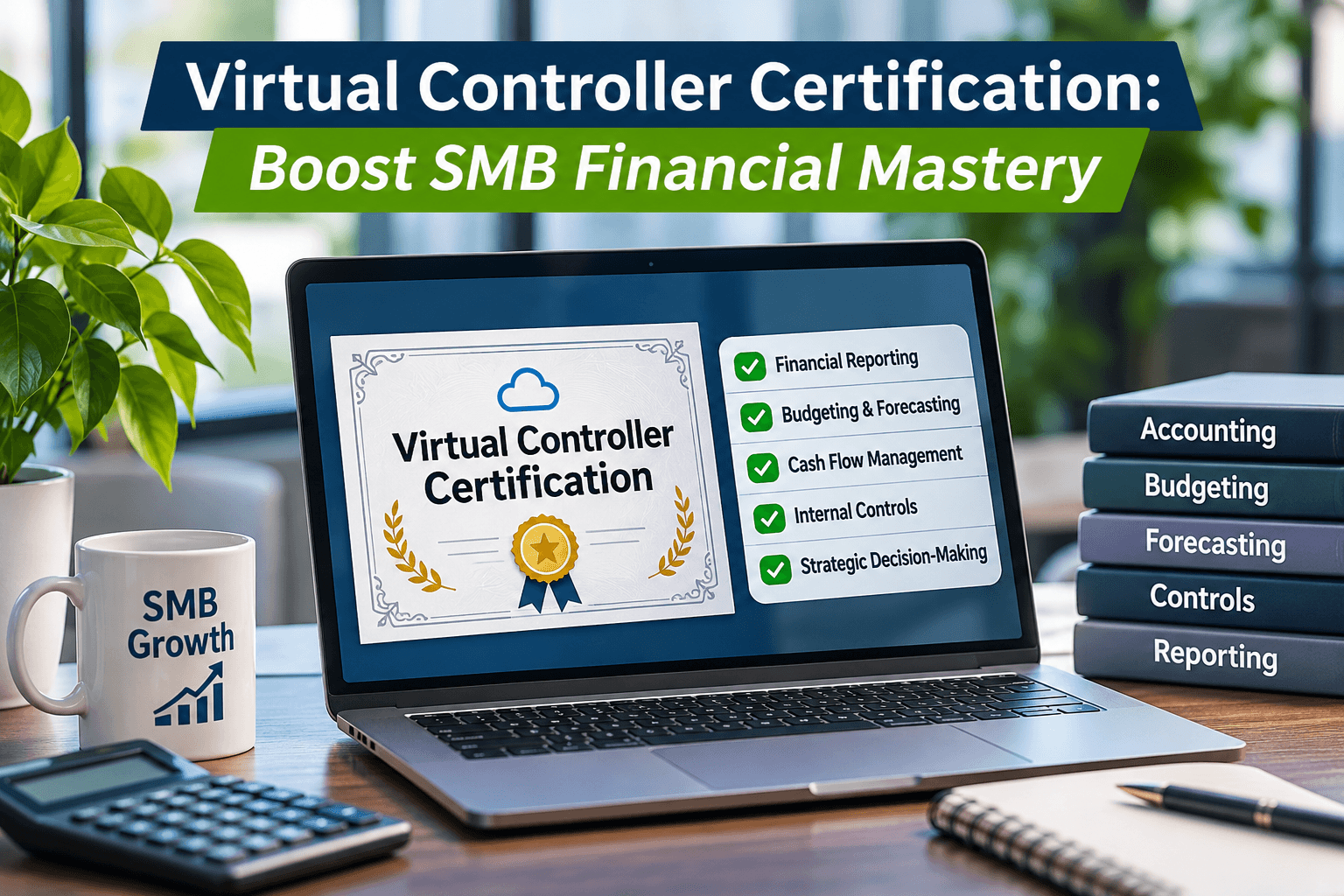
Virtual controller certification gives SMB owners and finance professionals the training to master financial reporting, budgeting, cash-flow visibility, internal controls, and strategic decision-making—all through structured, cloud-based education that ends with a verifiable credential.
Here’s what nobody tells you when you start searching: half the results you’ll find aren’t about finance at all. They’re about programmable logic controllers and factory automation. I’m Jennifer Brazer, Founder and CEO of Complete Controller, and after two decades pioneering cloud-based bookkeeping and controller services, I’ve watched too many business owners waste money on the wrong training—or worse, skip training entirely and make expensive decisions on messy numbers. Let’s fix that today.
Is virtual controller certification the right path for SMB financial mastery?
- Yes—when the program combines controller-level accounting, cloud technology, reporting discipline, budgeting, forecasting, and internal controls, and you apply it directly to your own business.
- A strong program should prepare you to build accurate financial statements, analyze variances, manage cash flow, and support leadership decisions.
- Certification pays off fastest when you apply lessons to your chart of accounts, close process, and key performance indicators—not hypothetical textbook companies.
- Verify whether a course offers a formal credential with assessment and continuing education, or just informal training with a printable badge.
- The end goal is simple: financial reports that directly drive hiring, pricing, borrowing, and expansion decisions.

What Does Virtual Controller Certification Cover?
A real controller does far more than data entry. The credential should teach the monthly close, reconciliations, GAAP-based reporting, budgeting, forecasting, controls, and—this is the part most courses skip—interpretation. Numbers without meaning are just decoration.
The virtual controller certification course itself
A quality virtual controller certification course walks you through the full accounting cycle: close procedures, reconciliations, and reporting discipline. It’s built for SMB owners, bookkeepers, accounting managers, and professionals moving toward fractional controller work. Avoid any course that teaches software clicks without teaching financial judgment. Ask whether the curriculum covers accrual accounting, tax coordination, and audit readiness before you pay a dime.
Remote-ready virtual controller training
Modern controllership happens in the cloud, which means virtual controller training must cover secure document sharing, access permissions, review procedures, dashboards, and communication with distributed teams. Shared logins and undocumented workflows are how financial data goes bad quietly. Strong programs establish review schedules, approval thresholds, and segregation of duties from day one.
Choosing the best virtual controller training program
Quality markers are easy to spot once you know them: experienced instructors, applied projects with real financial data, current software instruction, and a genuine assessment. Be skeptical of vague salary promises, outdated software demos, and “certifications” with no exam. Compare tuition, study time, renewal requirements, and refund policies—then pick the program that matches your role and your industry.
How Do You Get Virtual Controller Certified Step by Step?
Order matters here, so follow this sequence:
- Assess your baseline skills honestly—beginners need accounting foundations first.
- Select a curriculum that documents its prerequisites, exam format, and renewal terms.
- Complete the coursework and practice with real business reports, not just quizzes.
- Pass the assessment, targeting a score comfortably above the passing threshold.
- Document continuing education to keep the credential current.
One critical caution: a course certificate is not a CPA license or a regulated professional authorization. Know exactly what credential you’re earning and who issues it.
When reviewing virtual controller certification requirements, align them with the financial management fundamentals the SBA identifies—records, cash flow, and planning. The SBA also names financial projections, income statements, balance sheets, cash-flow statements, and capital-expenditure budgets as core business planning elements [2]. If your program doesn’t teach those, keep shopping. For exam prep, prioritize hands-on scenarios—reconciliations, variance analysis, budgeting cases, and timed mock exams—over memorizing terminology.
Want clearer financial reports and better cash flow decisions? See how Complete Controller’s virtual controller services can help your business grow with confidence.
What Reports and Skills Should a Certified Virtual Controller Deliver?
Financial reporting is the foundation: income statements, balance sheets, cash-flow reports, reconciliations, and management dashboards delivered on a schedule, with interpretation. Unreconciled accounts and stale receivables are red flags that discipline has slipped [3].
Budgeting and forecasting turn history into strategy. Rolling forecasts, scenario planning, and budget-to-actual analysis answer the question every owner asks: can we afford our next move? Static budgets that ignore seasonality or payroll growth answer nothing [6].
Internal controls protect everything above. Well-designed process control systems—approval workflows, restricted payment access, exception review—prevent fraud before it starts. Strengthen controls before adding locations, seeking financing, or delegating payment authority, not after something goes wrong.
Virtual Controller Certification vs Industrial Automation Credentials
Here’s where the terminology trap bites. A PLC virtual controller refers to programmable logic controllers—machine automation hardware and software for factories, not finance. If your goal is plant-floor automation, programmable logic controller training covering ladder logic, sensors, inputs/outputs, and troubleshooting is the right path. The same goes for Siemens TIA Portal training, an automation certification for industrial engineering environments.
The simple test for virtual PLC vs virtual controller certification: if the outcome is better financial reporting and budgeting, choose the finance pathway. If the outcome is automated physical operations, choose the industrial automation certification pathway. No industrial credential qualifies someone to manage ledgers, and no accounting certificate prepares anyone for process control systems on a plant floor. Any provider blurring that line is a provider to avoid.
Industrial businesses connecting production data with financial analysis should treat SCADA integration and OT automation training as separate, specialized investments with their own security and compatibility requirements—NIST’s guidance on industrial control system security makes clear how distinct that world is from accounting dashboards.
How Do You Know the Investment Paid Off?
At Complete Controller, we’ve seen certification concepts come alive when paired with accurate source data and defined review processes. Clients who adopt cloud-based bookkeeping with controller-level oversight gain timely financial statements, budget-versus-actual reporting, and real cash-flow visibility—which translates into faster decisions and clearer profitability tracking [3][4].
Measure your own return the same way:
- Close-cycle time: are books closed faster each month?
- Forecast variance: are predictions getting closer to actuals?
- Cash visibility: do you know your runway without guessing?
- Decision speed: does leadership act on numbers instead of waiting on them?
Before renewing any credential, confirm the curriculum still matches current cloud accounting tools, your role, and your company’s technology stack. If renewal costs exceed the value, targeted mentoring or outsourced controller support may deliver more [8].
Conclusion
A practical virtual controller certification strengthens reporting, budgeting, forecasting, controls, and business judgment—it’s never just a résumé line. Verify the credential’s issuer and requirements, practice with real SMB scenarios, steer clear of automation look-alikes, and connect every lesson to a measurable financial outcome. You deserve numbers you can trust and the skills to act on them. For expert guidance from the team that pioneered cloud-based bookkeeping and controller services, visit Complete Controller today.

Frequently Asked Questions About Virtual Controller Certification
What is virtual controller certification?
It’s a credential verifying controller-level skills—monthly close, reconciliations, financial reporting, budgeting, forecasting, and internal controls—delivered through cloud-based training for SMB finance work.
How do you get virtual controller certified?
Assess your baseline skills, select a documented curriculum, complete coursework, practice with real financial reports, pass the assessment, and maintain continuing education.
What are the typical virtual controller certification requirements?
Most programs expect bookkeeping or accounting experience, financial statement knowledge, cloud software proficiency, completed coursework, and a passing exam score. Always verify requirements with the issuer before enrolling.
How should I choose the best virtual controller training program?
Look for experienced instructors, applied projects, current software instruction, genuine assessments, and transparent outcomes—and avoid programs making unsupported salary or employment guarantees.
What is the difference between virtual PLC and virtual controller certification?
Virtual PLC credentials cover programmable logic controllers and industrial automation; virtual controller certification covers financial management. They share a word, not a career path.
Sources
- Complete Controller. “Digital Controller Services for SMBs.” Complete Controller, 16 Nov. 2026, https://www.completecontroller.com/digital-controller-services-for-smbs/. [4]
- Complete Controller. “Real-Time Financial Reporting Tools.” Complete Controller, 12 Nov. 2026, https://www.completecontroller.com/real-time-financial-reporting-tools/. [3]
- Complete Controller. “Budgets and Performance Reports.” Complete Controller, 3 Nov. 2026, https://www.completecontroller.com/budgets-and-performance-reports/. [6]
- U.S. Small Business Administration. “Plan Your Business.” SBA, 29 Oct. 2026, https://www.sba.gov/counseling/plan-your-business/. [2]
- U.S. Small Business Administration. “Manage Your Finances.” SBA, 26 Mar. 2025, https://www.sba.gov/business-guide/manage-your-business/manage-your-finances. [8]
 About Complete Controller® – America’s Bookkeeping Experts Complete Controller is the Nation’s Leader in virtual bookkeeping, providing service to businesses and households alike. Utilizing Complete Controller’s technology, clients gain access to a cloud platform where their QuickBooks™️ file, critical financial documents, and back-office tools are hosted in an efficient SSO environment. Complete Controller’s team of certified US-based accounting professionals provide bookkeeping, record storage, performance reporting, and controller services including training, cash-flow management, budgeting and forecasting, process and controls advisement, and bill-pay. With flat-rate service plans, Complete Controller is the most cost-effective expert accounting solution for business, family-office, trusts, and households of any size or complexity.



 Brittany McMillen