


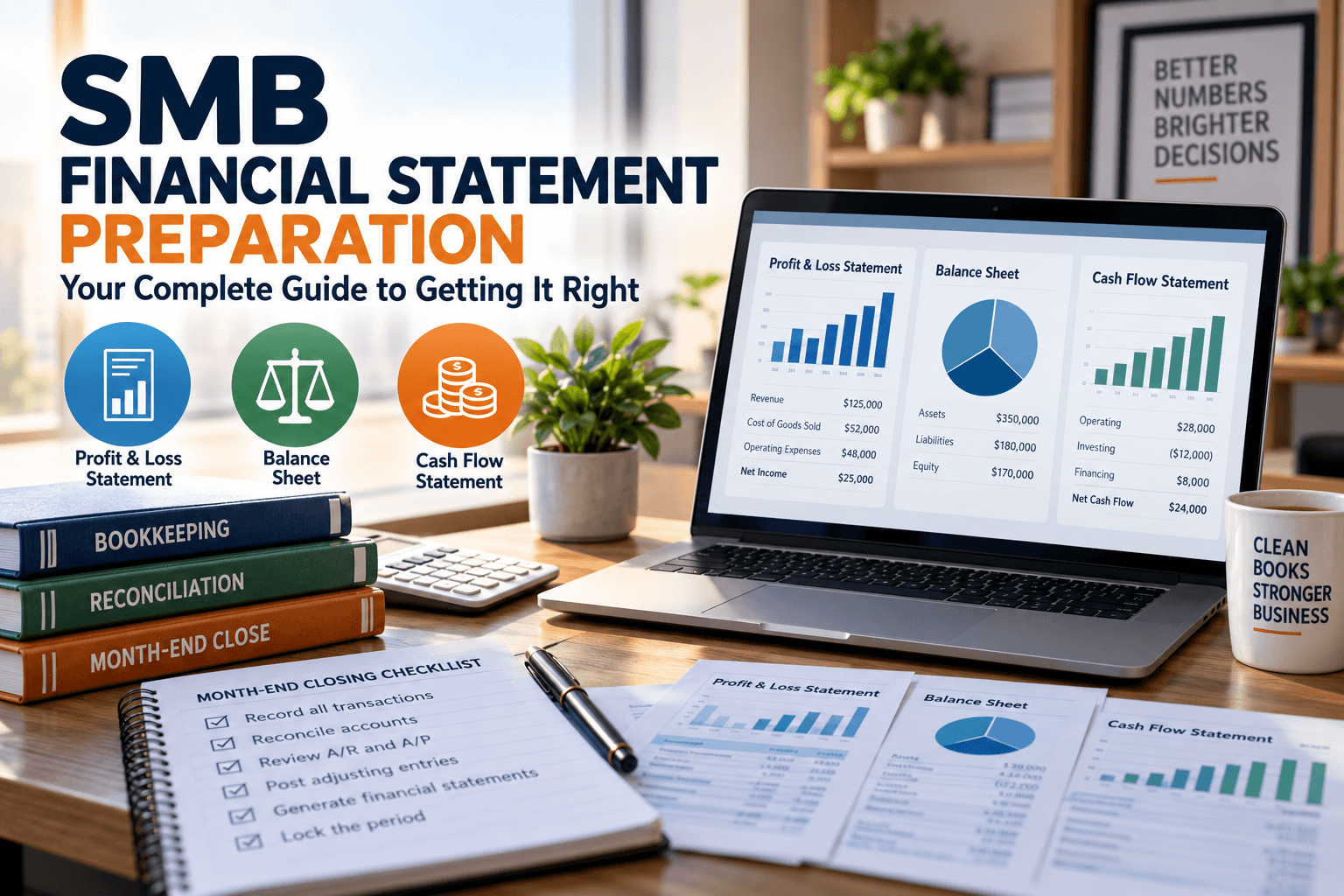
SMB Financial Statement Preparation:
Your Complete Guide to Getting It Right
SMB financial statement preparation is the process of organizing your business’s financial data into three core reports—the profit and loss statement, balance sheet, and cash flow statement—through accurate bookkeeping, account reconciliation, and a consistent month-end closing routine.
Here’s what nobody tells you: most small business owners don’t struggle with financial statements because the math is hard. They struggle because their books are messy, their process is inconsistent, and they’re preparing statements reactively instead of proactively. After more than two decades leading Complete Controller and helping thousands of businesses clean up their financial reporting, I can tell you this—the businesses that master statement preparation don’t just survive tax season. They make smarter decisions all year long.
What is SMB financial statement preparation and how do you do it right?
- SMB financial statement preparation means transforming clean, reconciled bookkeeping data into three tax-ready reports: the profit and loss statement, balance sheet, and cash flow statement.
- Accurate bookkeeping is the foundation—every statement is only as reliable as the records behind it.
- Reconciliation verifies that your books match your bank accounts before you report anything.
- Month-end closing locks in your numbers on a consistent schedule so statements stay comparable over time.
- Compliance standards like GAAP or IFRS keep your reports credible with lenders, investors, and the IRS.

Why Financial Statements Matter More Than You Think
Your financial statements are not paperwork—they’re your business’s story told in numbers. Lenders read them before approving loans. Investors read them before writing checks. And you should be reading them before every major decision.
The U.S. Small Business Administration emphasizes strong financial reporting for small businesses as a cornerstone of business management—and for good reason. Studies consistently show that cash flow problems contribute to the majority of small business failures, and you cannot manage what you don’t measure. Your statements are the measurement.
Once you understand the “why,” the next step is building the foundation those statements rest on.
Start With Clean Books: The Foundation of Every Statement
You can’t build a solid house on sand, and you can’t build accurate statements on sloppy books. Strong small business accounting habits—categorizing transactions weekly, separating business and personal expenses, and keeping digital records of receipts—make statement preparation almost effortless.
Habits that keep your books statement-ready
- Record transactions as they happen, not at quarter’s end
- Keep business and personal finances in completely separate accounts
- Use cloud-based accounting software so your data is current and accessible
- Store receipts and invoices digitally with clear naming conventions
When your books are clean, the next step—reconciliation—becomes a quick check instead of a forensic investigation.
Tired of wondering if your numbers are actually right? Let Complete Controller handle your SMB financial statement preparation so you can spend less time fixing the books and more time using them to make smarter business decisions.
Reconcile Before You Report
Reconciliation is the truth test. Before you prepare a single statement, bookkeeping reconciliation confirms that your ledger matches your bank statements, credit card statements, and loan balances. Skip this step, and you risk reporting numbers that simply aren’t real.
Here’s my rule: if it hasn’t been reconciled, it hasn’t happened. Reconcile monthly at minimum. Catch duplicate entries, missed transactions, and bank errors while they’re fresh—because a $200 discrepancy in March becomes a nightmare in December.
With reconciled accounts in hand, you’re ready to close the books.
Master the Month-End Closing Process
A disciplined month-end closing routine is what separates businesses with reliable statements from those scrambling every April. Closing the books means finalizing all entries for the period so your statements reflect a complete, locked picture.
Your month-end closing checklist
- Record all revenue and expenses for the period
- Reconcile bank, credit card, and loan accounts
- Review accounts receivable and payable for accuracy
- Post adjusting entries (depreciation, accruals, prepaid expenses)
- Review the trial balance for anything unusual
- Lock the period and generate your statements
The order matters here—generate statements before reconciling, and you’ll be redoing everything. Follow the sequence, and preparation becomes routine instead of chaos.
Preparing the Three Core Financial Statements
Now for the main event. Each statement answers a different question about your business.
The profit and loss statement
Your P&L answers: Am I making money? It summarizes revenue, cost of goods sold, and operating expenses over a period. Prepare it monthly and compare against prior periods—trends tell you more than any single month ever will.
The balance sheet
Your balance sheet answers: What do I own and owe? It’s a snapshot of assets, liabilities, and equity at a single point in time. If Assets ≠ Liabilities + Equity, something’s wrong—go back to reconciliation.
The cash flow statement
Your cash flow statement answers: Where is my money actually going? Profit on paper means nothing if cash isn’t in the bank. This statement tracks cash from operations, investing, and financing—and it’s the one most owners skip at their peril.
Stay Compliant and Tax-Ready Year-Round
Consistency and compliance turn good statements into credible ones. Following recognized standards like GAAP and IFRS compliance for SMB ensures your reports are comparable, understandable, and trusted by outside parties. The IFRS for SMEs standard was built specifically for smaller entities—proof that professional-grade reporting isn’t just for corporations.
On the tax side, the IRS is clear about maintaining tax-ready financial statements for small businesses through solid recordkeeping. Keep supporting documents organized, retain records for the required periods, and your tax preparation becomes a handoff—not a crisis.
Conclusion: Turn Your Numbers Into Your Advantage
SMB financial statement preparation comes down to a simple truth: clean books, reconciled accounts, and a consistent month-end close produce statements you can actually trust. Master the P&L, balance sheet, and cash flow statement, keep your reporting compliant, and you’ll stop guessing and start knowing where your business stands.
I built Complete Controller because I believe every small business deserves big-business financial clarity—without the big-business price tag. If you’re ready to hand off the bookkeeping and get expert-prepared, tax-ready statements every month, visit Complete Controller and let the team that pioneered cloud-based bookkeeping and controller services show you what’s possible.

Frequently Asked Questions About SMB Financial Statement Preparation
What financial statements does a small business need?
The three essentials are the profit and loss statement, balance sheet, and cash flow statement. Together they show profitability, financial position, and cash movement.
How often should an SMB prepare financial statements?
Monthly is the gold standard. Monthly statements catch problems early and make quarterly and annual reporting nearly effortless.
Can I prepare financial statements myself?
Yes, with cloud accounting software and disciplined bookkeeping. However, many owners outsource to bookkeeping and controller services to ensure accuracy and save time.
What’s the difference between bookkeeping and financial statement preparation?
Bookkeeping records daily transactions; statement preparation transforms those reconciled records into formal reports. One feeds the other.
Do small businesses have to follow GAAP or IFRS?
Most private SMBs aren’t legally required to, but following GAAP or IFRS for SMEs makes your statements credible to lenders, investors, and buyers.
Sources
- Complete Controller. Small Business Bookkeeping: 9 Tips and Tricks. https://www.completecontroller.com/small-business-bookkeeping-9-tips-and-tricks/
- Complete Controller. The Importance of Reconciling Your Accounting Statements Regularly. https://www.completecontroller.com/importance-of-reconciling-your-accounting-statements-regularly/
- Complete Controller. Accounting Cycle Closure. https://www.completecontroller.com/accounting-cycle-closure/
- U.S. Small Business Administration. Manage Your Finances. https://www.sba.gov/business-guide/manage-your-business/manage-your-finances
- Internal Revenue Service. Recordkeeping. https://www.irs.gov/businesses/small-businesses-self-employed/recordkeeping
- IFRS Foundation. IFRS for SMEs. https://www.ifrs.org/issued-standards/ifrs-for-smes/
 About Complete Controller® – America’s Bookkeeping Experts Complete Controller is the Nation’s Leader in virtual bookkeeping, providing service to businesses and households alike. Utilizing Complete Controller’s technology, clients gain access to a cloud platform where their QuickBooks™️ file, critical financial documents, and back-office tools are hosted in an efficient SSO environment. Complete Controller’s team of certified US-based accounting professionals provide bookkeeping, record storage, performance reporting, and controller services including training, cash-flow management, budgeting and forecasting, process and controls advisement, and bill-pay. With flat-rate service plans, Complete Controller is the most cost-effective expert accounting solution for business, family-office, trusts, and households of any size or complexity.



 Brittany McMillen
Brittany McMillen
Brittany McMillen