


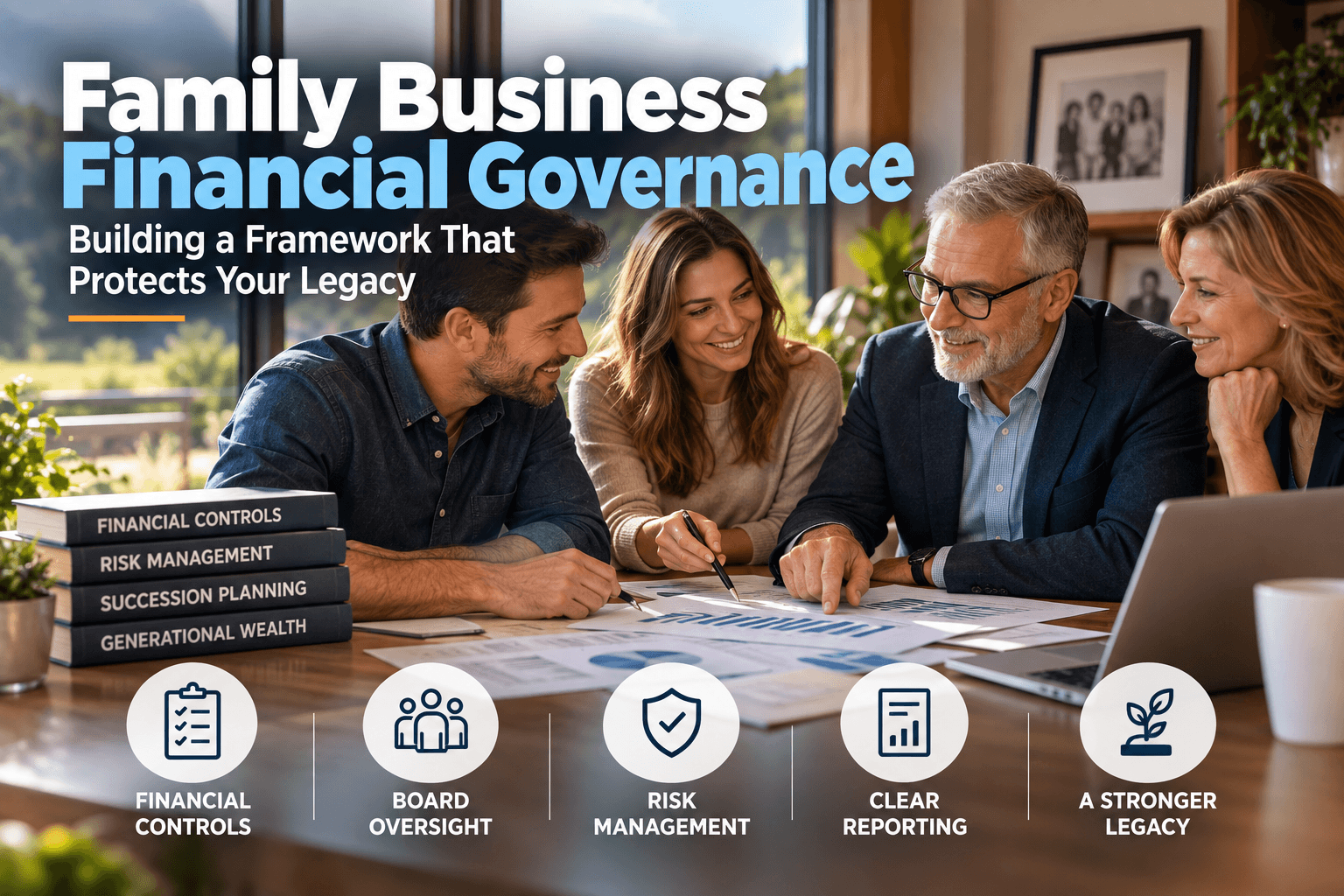
Family Business Financial Governance:
Building a Framework That Protects Your Legacy
Family business financial governance is the system of financial controls, board oversight, policies, and accountability structures that keeps a family-owned company transparent, compliant, and financially healthy across generations. Get it right, and you protect both the business and the relationships behind it.
Here’s what most family business owners don’t want to admit: the biggest financial risks usually aren’t from competitors or the economy—they come from inside the house. Blurred lines between family money and business money, handshake agreements instead of documented policies, and “we trust each other” standing in for actual internal controls. I’ve spent over two decades helping business owners build financial clarity, and I can tell you this—trust is not a control system. Love your family, absolutely. But govern your finances like a professional.
What is family business financial governance and how do you build it?
- Family business financial governance combines a financial control framework, board oversight, documented policies, internal controls monitoring, and compliance safeguards to protect the company’s finances and legacy.
- A financial control framework sets the rules for budgets, spending authority, and reporting so decisions aren’t made on emotion.
- Board oversight and audit committee governance add independent eyes to financial reporting and risk management.
- Internal controls and anti-fraud measures catch errors and misconduct before they become crises.
- Succession and ownership planning ensures the governance system outlives any single family member.

Why Family Business Financial Governance Matters More Than You Think
Family businesses aren’t a niche—they’re the engine of the economy. According to the Family Business Alliance, family businesses create 64% of U.S. GDP and employ 62% of the U.S. workforce. That’s staggering influence, and it comes with real responsibility.
Yet many of these companies run on informal habits that would make a corporate CFO break out in hives. When Dad approves his own expense reports and the family Thanksgiving doubles as the annual budget meeting, you don’t have governance—you have hope. And hope is not a regulatory compliance strategy.
The good news? Formal governance doesn’t kill the family culture. It protects it. Clear financial rules mean fewer arguments, cleaner audits, and a business that banks, investors, and the next generation can actually trust.
Designing Your Financial Control Framework
Every strong governance system starts with a documented financial control framework—the written playbook for how money moves through your business. This is where budgetary control systems and financial policy and procedures come to life.
The core elements you need
- Spending authority limits – Define who can approve what, and at what dollar amount. Yes, even family members. Especially family members.
- Budgeting and forecasting cadence – Annual budgets, quarterly reviews, monthly variance checks.
- Separation of duties – The person writing checks shouldn’t also reconcile the bank statement.
- Documented financial policies – Compensation, dividends, loans to family members, and related-party transactions all get written rules.
When these elements exist on paper—not just in someone’s head—you’ve converted family goodwill into institutional strength. That framework only works, though, if someone is watching over it. That’s where the board comes in.
Board Oversight and Audit Committee Governance
Strong board-level financial oversight processes are what separate family firms that endure from those that implode in generation two. The OECD’s principles of corporate financial governance emphasize board accountability, transparency, and independent oversight—standards that apply whether you’re a global giant or a third-generation manufacturer.
What effective board oversight looks like
Bring in at least one or two independent directors who aren’t at the family dinner table. They ask the questions family members won’t. Establish an audit committee—even an informal one—responsible for financial reporting oversight, reviewing statements, meeting with external accountants, and monitoring risk management governance.
For a real-world model, look at Ford. Its 2024 proxy statement shows Ford family members hold Class B shares carrying 40% of general voting power, even though public investors own most of the stock. The lesson: you can structure ownership and voting rights to preserve family control while embracing professional governance and public accountability. Structure isn’t the enemy of legacy—it’s the guardian of it.
Family trust is priceless—but your finances still need structure. Complete Controller helps family businesses build clearer books, stronger controls, and financial confidence that lasts for generations.
Internal Controls Monitoring and Reporting Accuracy
Governance lives or dies in the daily details. Regular internal controls monitoring—reconciling accounts, reviewing variances, investigating discrepancies—is how you catch small problems before they become expensive ones.
The U.S. Government Accountability Office’s Green Book sets the gold standard for internal control compliance reporting, covering the control environment, risk assessment, and monitoring activities. You don’t need to be a government agency to borrow its wisdom: design controls, document them, test them, and fix what breaks.
Monthly reconciliations, timely financial statements, and a clear paper trail turn your books from a guessing game into a decision-making tool. And when reporting is reliable, compliance gets a whole lot easier—which brings us to the regulatory side.
Regulatory Compliance and Ethics Safeguards
Even privately held family firms benefit from public-company discipline. The Sarbanes-Oxley Act—the foundation of SOX compliance—requires executive certification of financial statements and documented internal controls. Family businesses that adopt SOX-style habits are audit-ready, lender-ready, and sale-ready at any moment.
Ethics matter just as much as rules. Strong ethics and anti-fraud controls protect the business and the family from the devastating scenario nobody wants to imagine: misconduct by someone with a shared last name. Preventive controls, anonymous reporting channels, and a zero-tolerance policy applied equally to everyone—that’s governance risk compliance (GRC) with heart and backbone.
Succession Planning: Governance That Outlives You
Here’s the sobering truth: PwC’s Global Family Business Survey found only 34% of family businesses have a robust, documented, and communicated succession plan. That means two-thirds are betting their legacy on improvisation.
Your governance framework should answer these questions before a crisis forces the issue:
- Who inherits ownership, and how are shares valued and transferred?
- Who takes financial leadership roles, and what qualifications are required?
- How are non-active family members compensated or bought out?
- What happens to voting control across generations?
A documented succession plan tied to your financial governance structure is the single greatest gift you can leave the next generation. It transforms an emotional transition into an orderly one.
Conclusion: Govern Like a Pro, Lead Like a Family
Family business financial governance isn’t red tape—it’s legacy insurance. A documented financial control framework, independent board oversight, disciplined internal controls, real compliance safeguards, and a communicated succession plan turn family trust into institutional strength. I’ve watched businesses transform when they stop running on habit and start running on structure—and the family relationships get stronger, not weaker.
Ready to build governance that protects what you’ve worked so hard to create? Visit Complete Controller for expert guidance from the team that pioneered cloud-based bookkeeping and controller services. Your legacy deserves nothing less.

Frequently Asked Questions About Family Business Financial Governance
What is family business financial governance?
It’s the system of financial controls, board oversight, policies, and accountability structures that keeps a family-owned company transparent, compliant, and financially sound across generations.
Why do family businesses need formal financial controls?
Informal, trust-based practices create risk of errors, fraud, and family conflict. Documented controls protect both the business’s finances and the family’s relationships.
Does a family business need an independent board?
While not legally required for private firms, independent directors add objectivity, challenge assumptions, and strengthen financial oversight—key advantages as the business grows.
How does succession planning fit into financial governance?
Succession planning documents how ownership, voting rights, and financial leadership transfer between generations. Only 34% of family businesses have a robust, communicated plan, per PwC.
Do SOX compliance rules apply to private family businesses?
SOX legally applies to public companies, but its principles—executive accountability and documented internal controls—are best practices that make private family firms audit-ready and lender-ready.
Sources
- Family Business Alliance. (Accessed September 28, 2026). Family Business Facts. https://www.fbagr.org/family-business-facts
- PwC. (2023). PwC’s Global Family Business Survey 2023: Transform to Build Trust. https://www.pwc.com/gx/en/services/family-business/family-business-survey.html
- Ford Motor Company. (April 5, 2024). 2024 Proxy Statement. https://shareholder.ford.com/Investors/financials/sec-filings/default.aspx
- OECD. (2023). G20/OECD Principles of Corporate Governance. https://www.oecd.org/en/publications/g20-oecd-principles-of-corporate-governance-2023_ed750b30-en.html
- U.S. Securities and Exchange Commission. Sarbanes-Oxley Act of 2002. https://www.sec.gov/about/laws/soa2002.pdf
- U.S. Government Accountability Office. Green Book — Standards for Internal Control. https://www.gao.gov/greenbook/overview
 About Complete Controller® – America’s Bookkeeping Experts Complete Controller is the Nation’s Leader in virtual bookkeeping, providing service to businesses and households alike. Utilizing Complete Controller’s technology, clients gain access to a cloud platform where their QuickBooks™️ file, critical financial documents, and back-office tools are hosted in an efficient SSO environment. Complete Controller’s team of certified US-based accounting professionals provide bookkeeping, record storage, performance reporting, and controller services including training, cash-flow management, budgeting and forecasting, process and controls advisement, and bill-pay. With flat-rate service plans, Complete Controller is the most cost-effective expert accounting solution for business, family-office, trusts, and households of any size or complexity.



 Brittany McMillen
Brittany McMillen
Brittany McMillen