


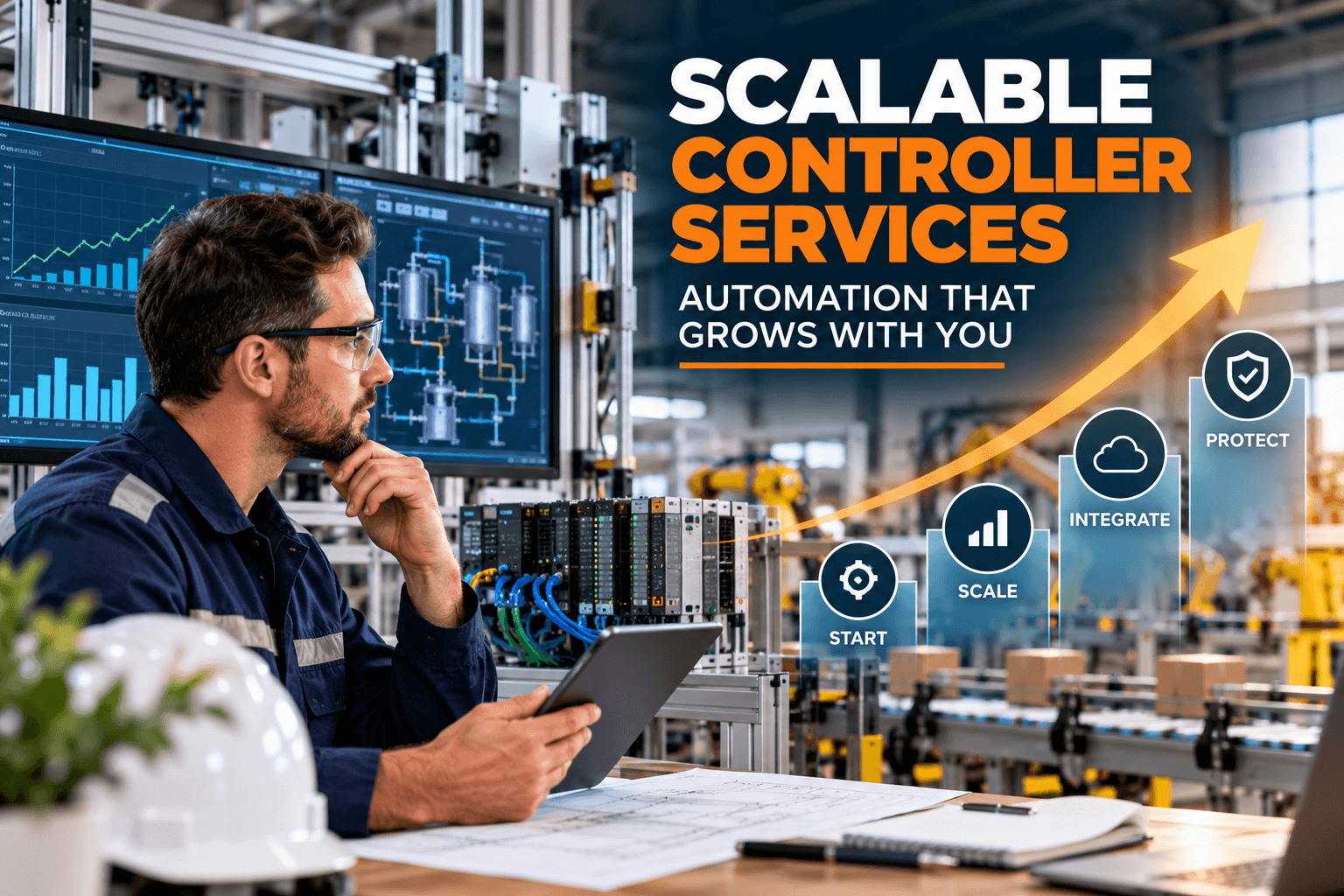
Scalable Controller Services:
How to Build Automation That Grows With You
Scalable controller services are managed solutions that design, deploy, and maintain programmable control units capable of expanding alongside your production needs—so you never have to rip out your automation infrastructure just because your business grew. Instead of locking you into rigid hardware, these services deliver modular, upgradeable systems that flex with demand.
Here’s the hard truth most vendors won’t tell you: the biggest cost in industrial automation isn’t the equipment—it’s the rework. I’ve watched growing operations pay twice, sometimes three times, for the same capability because their original controllers couldn’t scale. You deserve a system that fits your business today and five years from now. That’s exactly what we’re going to map out together.
What are scalable controller services and why do they matter?
- Scalable controller services combine modular hardware, flexible software, and ongoing support so your automation capacity grows without costly system replacements.
- They rely on programmable control units and modular architecture that let you add capacity in increments instead of overhauls.
- They include remote monitoring, firmware upgrades, and integration support as ongoing services—not one-time installs.
- They connect controllers to IoT devices and enterprise data systems for smarter, real-time decision-making.
- They reduce downtime, cut deployment costs, and protect your operation against obsolescence.

How Scalable Controller Services Fit Into Industrial Automation
Every automated facility runs on a nervous system of industrial control systems—the controllers, sensors, and networks that keep machines moving safely and precisely. The problem? Traditional setups were built like concrete: solid, but impossible to reshape.
Scalable automation controllers flip that model. Think of them as building blocks rather than a poured foundation. Need another production line? Add a module. New sensor array? Integrate it without touching the core system.
The shift from fixed to modular
Legacy programmable logic controllers often required full reprogramming—or full replacement—when operations changed. Modular controller solutions changed the game by separating functions into swappable units. You upgrade what needs upgrading and leave the rest alone. That’s not just convenient; it’s a fundamentally smarter way to spend capital.
The Cost Case for Modular Controller Deployment
Let me be blunt: rigid automation is expensive automation. When you design for scale from day one, the savings show up in three places—assembly, configuration, and maintenance. Smart operators are already cutting costs through modular automation controller deployment, using standardized components that slash custom engineering hours.
Here’s what the numbers tell us. McKinsey research has found that predictive maintenance enabled by connected systems can reduce machine downtime by 30–50% and extend equipment life by 20–40%. Downtime is the silent profit killer—industry analyses routinely estimate unplanned outages cost manufacturers tens of thousands of dollars per hour in lost production.
Scalable controller installation services front-load the planning so you avoid those losses later. It’s the same principle I built Complete Controller on: systems designed right the first time pay dividends forever.
Connecting Controllers to IoT and Smart Manufacturing
This is where things get exciting. Controllers used to be islands—now they’re conversation partners. Modern IoT scalable controller integration links your automation assets, sensors, and data systems into one intelligent production workflow. Your controllers don’t just execute commands; they report, learn, and optimize.
Why connected controllers win
With industry forecasts projecting tens of billions of connected IoT devices in operation this decade, manufacturers who integrate early gain a serious data advantage. But connection without security is a liability. That’s why best practices from the NIST IoT controller services cybersecurity program matter—secure data exchange between controllers and enterprise systems isn’t optional anymore. It’s table stakes.
Growing your business shouldn’t mean starting over! Complete Controller helps businesses scale smarter with expert bookkeeping, financial oversight, and controller services that grow with you. Discover how we can help!
Designing a Secure, Scalable Control Architecture
Growth without governance is just risk with a nicer name. A properly designed scalable control architecture follows guidance like NIST SP 800-82, which lays out how to protect operational technology environments while keeping them flexible. In my experience, the companies that treat security as a design input—not a patch—are the ones that scale without stumbling.
What good architecture looks like
A resilient controller ecosystem includes segmented networks that isolate critical controls, role-based access so only the right people touch the right systems, redundancy that keeps production running during failures, and documented firmware upgrade paths so your programmable control units stay current without surprise downtime. None of this is glamorous. All of it is what separates operations that scale smoothly from those that scramble.
Remote Monitoring and Ongoing Controller Support
Your controllers don’t clock out at 5 p.m.—and neither should your oversight. Modern remote controller monitoring and support lets your team securely manage distributed operations from anywhere, catching anomalies before they become outages. I pioneered cloud-based services in my own industry precisely because I saw this truth early: location should never limit control.
Scalable programmable controller maintenance delivered remotely means faster response times, lower travel costs, and continuous firmware updates—without pulling engineers onto the factory floor for every tweak.
How to Get Started with Scalable Controller Services
Ready to move? Here’s the sequence that works:
- Audit your current systems. Document every controller, its age, capacity, and integration points.
- Define your growth horizon. Plan architecture for where you’ll be in 3–5 years, not just today.
- Choose modular over monolithic. Prioritize vendors offering swappable, upgradeable components.
- Build security into the design. Apply OT security frameworks before deployment, not after.
- Establish remote monitoring from day one. Visibility is the foundation of reliability.
Follow that order. Skipping step one is how companies end up buying solutions to problems they don’t actually have.
Conclusion
Scalable controller services aren’t a luxury—they’re the difference between automation that fuels growth and automation that fights it. Modular design cuts deployment costs, IoT integration turns data into decisions, secure architecture protects your uptime, and remote monitoring keeps it all humming around the clock. You don’t need to predict the future perfectly; you just need systems built to adapt to it.
That’s the philosophy I’ve built my entire career on—smart systems, designed for growth, managed by experts. For more strategies on running a leaner, smarter operation, visit the team that pioneered cloud-based bookkeeping and controller services at Complete Controller.

Frequently Asked Questions About Scalable Controller Services
What makes a controller service “scalable”?
Scalability means the system can expand capacity—adding modules, devices, or production lines—without replacing core infrastructure or causing extended downtime.
How much do scalable controller services cost compared to traditional systems?
Upfront costs are often similar, but modular systems typically cost significantly less over time by eliminating full replacements and reducing downtime through predictive maintenance.
Are IoT-connected controllers safe from cyberattacks?
They can be, when designed using frameworks like NIST SP 800-82 and NIST’s IoT cybersecurity guidance—network segmentation, access controls, and regular firmware updates are essential.
Can I upgrade my existing controllers instead of replacing them?
Often, yes. Many legacy systems can be extended with modular units and firmware upgrades, though an audit is needed to confirm compatibility.
What is remote controller monitoring and why does it matter?
It’s secure, off-site oversight of your control systems that catches issues early, reduces on-site service costs, and keeps operations running continuously.
Sources
- Complete Controller. IoT Trends That Could Shape Manufacturing in 2021. https://www.completecontroller.com/iot-trends-that-could-shape-manufacturing-in-2021/
- Complete Controller. Cut Custom Assembly Costs: 5 Ways. https://www.completecontroller.com/cut-custom-assembly-costs-5-ways/
- Complete Controller. Remote Work Security Post-COVID. https://www.completecontroller.com/remote-work-security-post-covid/
- CISA. Industrial Control Systems. https://www.cisa.gov/topics/industrial-control-systems
- NIST. SP 800-82 Rev. 3: Guide to Operational Technology (OT) Security. https://csrc.nist.gov/pubs/sp/800/82/r3/final
- NIST. NIST Cybersecurity for IoT Program. https://www.nist.gov/itl/applied-cybersecurity/nist-cybersecurity-iot-program
 About Complete Controller® – America’s Bookkeeping Experts Complete Controller is the Nation’s Leader in virtual bookkeeping, providing service to businesses and households alike. Utilizing Complete Controller’s technology, clients gain access to a cloud platform where their QuickBooks™️ file, critical financial documents, and back-office tools are hosted in an efficient SSO environment. Complete Controller’s team of certified US-based accounting professionals provide bookkeeping, record storage, performance reporting, and controller services including training, cash-flow management, budgeting and forecasting, process and controls advisement, and bill-pay. With flat-rate service plans, Complete Controller is the most cost-effective expert accounting solution for business, family-office, trusts, and households of any size or complexity.



 Brittany McMillen