


Controller vs Bookkeeper Responsibilities:
Who Does What in Your Business Finances
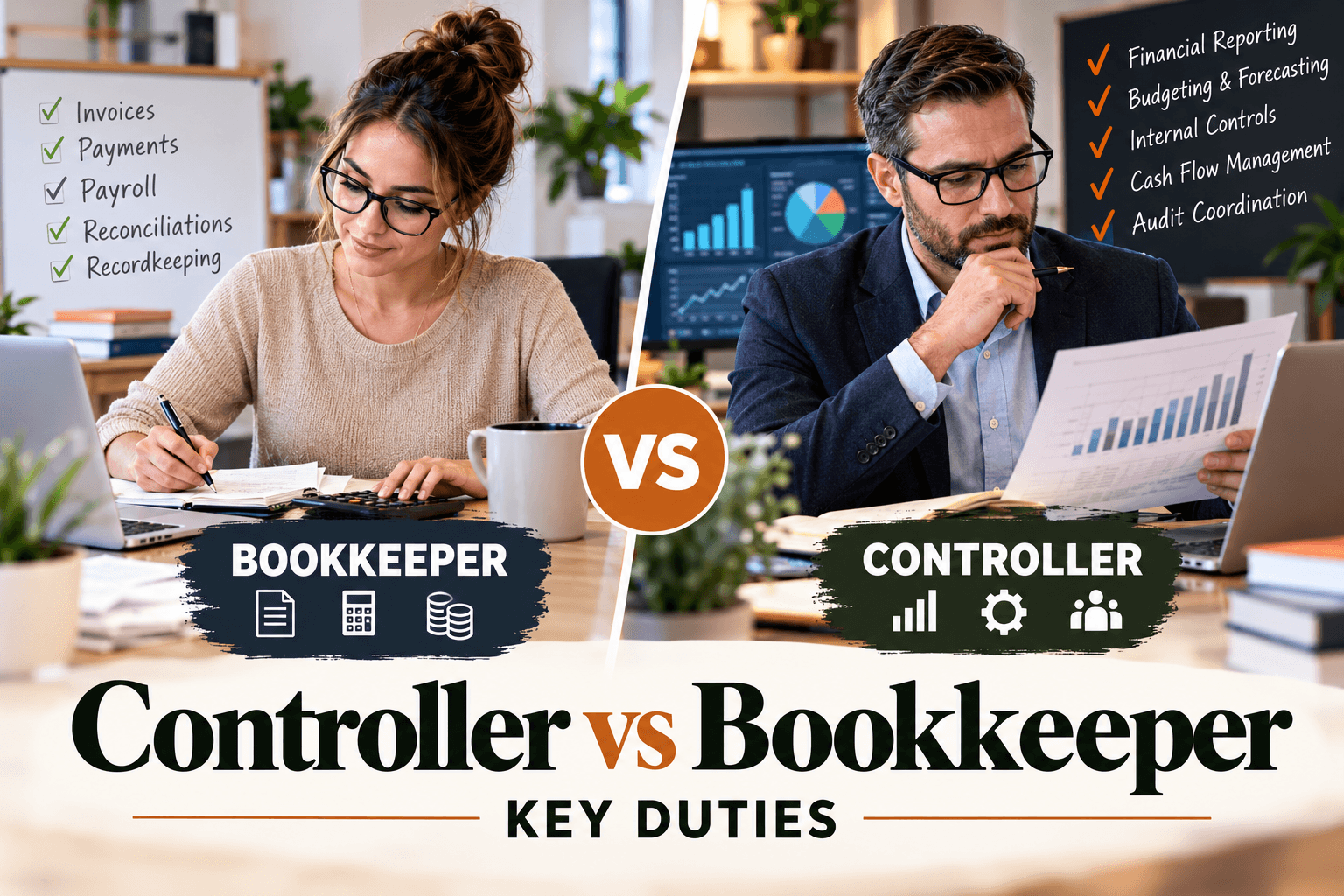
Controller vs bookkeeper responsibilities break down simply: a bookkeeper records your daily financial transactions—invoices, payments, payroll, reconciliations—while a controller oversees the entire accounting function, managing financial reporting, internal controls, budgeting, and strategic analysis. One builds the data; the other makes it mean something.
Here’s what I’ve learned after two decades of leading Complete Controller: most business owners hire the wrong role at the wrong time—and it costs them dearly. They bring on a controller when they need clean books, or they lean on a bookkeeper to make CFO-level decisions. If you’ve ever stared at a financial report wondering who’s actually responsible for this, this article will clear the fog for good.
What is the difference between controller and bookkeeper responsibilities?
- A bookkeeper handles daily transaction recording, while a controller manages financial strategy, reporting accuracy, compliance, and team oversight.
- Bookkeepers manage accounts payable, accounts receivable, payroll entry, and general ledger management.
- Controllers own the month-end close, financial reporting, internal controls, and audit coordination.
- Bookkeepers typically report to controllers in a healthy finance structure.
- Most small businesses need a bookkeeper first—and controller oversight as they scale past basic recordkeeping.

Bookkeeping Responsibilities: The Foundation of Every Financial Decision
Your bookkeeper is the heartbeat of your daily finances. Every dollar in, every dollar out—captured, categorized, and reconciled. Without that discipline, nothing downstream works. Not your tax return, not your loan application, not your gut-check on whether you can afford that new hire.
Core bookkeeping responsibilities include recording transactions, managing accounts payable (what you owe) and accounts receivable (what you’re owed), processing payroll data, and reconciling bank and credit card statements. Think of it as financial journalism—documenting the facts, accurately and on time.
Why accuracy at this level changes everything
Here’s the truth most owners miss: bookkeeping for small businesses isn’t clerical work—it’s risk management. A missed receivable is cash you never collect. A duplicated payable is money out the door twice. Regular reconciliation is the safeguard, which is exactly why connecting bookkeeping and financial statements through consistent review keeps your records trustworthy and your decisions grounded in reality.
Once that foundation is solid, someone needs to interpret it. Enter the controller.
Controller Duties: Where Oversight Meets Strategy
A controller is your financial quarterback. According to the U.S. Bureau of Labor Statistics, controller duties fall under financial management—a field projected to grow much faster than average, precisely because businesses increasingly need leaders who turn data into direction.
Controller job responsibilities include:
- Financial reporting oversight – ensuring statements are accurate, timely, and decision-ready
- Budgeting and forecasting – mapping where your money should go, not just where it went
- Cash flow management – protecting liquidity so you never get blindsided
- Audit coordination – serving as the point person when auditors or lenders come knocking
- Team supervision – reviewing and guiding the bookkeeping function
The controller as translator
The SEC’s guidance on financial reporting makes one thing clear: financial statements only create value when someone can read the story inside them. That’s your controller—translating raw numbers into answers. Can we expand? Should we cut? Where’s the leak?
And speaking of leaks, there’s one controller responsibility that deserves its own spotlight.
Are you getting the financial insights your business needs? Complete Controller combines expert bookkeeping and controller services to keep your books accurate, cash flow clear, and business decisions confident. See how we can help!
Internal Controls: The Controller’s Most Underrated Responsibility
If bookkeeping is recording the facts, internal controls are protecting them. Controllers design approval workflows, enforce segregation of duties, and build checks that prevent fraud and error before they happen. The U.S. Government Accountability Office’s Green Book on internal controls is the gold standard framework here—and yes, its principles apply beautifully to private businesses, not just government agencies.
Consider this: the Association of Certified Fraud Examiners consistently finds that small businesses suffer disproportionate fraud losses, largely because one person often handles too many financial duties unchecked. A controller fixes that structural weakness. That’s not bureaucracy—that’s protection.
The Month-End Close: Where Both Roles Work Together
Nothing illustrates the controller-bookkeeper partnership better than the monthly close. It’s a relay race, and the handoff matters.
- The bookkeeper completes month-end close bookkeeping tasks—reconciling accounts, posting final entries, and cleaning up the general ledger.
- The controller reviews the work, posts adjusting entries, analyzes variances against budget, and finalizes the statements.
- Leadership receives accurate reports they can actually act on—ideally within days, not weeks.
When this rhythm runs smoothly, you get something priceless: real-time financial visibility. When it doesn’t, you’re making this month’s decisions with last quarter’s data.
Which Role Does Your Business Need Right Now?
Here’s my honest, founder-to-founder take. If your books are behind, messy, or nonexistent—start with bookkeeping. No controller on earth can analyze data that doesn’t exist. But if your books are current and you’re still flying blind on margins, cash flow, or growth decisions, you’ve outgrown recordkeeping alone. You need controller-level oversight.
The good news? You don’t have to choose between a $50K bookkeeper and a $150K+ controller salary. This is exactly why I built Complete Controller—to give small and mid-sized businesses both functions through cloud-based services, scaled to what you actually need. The traditional model of hiring full-time for both roles is outdated for most growing companies, and I’ve watched thousands of clients thrive without it.
Conclusion: Clarity Creates Confidence
The difference between controller and bookkeeper responsibilities comes down to this: bookkeepers create accurate financial records, and controllers transform those records into protection, insight, and strategy. You need both functions—done right, in the right order—to build a business that grows on purpose instead of by accident.
Your numbers should work for you, not haunt you. If you’re ready for expert bookkeeping and controller support without the full-time overhead, visit Complete Controller and connect with the team that pioneered cloud-based bookkeeping and controller services. Your clarity starts now.

Frequently Asked Questions About Controller vs Bookkeeper Responsibilities
Can a bookkeeper do a controller’s job?
Generally, no. Bookkeepers specialize in transaction recording, while controllers require expertise in financial analysis, internal controls, and reporting oversight. Some experienced bookkeepers grow into controller roles with additional training.
Does a controller report to a CFO?
Yes, in larger organizations the controller reports to the CFO. In small businesses, the controller often serves as the top financial role, reporting directly to the owner.
What does a controller do during month-end close?
The controller reviews the bookkeeper’s reconciliations, posts adjusting entries, analyzes budget variances, and approves the final financial statements for leadership.
When should a small business hire a controller?
Typically when revenue complexity grows—multiple revenue streams, outside investors, lender reporting requirements, or when owners need forecasting and cash flow strategy beyond basic books.
Is outsourcing bookkeeping and controller services safe?
Yes, when done through a reputable cloud-based provider with strong internal controls, secure technology, and transparent processes. Outsourcing often improves security through built-in segregation of duties.
Sources
- Complete Controller. Business Bookkeeping Essentials. https://www.completecontroller.com/business-bookkeeping-essentials/
- Complete Controller. The Importance of Reconciling Your Accounting Statements Regularly. https://www.completecontroller.com/importance-of-reconciling-your-accounting-statements-regularly/
- Complete Controller. Accounting Cycle Closure. https://www.completecontroller.com/accounting-cycle-closure/
- U.S. Bureau of Labor Statistics. Occupational Outlook Handbook: Financial Managers. https://www.bls.gov/ooh/management/financial-managers.htm
- U.S. Securities and Exchange Commission. Beginners’ Guide to Financial Statements. https://www.sec.gov/investor/pubs/begfinstmtguide.htm
- U.S. Government Accountability Office. Standards for Internal Control in the Federal Government (Green Book). https://www.gao.gov/greenbook
 About Complete Controller® – America’s Bookkeeping Experts Complete Controller is the Nation’s Leader in virtual bookkeeping, providing service to businesses and households alike. Utilizing Complete Controller’s technology, clients gain access to a cloud platform where their QuickBooks™️ file, critical financial documents, and back-office tools are hosted in an efficient SSO environment. Complete Controller’s team of certified US-based accounting professionals provide bookkeeping, record storage, performance reporting, and controller services including training, cash-flow management, budgeting and forecasting, process and controls advisement, and bill-pay. With flat-rate service plans, Complete Controller is the most cost-effective expert accounting solution for business, family-office, trusts, and households of any size or complexity.



 Brittany McMillen