


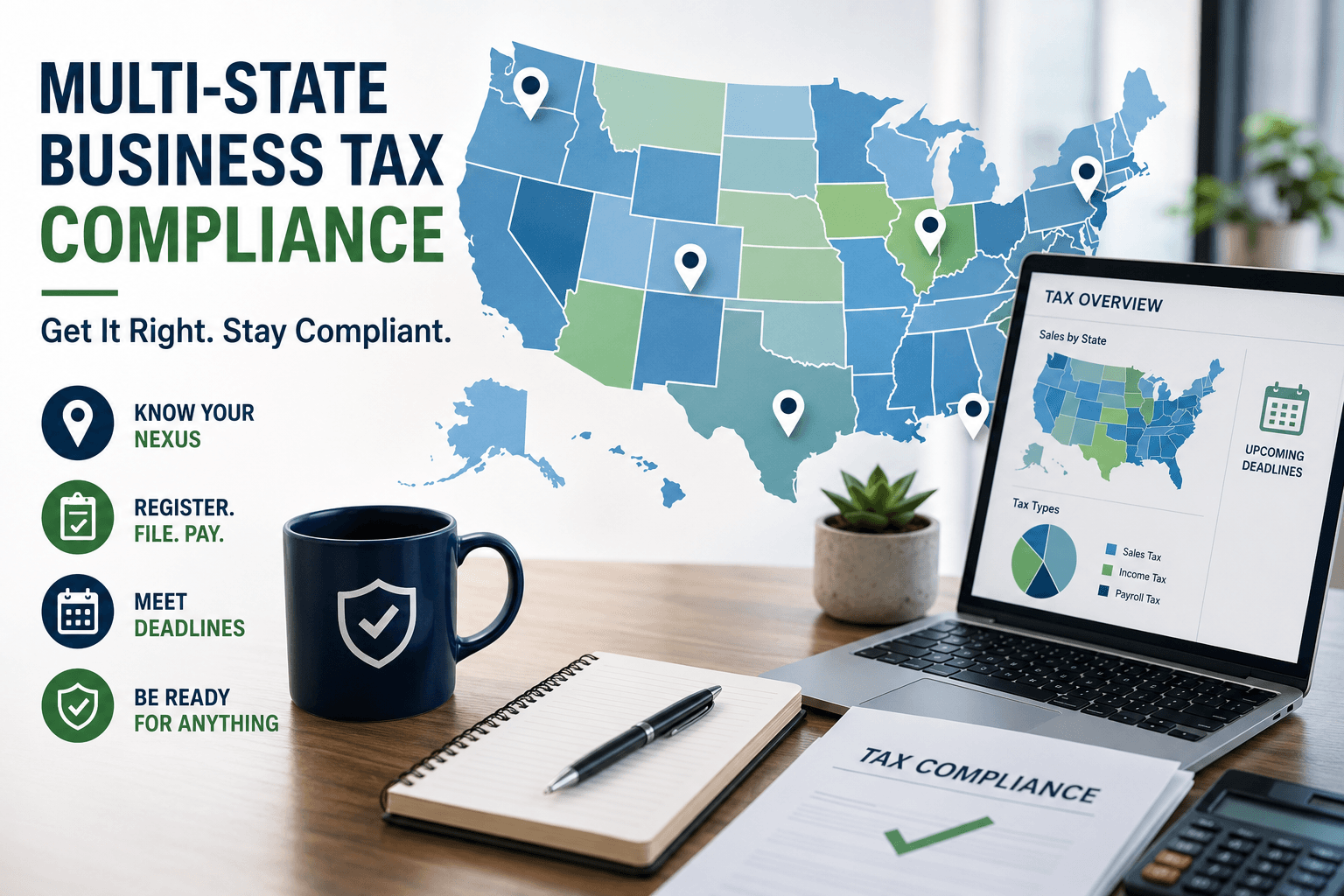
Multi-State Business Tax Compliance:
Your Complete Guide to Getting It Right
Multi-state business tax compliance means registering, collecting, filing, and paying the right taxes in every state where your business has a legal obligation—known as nexus—and it requires tracking sales tax, income tax, and payroll tax rules that vary in all fifty states.
Here’s what nobody tells you when your business starts growing: the moment you sell across state lines, hire a remote employee, or ship products to new markets, you may have quietly signed up for tax obligations you’ve never heard of. I’ve spent over two decades helping business owners untangle this exact mess, and I can tell you—the businesses that thrive aren’t the ones that avoid multi-state growth. They’re the ones that build a compliance system before the notices start arriving.
What is multi-state business tax compliance and how do you manage it?
- Multi-state business tax compliance is the process of identifying nexus, registering with state agencies, filing required returns, and remitting sales, income, and payroll taxes in every state where you have obligations.
- Nexus determination comes first—economic activity, not just physical presence, can trigger tax duties in a state.
- Business tax registration must happen in each state before you collect or file, or you risk penalties.
- Ongoing filing and reporting obligations vary by state, including deadlines, thresholds, and local tax rates.
- Audit readiness and notice management protect you when states come asking questions—and they will.

Why Multi-State Sales Tax Compliance Is So Hard to Manage
Let’s start with the honest truth: sales tax in America is a patchwork quilt sewn by fifty different tailors. According to the Tax Foundation, in 2024, 45 states and Washington, D.C., had a statewide sales tax, and 38 states also allowed local sales taxes. That means the rate you charge can change from one zip code to the next—sometimes from one side of the street to the other.
The moving parts you’re juggling
Sales and use tax compliance isn’t one task. It’s a system of tasks:
- Rate tracking across state, county, and city jurisdictions
- Product taxability rules (clothing might be exempt in one state, taxed in another)
- Filing frequencies that shift as your sales volume grows
- Marketplace facilitator rules if you sell on platforms like Amazon or Etsy
If that list made your shoulders tense, good—that awareness is the first step toward building a system that handles it for you. And it all starts with one question: where do you actually owe tax?
Nexus Determination: The Rule That Changed Everything
Before 2018, most businesses asked one simple question: Do we have a physical presence in this state? An office, a warehouse, an employee—no presence, no problem. Then the Supreme Court rewrote the playbook. In South Dakota v. Wayfair, the Court upheld economic nexus rules, including South Dakota’s threshold of $100,000 in sales or 200 transactions—no physical footprint required. You can read the full decision on state tax nexus and filing obligations directly from the Supreme Court.
Translation: if you sell enough into a state, you owe that state sales tax—even if you’ve never set foot there. Most states adopted similar economic nexus thresholds within two years of the ruling. Your job is to monitor your sales by state, every quarter, so you know the moment you cross a line. Because once you cross it, the clock on registration starts ticking.
Business Tax Registration and State Filing Requirements
Once nexus exists, registration comes before collection. Collecting sales tax without a permit is illegal in most states—yes, even with good intentions. The IRS maintains a helpful directory for business tax registration that links to every state’s tax agency, which is your starting point for each new jurisdiction.
Building a filing rhythm that doesn’t break
Registration is the handshake; filing is the marriage. Every state sets its own deadlines, forms, and frequencies, and missing them—even with zero tax due—triggers penalties. Strong bookkeeping is the backbone here. Organized records, clean categorization, and timely reporting make state tax filing requirements manageable instead of miserable. When your books are current, your filings practically prepare themselves.
Corporate Income Tax and Payroll Tax Exposure Beyond Sales Tax
Here’s where many business owners get blindsided: sales tax isn’t the only nexus game in town. Your income tax exposure can grow right alongside it—even through your website. The Multistate Tax Commission’s 2021 guidance states that a business may create in-state activity when it interacts with customers in a state through its website or app, especially when that activity goes beyond simply soliciting orders. Live chat support, software updates, warranty services—these digital touchpoints can create corporate income tax compliance obligations you didn’t see coming.
Remote employees, real obligations
Hired a remote team member in another state? Congratulations—you likely just created payroll nexus. You’ll need to handle state income tax withholding, unemployment insurance, and workers’ compensation in that state. The U.S. Department of Labor’s directory of state workforce agencies is your go-to resource for payroll tax compliance contacts. Handle this at hiring, not at year-end, and you’ll save yourself a world of cleanup.
Multi-state taxes don’t have to slow you down. Complete Controller helps you stay organized, compliant, and ready for every filing deadline.
Tax Audit Readiness and Notice Management
States are hungry for revenue, and multi-state businesses are prime audit targets. The difference between a stressful audit and a routine one comes down to documentation. Regular reconciliations, exemption certificate files, and clean financial statements are the foundation of tax audit readiness—when an auditor asks for records, you want to hand them over in days, not months.
Tax notice management deserves its own discipline, too. Never ignore a state notice, even one that looks wrong. Here’s the sequence I coach clients through:
- Log the notice with its date, state, and deadline immediately.
- Verify the claim against your filing records.
- Respond in writing before the deadline, keeping copies of everything.
- Track resolution until you receive written confirmation the matter is closed.
When to Bring in Multi-State Business Tax Compliance Services
At some point, spreadsheets stop scaling. If you’re filing in five-plus states, managing remote payroll, or losing sleep over nexus thresholds, it’s time to build real infrastructure. Professional multi state business tax compliance services give you expert bookkeeping, consistent reconciliations, and a team that keeps your records audit-ready year-round—usually for less than the cost of one compliance mistake. I built Complete Controller on this exact premise: growing businesses deserve enterprise-grade financial infrastructure without enterprise-grade overhead.
Conclusion
Multi-state tax compliance isn’t a burden reserved for big corporations—it’s the natural companion of growth, and it rewards businesses that get organized early. Determine your nexus, register before you collect, keep your books reconciled, and treat every state notice like it matters. Do that, and expansion becomes an opportunity instead of a liability. If you’re ready to build a compliance system that grows with you, visit Complete Controller for expert guidance from the team that pioneered cloud-based bookkeeping and controller services.

Frequently Asked Questions About Multi-State Business Tax Compliance
What triggers tax nexus in another state?
Physical presence (offices, inventory, employees) or economic activity—typically $100,000 in sales or 200 transactions, following the Wayfair decision—can create nexus and trigger tax obligations.
Do I need to register in a state before collecting sales tax?
Yes. Most states require a sales tax permit before you collect. Collecting without registration can result in penalties, so register the moment you establish nexus.
Can a remote employee create tax obligations in their state?
Absolutely. A remote worker usually creates payroll nexus, requiring state withholding, unemployment insurance registration, and sometimes corporate income tax filings.
How do I know if my website creates income tax nexus?
Under 2021 Multistate Tax Commission guidance, interactive website features like live chat, software updates, or post-sale support may create in-state activity beyond protected solicitation.
What should I do when I receive a state tax notice?
Log it immediately, verify the claim against your records, respond in writing before the deadline, and keep documentation until you have written confirmation the issue is resolved.
Sources
- Tax Foundation. (February 6, 2024). State and Local Sales Tax Rates, 2024. Janelle Fritts. https://taxfoundation.org/data/all/state/2024-sales-taxes/
- Supreme Court of the United States. (June 21, 2018). South Dakota v. Wayfair, Inc. Anthony M. Kennedy. https://www.supremecourt.gov/opinions/17pdf/17-494_j4el.pdf
- Multistate Tax Commission. (August 4, 2021). Statement of Information Concerning Practices of Multistate Tax Commission and Signatory States Under Public Law 86-272. https://www.mtc.gov/wp-content/uploads/2023/02/StatementofInfoPublicLaw86-272.pdf
- IRS. State Government Websites. https://www.irs.gov/businesses/small-businesses-self-employed/state-government-websites
- U.S. Department of Labor. Unemployment Insurance Agencies. https://oui.doleta.gov/unemploy/agencies.asp
- Complete Controller. Accounting Outsourcing Economics. https://www.completecontroller.com/accounting-outsourcing-economics/
- Complete Controller. The Importance of Reconciling Your Accounting Statements Regularly. https://www.completecontroller.com/importance-of-reconciling-your-accounting-statements-regularly/
- Complete Controller. Small Business Bookkeeping: 9 Tips and Tricks. https://www.completecontroller.com/small-business-bookkeeping-9-tips-and-tricks/
 About Complete Controller® – America’s Bookkeeping Experts Complete Controller is the Nation’s Leader in virtual bookkeeping, providing service to businesses and households alike. Utilizing Complete Controller’s technology, clients gain access to a cloud platform where their QuickBooks™️ file, critical financial documents, and back-office tools are hosted in an efficient SSO environment. Complete Controller’s team of certified US-based accounting professionals provide bookkeeping, record storage, performance reporting, and controller services including training, cash-flow management, budgeting and forecasting, process and controls advisement, and bill-pay. With flat-rate service plans, Complete Controller is the most cost-effective expert accounting solution for business, family-office, trusts, and households of any size or complexity.



 Brittany McMillen
Brittany McMillen
Brittany McMillen