


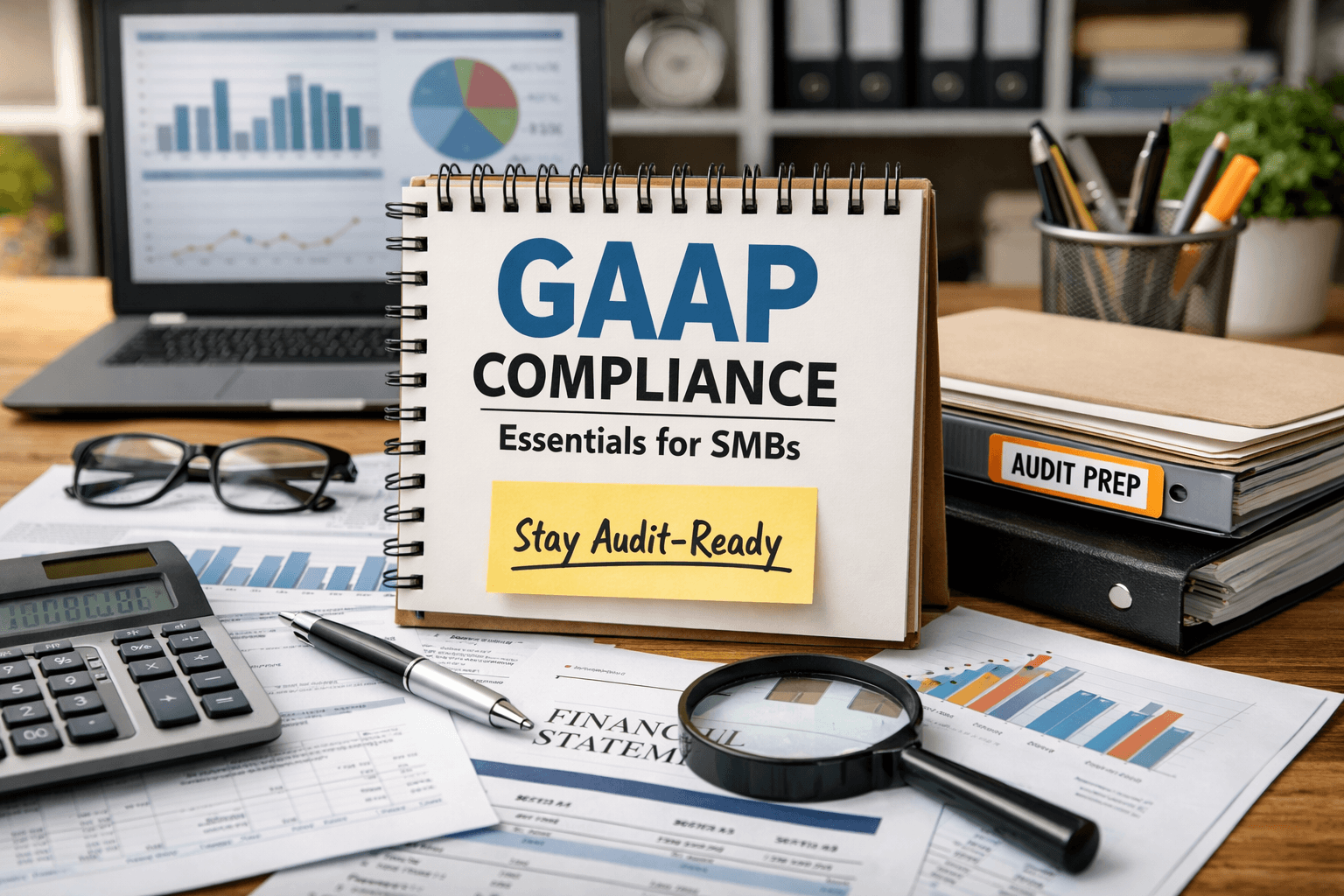
GAAP Compliance Essentials for SMBs:
Stay Audit-Ready
GAAP Compliance is the systematic adoption of Generally Accepted Accounting Principles to ensure your financial statements are accurate, comparable, and audit-ready—think of it as the gold standard that transforms messy books into investor-ready financials.
Here’s what keeps me up at night: watching brilliant business owners with game-changing products lose funding opportunities because their books look like a teenager’s bedroom. After 15+ years guiding companies through financial transformation, I’ve seen the exact moment when clean, GAAP-compliant financials unlock doors that seemed permanently closed. You don’t need a Fortune 500 accounting department to get this right—you need the right framework and someone to show you the shortcut.
What is GAAP compliance and how do you get it right?
- GAAP Compliance means adopting standardized U.S. accounting rules for consistent, transparent financial reporting that builds credibility with lenders, investors, and regulators
- It requires accrual-based accounting where you record revenue when earned and expenses when incurred—not when cash changes hands
- You’ll need documented internal controls that separate who records, reviews, and approves transactions to prevent errors and fraud
- Success demands consistent application of accounting methods year-over-year so financial comparisons actually mean something
- The payoff is immediate: better loan terms, smoother audits, and financial statements that tell your real business story
What Does GAAP Compliance Really Mean for Your SMB?
Let me paint you a picture: You’re sitting across from a potential investor who’s ready to write a seven-figure check. They ask for your financials, and suddenly you’re scrambling to explain why your revenue looks different every month or why your expenses don’t match your income periods. That’s the nightmare GAAP Compliance prevents.
At its core, adopting US GAAP means following standardized accounting rules that make your financial statements speak the same language as every other professionally-run business. Unlike larger corporations that face legal mandates, SMBs enjoy flexibility in implementation pace—you don’t have to transform overnight. What matters is that you’re building financial credibility brick by brick.
The credibility advantage is real and measurable. Research shows that 80% of early-stage companies lack a dedicated CFO, yet those who implement GAAP accounting standards attract better loan terms and equity partners despite this gap. Banks and investors see GAAP-ready financials as a signal of professional management, even from a two-person startup.
Your practical reality might include resource constraints, but phased implementation focused on your industry’s specific principles works beautifully. Start with the basics that matter most to your stakeholders, then layer in sophistication as you grow.
The 5 Steps to GAAP Compliance for SMBs
Implement US GAAP internal controls
GAAP internal controls aren’t just bureaucratic red tape—they’re your early warning system for financial problems. Start by establishing separation of duties to reduce fraud risk and detect errors before they compound. Even with a small team, you can cross-check critical functions by assigning different people to record transactions, reconcile accounts, and approve payments.
Document your workflows meticulously. Every approval process and reconciliation procedure needs a paper trail that auditors can follow. Think of it as creating a financial GPS that shows exactly how each dollar moves through your business. Assign clear ownership for bank reconciliations, accrual adjustments, and month-end close tasks—accountability prevents things from falling through cracks.
Master GAAP accounting standards and core principles
The foundation of GAAP financial statements rests on four non-negotiable principles that transform chaotic records into credible reports:
Accrual basis accounting means recording revenue when you earn it and expenses when you incur them—not when payment happens. If you deliver services in December but get paid in January, December gets the revenue credit. This principle alone eliminates the feast-or-famine appearance that plagues cash-based books.
The matching principle requires aligning expenses to the revenue period they generate. Spent $10,000 on a marketing campaign in March that brings customers through June? Spread that cost across the benefit period. The consistency principle demands using the same methods year-over-year so comparisons actually mean something. Choose your depreciation method and stick with it.
Finally, full disclosure means documenting assumptions, policy changes, and material items in financial statement footnotes. Transparency builds trust faster than perfection.
Upgrade your chart of accounts for GAAP financial statements
Your chart of accounts is the backbone of GAAP bookkeeping practices. Redesign your account structure to reflect GAAP categories including accruals, deferrals, and deferred revenue accounts. This isn’t just reorganization—it’s building a framework that scales.
Separate current and non-current assets and liabilities so balance sheets follow standard formatting that lenders expect. Create distinct accounts for operating versus non-operating items, allowing stakeholders to see your true operational performance without one-time windfalls or disasters clouding the picture.
Establish a formal close process
A rock-solid close process separates audit-ready companies from those who scramble every quarter. Create detailed monthly, quarterly, and annual close checklists that leave nothing to memory or chance. Following steps to prepare GAAP-compliant financial statements consistently is what builds credibility.
Assign owners and hard deadlines for every task: bank reconciliation by day 3, accrual posting by day 5, depreciation adjustments by day 7. Document each step so thoroughly that someone new could execute your close process without asking questions. This documentation becomes invaluable during audits when you need to demonstrate control and consistency.
Maintain clear policies for GAAP revenue recognition
Revenue recognition trips up more companies than any other accounting area. According to Audit Analytics, revenue recognition issues topped the list of financial restatement causes for three consecutive years following the rollout of ASC 606. Don’t become a statistic.
Write down exactly when you recognize revenue—upfront for products, over time for services, at specific milestones for projects. Clarify handling of deferred income, subscription renewals, and partial refunds. Document your accrual methods for bonuses, commissions, and contingent expenses. Train your entire team on these rules because auditors verify revenue recognition first and scrutinize it hardest.
Audit-ready… or just hoping? Let Complete Controller clean up your books, lock in GAAP compliance, and give you numbers you can stand behind.
Building GAAP Compliance: Core Principles Every SMB Needs
Understanding GAAP vs. IFRS for your business model
The choice between GAAP vs IFRS isn’t academic—it’s strategic. GAAP serves U.S.-focused businesses while GAAP vs IFRS International Financial Reporting Standards dominate globally. If you operate or plan to raise capital in the U.S., GAAP is your clear path.
Switching between them later proves costly and complex, requiring complete financial restatement. I’ve watched companies spend $75,000 and six months converting from IFRS to GAAP when U.S. investors knocked on their door. Choose early based on where you’ll grow, not where you are today.
GAAP audit requirements and what auditors actually check
Understanding GAAP audit requirements removes the mystery and fear from the audit process. External auditors focus on three core areas: your internal controls, reconciliation accuracy, and documentation completeness.
They’ll test revenue transactions against GAAP revenue recognition standards, particularly the five-step model under ASC 606. They reconcile your chart of accounts to supporting schedules and bank statements, looking for unexplained variances. Most importantly, they evaluate whether your documented policies match your actual practices. Having clear policies and organized records can cut audit time—and fees—by 40%.
GAAP bookkeeping practices that save time and headaches
Smart GAAP bookkeeping practices prevent problems rather than fixing them. Post transactions daily or weekly instead of cramming everything at month-end—you’ll spot errors while details remain fresh. Data shows manual entry has error rates 100 times higher than automated systems, making the case for modern accounting software overwhelming.
Reconcile bank accounts before closing the books and resolve all outstanding items immediately. Track accruals for wages, taxes, and subscriptions in real-time so period-end surprises vanish. Always use detailed journal entry references linking back to source documents—your future self will thank you during the next audit.
GAAP compliance requirements for private companies
Here’s what surprises many SMB owners: GAAP compliance requirements for private companies aren’t legally mandated unless specific stakeholders demand them. However, “specific stakeholders” includes virtually everyone who matters—SBA lenders, venture capitalists, potential acquirers, and sophisticated vendors all expect GAAP-compliant financials.
Building compliance early gives you a six-month head start instead of a last-minute scramble when opportunity knocks. One SaaS startup I know delayed their Series A by four months while converting to GAAP, burning an extra $350,000 in runway. That money could have funded two additional engineers or a year of marketing—all because they thought GAAP could wait.
GAAP Compliance Checklist: Your Audit-Ready Roadmap
Essential GAAP Compliance Checklist for Startups and Early-Stage SMBs
Print this GAAP compliance checklist and pin it next to your desk—these fundamentals will save you from expensive mistakes:
☐ Separate personal and business finances completely (no exceptions, ever)☐ Choose accrual accounting and commit fully—no mixing with cash basis
☐ Document your revenue recognition policy in writing and train your team
☐ Establish a monthly close calendar with assigned owners and firm deadlines
☐ Reconcile all balance sheet accounts: cash, AR, inventory, credit cards, loans
☐ Post all accruals and adjustments before generating financial statements
☐ Review financials for reasonableness before sharing externally
This isn’t busywork—it’s building a financial foundation that supports growth rather than constraining it.
Common GAAP Compliance Mistakes and How to Avoid Them
Revenue recognition errors that auditors flag
Revenue recognition mistakes cost companies millions in restatements and lost credibility. The most common error? Recording revenue too early—before delivery, customer acceptance, or contract finality. One e-commerce company I encountered showed inflated Q4 profits using cash accounting, hiding losses in other quarters. Their eventual restatement led to a 40% valuation haircut during fundraising.
Prevention strategy: Document ASC 606 compliance for each revenue stream. Train everyone who touches sales contracts on timing rules. When in doubt, recognize revenue later rather than earlier—conservative accounting beats aggressive accounting every time.
Missing or weak GAAP internal controls
Weak GAAP internal controls create vulnerabilities that compound over time. The classic mistake is having one person record, approve, and reconcile transactions—a recipe for undetected errors or worse. Without written workflows, institutional knowledge walks out the door with departing employees.
Prevention strategy: Create a simple control matrix assigning an owner, reviewer, and deadline for every close task. Even with three employees, you can separate duties effectively. The goal isn’t perfection—it’s creating enough checks and balances that errors surface quickly.
Best Practices for Maintaining GAAP Compliance Year-Round
GAAP compliance software for financial reporting and automation
GAAP compliance software transforms compliance from a burden into a competitive advantage. Cloud platforms like QuickBooks Online Plus, NetSuite, and Xero offer built-in accrual features and automatic audit trails. Considering that businesses overpay $11 billion annually in taxes due to accounting errors, the ROI on proper software is immediate.
Automation cuts manual work and virtually eliminates data entry errors. Real-time reconciliation modules flag mismatches immediately instead of surprising you at month-end. Most critically, audit-trail functionality shows who made changes, when, and why—giving auditors the transparency they crave.
How to ensure GAAP compliance without a full accounting team
You don’t need a full accounting department to maintain how to ensure GAAP compliance for small businesses. Partner with a fractional controller or outsourced accounting firm for strategic oversight without the full-time cost. A part-time bookkeeper trained in GAAP basics can handle daily posting and reconciliation at a fraction of CFO salary.
Use templates and checklists religiously—consistency matters more than credentials. Schedule quarterly reviews with your accountant to catch any drift before year-end. The goal is building a system that runs smoothly whether you’re in the office or on vacation.
Conclusion
GAAP compliance isn’t about following rules for the sake of bureaucracy—it’s about building financial infrastructure that supports your ambitions. Whether you’re seeking your first bank loan or preparing for a nine-figure exit, GAAP-compliant financials open doors that sloppy books slam shut.
Start where you are with what you have. Pick one principle from this guide and implement it this week. Build momentum with small wins: reconcile one account daily, document one policy, automate one manual process. Before you know it, you’ll have financial statements that tell your true business story with clarity and credibility.
Remember, the companies that win aren’t necessarily the ones with the best products—they’re the ones whose financials inspire confidence when opportunity knocks. Ready to transform your financial foundation? The team that pioneered cloud-based bookkeeping and controller services is waiting to guide your journey at Complete Controller.
Frequently Asked Questions About GAAP Compliance
Is GAAP compliance legally required for my small business?
Private companies aren’t legally required to follow GAAP unless specific stakeholders demand it—but those stakeholders include banks, investors, and many vendors. While you won’t face jail time for using cash accounting, you’ll face closed doors when seeking capital or credit. Most SBA loans, venture capital rounds, and acquisition processes require GAAP-compliant audited financials.
How much does it cost to become GAAP compliant?
Initial implementation typically costs $5,000-$25,000 depending on your current state and transaction volume. This includes chart of accounts redesign, policy documentation, and staff training. Ongoing compliance adds roughly 10-20% to your current bookkeeping costs but saves multiples of that through better financial decisions and avoided restatement costs.
Can I use QuickBooks for GAAP compliance?
Absolutely—QuickBooks Online Plus and Advanced versions include accrual accounting, automated reconciliation, and audit trail features that support GAAP compliance. The key is proper setup and consistent use of these features. Many companies successfully pass audits using QuickBooks as their primary accounting system when configured correctly.
How long does it take to convert from cash to GAAP accounting?
A typical conversion takes 30-90 days depending on your transaction volume and historical record quality. The process includes restating 1-2 years of financials, documenting accounting policies, and training staff on new procedures. Starting mid-year often proves easier than waiting for year-end when everyone is busy.
What happens if auditors find GAAP compliance issues?
Auditors classify issues by severity. Minor issues might require footnote disclosures or policy adjustments going forward. Material issues could force financial restatement, delayed funding rounds, or loan covenant violations. The good news: auditors want you to succeed and will often provide specific guidance on fixing problems before issuing their final report.
Sources
- Paro. (2024). Mastering GAAP Compliance for SMBs: A Comprehensive Guide. https://paro.ai/resources/gaap-compliance-small-business/
- Asnani CPA. (2024). GAAP vs. Cash Accounting for Startups: The $50K Mistake That Costs You VC Investment. https://www.asnanicpa.com/post/gaap-vs-cash-accounting-for-startups-the-50k-mistake-that-costs-you-vc-investment
- Audit Analytics. (2020). 2020 Financial Restatements: A Twenty-Year Review. https://www.auditanalytics.com/doc/2020FinancialRestatementsATwenty-Year_Review.pdf
- Bay Area Accounting Solutions. (2024). Why Bookkeeping Errors Cost Small Businesses Thousands. https://bayareaaccountingsolutions.com/why-bookkeeping-errors-cost-small-businesses-thousands/
- DocuClipper. (2025). 67 Data Entry Statistics For 2025. https://www.docuclipper.com/blog/data-entry-statistics/
- Complete Controller. Accounting Outsourcing Economics. https://www.completecontroller.com/accounting-outsourcing-economics/
- Complete Controller. Importance of Reconciling Your Accounting Statements Regularly. https://www.completecontroller.com/importance-of-reconciling-your-accounting-statements-regularly/
- Complete Controller. Accounting Cycle Closure. https://www.completecontroller.com/accounting-cycle-closure/
- Wikipedia. ASC 606. https://en.wikipedia.org/wiki/ASC_606
- Wikipedia. International Financial Reporting Standards. https://en.wikipedia.org/wiki/InternationalFinancialReporting_Standards
- AICPA. Understanding an Audit of Your Financial Statements. https://www.aicpa.org/resources/article/understanding-an-audit-of-your-financial-statements