


Financial ERP System Integration:
How to Connect Your Finance Stack the Right Way
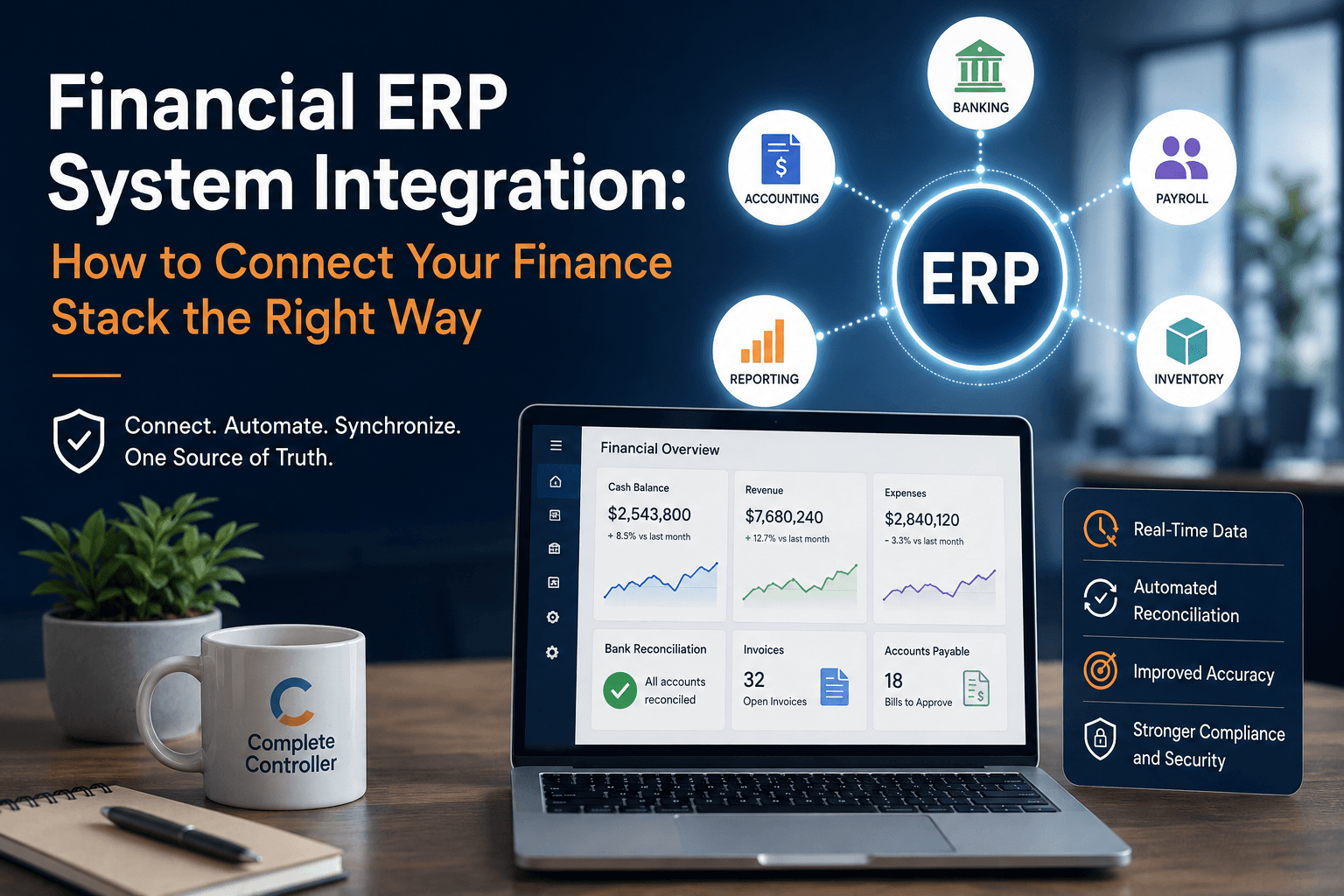
Financial ERP system integration is the process of connecting your enterprise resource planning software with your accounting, banking, payroll, and reporting tools so financial data flows automatically—accurately, securely, and in real time—across your entire business.
Here’s what nobody tells you: most businesses don’t have a data problem. They have a disconnection problem. Your numbers live in five different systems that don’t talk to each other, and every month someone on your team plays translator—copying, pasting, and praying nothing breaks. I’ve spent over two decades helping business owners escape that trap, and I can tell you this with confidence: integration isn’t a luxury for big corporations anymore. It’s the foundation of a financially healthy business at any size.
What is financial ERP system integration and how do you get it right?
- Financial ERP system integration connects your ERP with accounting, banking, and reporting tools through APIs or middleware, enabling real-time financial data, automated reconciliation, and a single source of truth.
- APIs and middleware act as the connective tissue, syncing transactions between systems without manual entry.
- Data synchronization ensures every platform reflects the same numbers at the same time—no more version confusion.
- Security and compliance must be built into the integration from day one, not bolted on later.
- A phased rollout—map, migrate, test, then automate—beats a big-bang launch every time.

Why Disconnected Financial Systems Are Costing You More Than You Think
Every hour your team spends rekeying data is an hour stolen from strategy. Manual data entry doesn’t just waste time—it introduces errors that compound. Research consistently shows manual data entry error rates hover around 1–4%, and when those errors land in your general ledger, they ripple through every report you make decisions on.
The real cost isn’t the typo. It’s the decision you made based on the typo.
This is why the shift toward accounting systems integration matters so much. Moving from spreadsheets to connected platforms isn’t about chasing shiny technology—it’s about trusting your numbers. If you’re still living in spreadsheet land, my team wrote about making that leap in our guide on accounting systems integration.
Once you understand what disconnection costs, the next question is obvious: how do these systems actually connect?
How Financial ERP Integration Actually Works
At its core, ERP system integration relies on three building blocks working together.
APIs: The direct line
An API integration (application programming interface) lets two systems exchange data directly. When your payment processor records a sale, a finance ERP API can push that transaction into your ERP instantly—no human required.
Middleware: The translator
Middleware integration sits between systems that don’t natively speak the same language. Think of it as a skilled interpreter handling enterprise application integration across your whole stack—ERP, CRM, payroll, inventory.
Data synchronization: The heartbeat
Data synchronization keeps every connected system aligned. Whether it syncs in real time or on a schedule, the goal is the same: one version of the truth, everywhere, always.
With the mechanics clear, let’s talk about what you actually gain—because this is where integration earns its keep.
Connect your financial systems and your strategy with Complete Controller’s expert bookkeeping, real-time reporting, and smarter financial oversight.
The Payoff: Finance Automation and Real-Time Reporting
When your systems connect, finance automation takes over the repetitive work your team never loved anyway. Invoices post themselves. Bank feeds flow in automatically. Reports build from live data instead of last month’s export. This is the same transformation we champion in our work on finance automation—technology handling the grunt work so humans can handle the thinking.
The reporting upside is just as powerful. Real-time financial data means you’re steering your business by the windshield, not the rearview mirror. And standardized, structured data isn’t just convenient—it’s the direction regulators are heading. The SEC’s push toward integrated financial reporting through structured data shows exactly why consistent, machine-readable financial information is becoming the standard, not the exception.
Automated reconciliation: The quiet hero
Here’s my favorite benefit, and the one clients thank me for most. After integration, automated reconciliation matches transactions across systems continuously—flagging discrepancies the moment they appear instead of during a frantic month-end scramble. Companies with strong reconciliation practices routinely cut their financial close time by days. That’s not efficiency for efficiency’s sake. That’s faster answers to the questions that actually matter.
Of course, connecting financial systems means moving sensitive data—which brings us to the part too many businesses rush past.
Security and Compliance: Non-Negotiables in Financial Integration
I’ll be blunt: an integration without security planning is a liability with a nice dashboard. Your financial data is among your most sensitive assets, and every connection point is a potential doorway.
Secure financial integration starts with a framework, and the secure financial integration guidance from NIST is the gold standard—helping you identify risks, protect data, detect threats, and plan your response before you need one.
Build these into your integration from the start:
- Role-based access controls so people only see what their job requires
- Encryption for data in transit and at rest
- Audit trails that log every change and every user
- Vendor vetting for any third-party integration tool touching your books
If your ERP lives in the cloud—and increasingly, it should—architecture matters even more. CISA’s technical reference for ERP cloud integration offers authoritative guidance on designing cloud environments that are both connected and protected. As the pioneer of cloud-based bookkeeping, I’ve watched cloud security mature from an afterthought into a genuine competitive advantage for the businesses that take it seriously.
Security handled, there’s one more piece: doing the migration itself without breaking everything.
Your Roadmap: How to Execute Financial Data Migration Without the Chaos
Financial data migration fails when businesses treat it like flipping a switch. Treat it like a relay race instead—each phase hands off cleanly to the next.
- Map your data. Document every system, every field, and where each piece of financial data lives today.
- Clean before you move. Migrating messy data just gives you faster access to bad numbers.
- Migrate in stages. Start with historical data, validate it, then move to live transactions.
- Test with parallel runs. Run old and new systems side by side for at least one full close cycle.
- Automate and monitor. Turn on automation gradually, watching for sync errors as volume grows.
Businesses that follow a phased approach dramatically reduce go-live failures—and studies of ERP projects show that inadequate planning and testing are among the top reasons implementations miss budget and timeline targets. Don’t be that statistic. If your team lacks the bandwidth, ERP integration services or an outsourced controller team can carry the technical load while you run your business.
The Bottom Line on Financial ERP System Integration
Financial ERP system integration transforms scattered tools into one intelligent financial engine—cutting errors, accelerating your close, strengthening security, and putting real-time numbers at your fingertips. The businesses that thrive in the next decade won’t be the ones with the most software. They’ll be the ones whose software works together.
You don’t have to figure this out alone. My team at Complete Controller pioneered cloud-based bookkeeping and controller services, and we’ve guided thousands of businesses through exactly this kind of transformation. Come see what connected, confident finances feel like.

Frequently Asked Questions About Financial ERP System Integration
What is financial ERP system integration?
It’s the process of connecting your ERP software with accounting, banking, payroll, and reporting systems so financial data flows automatically between them—eliminating manual entry and creating a single source of truth.
How long does ERP integration take?
Most small-to-midsize integrations take one to three months, depending on data complexity, the number of systems, and how clean your existing data is. Phased rollouts take longer but fail far less often.
Is API integration or middleware better for connecting financial systems?
APIs are ideal for direct, real-time connections between two modern systems. Middleware works better when you’re connecting multiple systems or older software without native APIs. Many businesses use both.
How do I keep financial data secure during ERP integration?
Use encryption in transit and at rest, enforce role-based access controls, maintain audit trails, and follow established frameworks like the NIST Cybersecurity Framework when designing your integration.
Can small businesses benefit from ERP integration, or is it only for large companies?
Absolutely—small businesses often see the biggest relative gains because they’re losing proportionally more time to manual work. Cloud-based tools have made integration affordable at nearly any size.
Sources
- CompleteController. Accounting Innovations and Trends. https://www.completecontroller.com/accounting-innovations-trends/
- CompleteController. The Importance of Reconciling Your Accounting Statements Regularly. https://www.completecontroller.com/importance-of-reconciling-your-accounting-statements-regularly/
- CompleteController. From Spreadsheets to CRMs. https://www.completecontroller.com/from-spreadsheets-to-crms/
- National Institute of Standards and Technology (NIST). Cybersecurity Framework. https://www.nist.gov/cyberframework
- U.S. Securities and Exchange Commission (SEC). Structured Data. https://www.sec.gov/structureddata
- Cybersecurity and Infrastructure Security Agency (CISA). Cloud Security Technical Reference Architecture. https://www.cisa.gov/resources-tools/resources/cloud-security-technical-reference-architecture
 About Complete Controller® – America’s Bookkeeping Experts Complete Controller is the Nation’s Leader in virtual bookkeeping, providing service to businesses and households alike. Utilizing Complete Controller’s technology, clients gain access to a cloud platform where their QuickBooks™️ file, critical financial documents, and back-office tools are hosted in an efficient SSO environment. Complete Controller’s team of certified US-based accounting professionals provide bookkeeping, record storage, performance reporting, and controller services including training, cash-flow management, budgeting and forecasting, process and controls advisement, and bill-pay. With flat-rate service plans, Complete Controller is the most cost-effective expert accounting solution for business, family-office, trusts, and households of any size or complexity.



 Brittany McMillen
Brittany McMillen
Brittany McMillen