


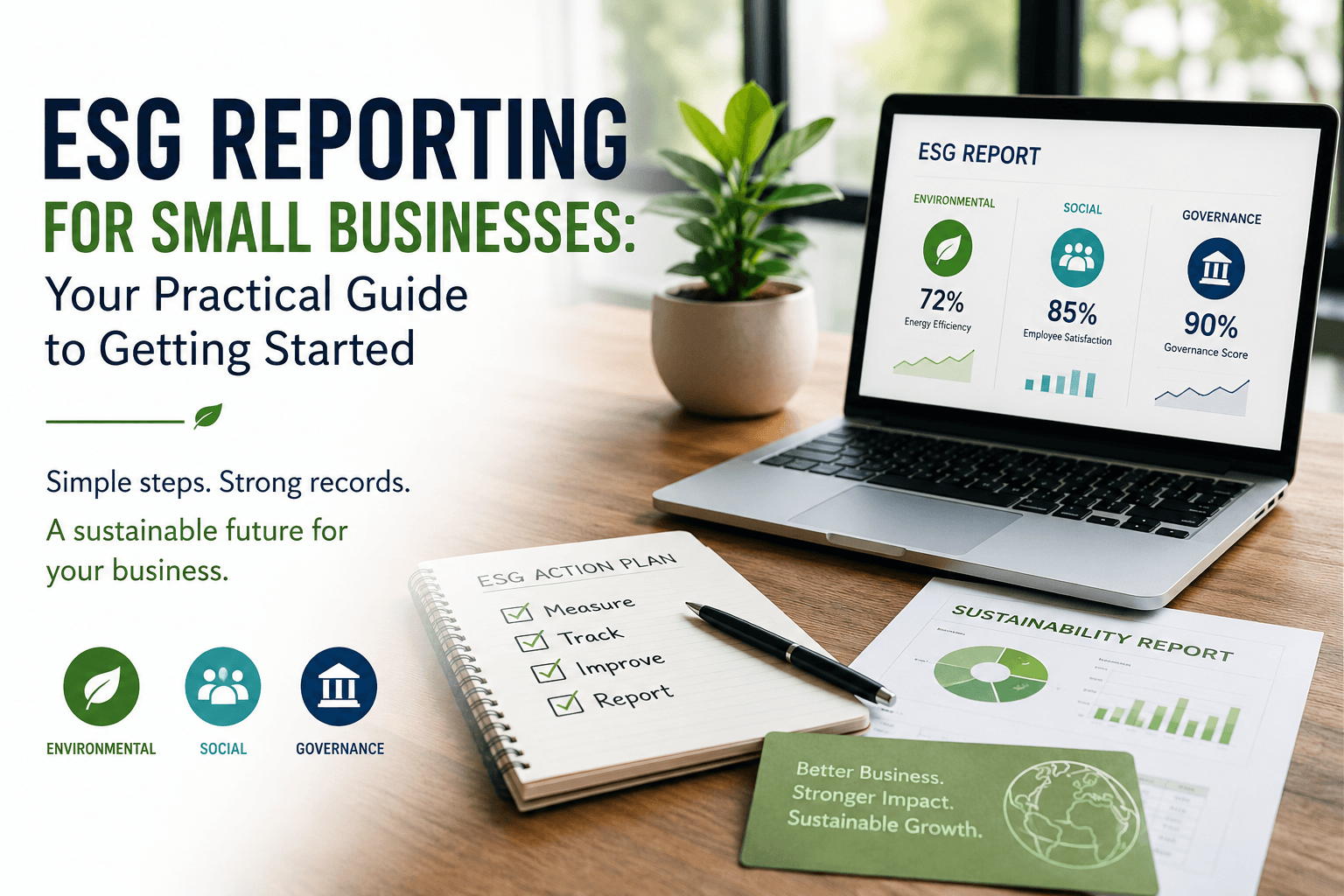
ESG Reporting for Small Businesses:
Your Practical Guide to Getting Started
ESG reporting for small businesses is the process of measuring and sharing your company’s environmental, social, and governance performance—and you can start today by tracking just three things: your energy use, your workplace practices, and how decisions get made in your company.
Here’s what nobody tells you: the small businesses that figure this out early aren’t just checking a compliance box. They’re winning contracts, attracting investors, and building trust while their competitors scramble to catch up. I’ve spent over two decades helping small business owners get their financial houses in order, and I can tell you—ESG reporting follows the same rule as bookkeeping. The businesses that treat it as a strategy, not a chore, come out ahead every single time.
What is ESG reporting for small businesses and how do you get it right?
- Quick answer: ESG reporting means documenting your environmental impact, social practices, and governance structure, and you get it right by starting small, using recognized frameworks, and building on accurate records.
- Environmental covers your energy consumption, waste, emissions, and resource use—measurable data you likely already have in your utility bills.
- Social includes how you treat employees, engage your community, and manage your supply chain relationships.
- Governance addresses how your business makes decisions, manages risk, and maintains ethical standards.
- Getting it right means choosing metrics that matter to your stakeholders, not copying what a Fortune 500 company publishes.

Why ESG Reporting Matters for Small Businesses Right Now
The regulatory ground is shifting fast, and small businesses are no longer on the sidelines. The EU estimates about 50,000 companies will fall under the Corporate Sustainability Reporting Directive (CSRD)—up from roughly 11,700 under the older NFRD rules. That’s more than a fourfold increase, and while many small businesses aren’t directly covered yet, the ripple effects reach everyone.
Here’s how the pressure flows downhill: big companies covered by these rules must report on their supply chains. That means their suppliers—often small businesses like yours—get asked for ESG data. Ignore the request, and you risk losing the contract.
Real-world example: The unilever effect
Unilever’s Responsible Sourcing Policy states it will only do business with suppliers who meet the policy’s requirements. Read that again. A small manufacturer supplying a Unilever brand doesn’t get a pass because of its size. ESG standards became a condition of keeping the customer. This is happening across retail, manufacturing, food service, and tech—and it’s exactly why sustainability disclosures are becoming table stakes for small companies that sell to bigger ones.
How ESG Reporting Helps Small Businesses Win Funding and Customers
Let’s talk upside, because this isn’t all pressure—there’s real opportunity here. In PwC’s 2022 Global Investor Survey, 79% of investors said they consider how a company manages ESG risks and opportunities when making investment decisions. If you’re seeking capital, a clean ESG story is a competitive advantage.
Transparency around climate risk disclosure is also becoming a baseline expectation for lenders and institutional partners, not just publicly traded giants. And customers? They increasingly vote with their wallets for businesses whose values they trust. Your ESG report becomes marketing material, investor collateral, and a trust signal—all in one document.
The takeaway: ESG reporting isn’t overhead. It’s an asset you build once and leverage everywhere.
Building the Foundation: Get Your Records Right First
Before you write a single line of a sustainability report, your underlying data needs to be solid. This is where my bookkeeping heart gets excited, because ESG reporting lives or dies on record quality. Utility costs, payroll data, vendor spending, insurance, and compliance records—these all feed your ESG metrics.
If your books are messy, your ESG data will be too. Strong financial records make ESG reporting for small business dramatically easier because the numbers you need are already organized, categorized, and verifiable. Auditors and stakeholders don’t just want claims—they want evidence. Your accounting system is that evidence.
What to organize before you start
- Gather twelve months of utility and fuel records to establish your environmental baseline.
- Document your HR policies—hiring practices, pay equity, benefits, and safety records.
- Map your governance structure, even if it’s simple. Who makes decisions? How are conflicts handled?
- List your major suppliers and note any sustainability information you have about them.
The order matters here. Environmental data takes the longest to compile, so start there.
Good ESG reporting starts with good bookkeeping. See how Complete Controller helps you build financial records you can actually trust.
Choosing a Framework: How to Do ESG Reporting for SMEs
You don’t need to invent your own reporting structure—recognized frameworks exist, and using one instantly boosts your credibility. The GRI standards are the most widely used sustainability reporting standards in the world, and they offer guidance that scales down to smaller organizations. Starting with a recognized framework means your report speaks the same language as your big customers and potential investors.
For the environmental piece, understanding what a formal environmental impact assessment involves—even if you’re not legally required to produce one—teaches you what measurable, defensible environmental data looks like.
The workflow side matters just as much as the framework. Knowing how to do ESG reporting for SMEs really comes down to building repeatable data collection habits into your existing accounting and operations rhythm—monthly, not annually. Trust me on this: businesses that scramble once a year produce weak reports. Businesses that collect as they go produce strong ones without breaking a sweat.
Tools and Systems That Simplify ESG Reporting for Startups
Here’s where I challenge the old-school thinking: you do not need expensive consultants or enterprise software to produce a credible first report. You need clean digital systems and a little discipline.
Cloud-based document management is your best friend here. Going digital with your records helps simplify ESG reporting for startups in two ways—it reduces your own paper waste (an ESG win itself!) and it makes every data point searchable and shareable when a customer or investor asks for proof.
Your first report, simplified
Keep version one short and honest. A strong starter report includes your environmental baseline, two or three social metrics, a plain-language description of your governance, and one or two improvement goals for next year. Stakeholder engagement doesn’t require a summit—a simple survey of your customers, employees, and key vendors tells you which ESG topics they actually care about, so you report on what matters instead of everything under the sun.
Common Mistakes Small Businesses Make with ESG Reporting
I’ve watched businesses stumble on the same avoidable traps, so let me save you the trouble. Greenwashing is the fastest way to destroy trust—never claim more than your data supports. Vague statements like “we care about the planet” without numbers behind them do more harm than good.
The second big mistake is treating ESG as a one-time project. Corporate governance reporting and social impact reporting gain their power through consistency—year-over-year comparisons show progress, and progress is the story stakeholders want. The third? Perfectionism. A modest, accurate report published this year beats a flawless report that never ships.
Your ESG Reporting Journey Starts with Good Records
ESG reporting for small businesses isn’t a burden reserved for corporate giants—it’s a growth tool hiding in plain sight. Start with solid records, choose a recognized framework, collect data monthly, and report honestly. The regulations are expanding, investors are watching, and your biggest customers are already asking. The businesses that act now will own the advantage.
You don’t have to build this alone. The team at Complete Controller—the pioneers of cloud-based bookkeeping and controller services—can help you build the accurate, organized financial foundation that makes ESG reporting straightforward instead of stressful. Your books are your evidence. Let’s make them bulletproof.

Frequently Asked Questions About ESG Reporting for Small Businesses
Are small businesses legally required to do ESG reporting?
Most small businesses aren’t directly required yet, but regulations like the EU’s CSRD are expanding coverage, and large customers increasingly require ESG data from their suppliers—making it practically necessary even when it’s not legally mandated.
How much does ESG reporting cost for a small business?
It can cost very little if you start simple. Using free frameworks like GRI, your existing accounting records, and cloud-based document systems, many small businesses produce their first report in-house with minimal expense.
What ESG metrics should a small business track first?
Start with energy use and emissions from utility bills, employee metrics like turnover and safety incidents, and a basic description of your governance and decision-making structure.
How long does it take to create a first ESG report?
With organized financial records, most small businesses can compile a baseline report in one to three months. Messy records can double that timeline, which is why clean bookkeeping comes first.
Can ESG reporting actually help me win customers?
Yes. Large companies like Unilever require suppliers to meet responsible sourcing standards, and 79% of investors consider ESG management in their decisions—so credible reporting opens doors that stay closed to businesses without it.
Sources
- European Commission. (April 21, 2021). Corporate Sustainability Reporting. https://finance.ec.europa.eu/capital-markets-union-and-financial-markets/company-reporting-and-auditing/company-reporting/corporate-sustainability-reporting_en
- PwC. (October 12, 2022). 2022 Global Investor Survey. https://www.pwc.com/gx/en/services/audit-assurance/publications/investor-survey.html
- Unilever. (2023). Responsible Sourcing Policy. https://www.unilever.com/suppliers/responsible-sourcing-policy/
- Global Reporting Initiative. GRI Standards. https://www.globalreporting.org/standards/
- U.S. Environmental Protection Agency. What is an Environmental Impact Statement. https://www.epa.gov/nepa/what-environmental-impact-statement
- U.S. Commodity Futures Trading Commission. Climate Risk Subcommittee Report. https://www.cftc.gov/LabCFTC/ClimateRiskSubcommitteeReport.html
 About Complete Controller® – America’s Bookkeeping Experts Complete Controller is the Nation’s Leader in virtual bookkeeping, providing service to businesses and households alike. Utilizing Complete Controller’s technology, clients gain access to a cloud platform where their QuickBooks™️ file, critical financial documents, and back-office tools are hosted in an efficient SSO environment. Complete Controller’s team of certified US-based accounting professionals provide bookkeeping, record storage, performance reporting, and controller services including training, cash-flow management, budgeting and forecasting, process and controls advisement, and bill-pay. With flat-rate service plans, Complete Controller is the most cost-effective expert accounting solution for business, family-office, trusts, and households of any size or complexity.



 Brittany McMillen
Brittany McMillen
Brittany McMillen