


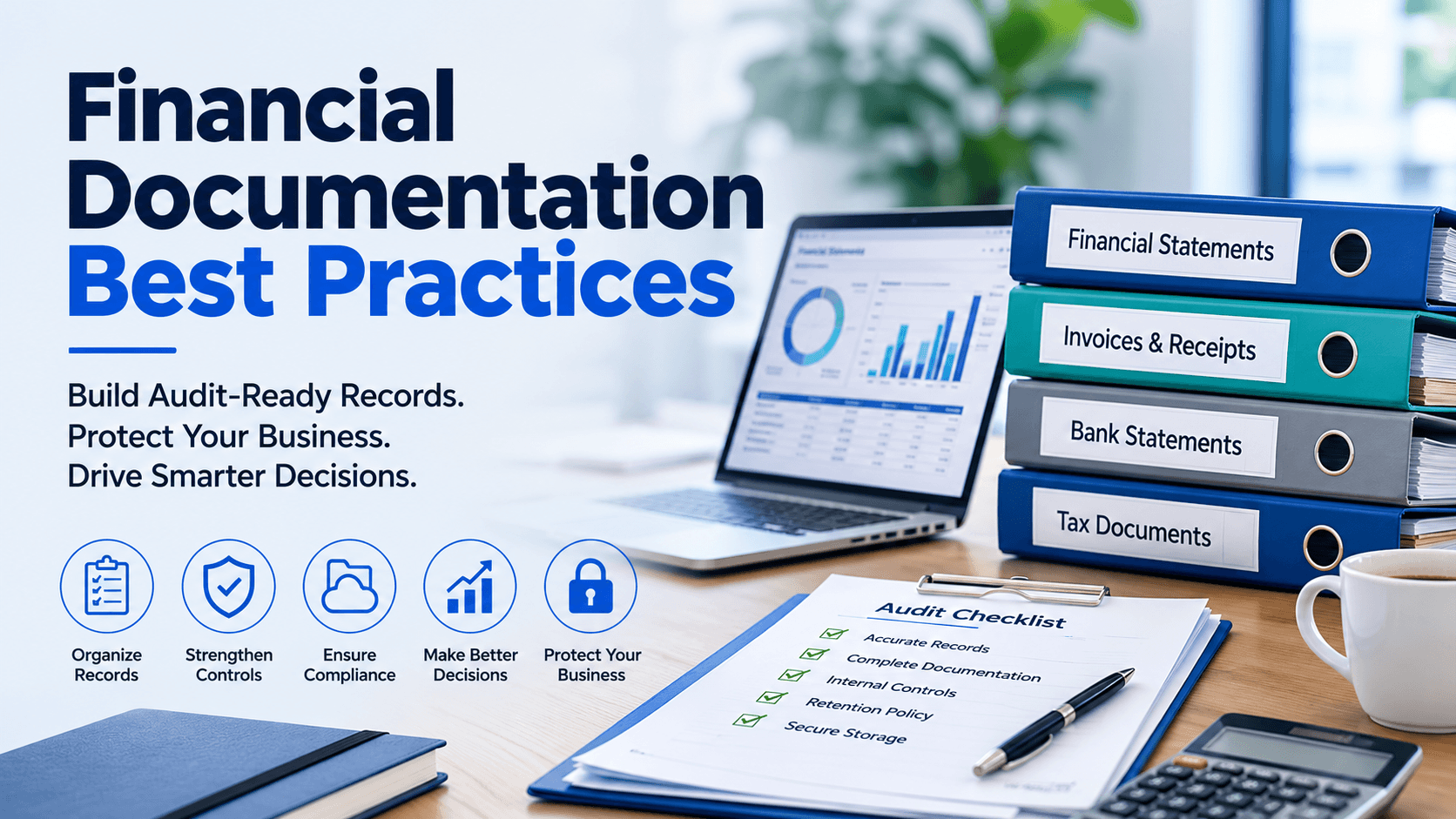
Financial Documentation Best Practices:
How to Build Audit-Ready Records That Protect Your Business
Financial documentation best practices come down to five essentials: standardize your templates, maintain a clear audit trail, document your internal controls, follow a retention schedule, and store everything in a secure digital system. Get those five right, and you’ve built a financial foundation that can survive an audit, satisfy a lender, and support every decision you make.
Here’s what most business owners don’t realize until it’s too late: your documentation is your defense. When the IRS comes calling, when an investor asks for records, or when a dispute lands on your desk, the business with organized, verifiable records wins. The one with a shoebox of receipts and a prayer? That’s the one paying penalties. I’ve spent over two decades helping businesses clean up their financial records, and I can tell you—the pain of building good systems now is nothing compared to the pain of rebuilding them under audit pressure.
What are financial documentation best practices and how do you implement them?
- Financial documentation best practices are standardized methods for creating, organizing, retaining, and securing financial records—implemented through consistent templates, documented internal controls, audit trails, retention policies, and cloud-based storage.
- Standardized templates ensure every invoice, expense report, and reconciliation follows the same format, making records easy to verify.
- Audit trails connect every transaction to its supporting evidence, so anyone can trace a number from your financial statements back to its source.
- Retention policies tell you exactly how long to keep each document type, based on IRS and regulatory requirements.
- Internal controls documentation proves your processes work—and protects you when someone questions them.

Why Financial Documentation Matters More Than You Think
Weak documentation isn’t just messy—it’s expensive. A study of 349 major public companies published in The Accounting Review found that firms with material weaknesses in internal controls had more complex accounts, more accounting-rule risk, and higher audit fees after those problems were disclosed. Translation: sloppy records cost real money, even after you fix them.
Strong documentation does the opposite. It lowers your audit costs, speeds up financing approvals, and gives you trustworthy numbers for decision-making. When your records are clean, your CPA works faster, your lender says yes sooner, and you sleep better.
The real-world cost of getting it wrong
This isn’t theoretical. In 2011, the SEC charged Kraft Foods for inflating results through improper accounting practices, and the company agreed to pay a $3 million civil penalty. If a corporate giant with entire accounting departments can stumble on documentation and reporting, small businesses without systems are even more exposed. The difference? You can fix this before it becomes a problem.
Build Consistent Bookkeeping Documentation Standards
Every great financial system starts with daily habits. Your bookkeeping documentation standards should answer one question: Could a stranger understand this transaction six months from now?
That means every entry needs a date, an amount, a category, and supporting evidence—a receipt, invoice, or contract. Consistency is the secret ingredient. When your team follows the same bookkeeping documentation standards every single day, errors surface fast and month-end close stops being a fire drill.
Standardized templates save you from chaos
Create standardized financial templates for your most common documents:
- Invoices and credit memos
- Expense reports with receipt attachments
- Journal entry forms with approval fields
- Monthly reconciliation checklists
Templates aren’t bureaucracy—they’re freedom. When formats stay consistent, review time drops and nothing slips through the cracks.
Ready to stop chasing paperwork? Complete Controller helps small businesses build organized, audit-ready financial systems so you can spend less time on documentation and more time growing your business. Learn how Complete Controller can help.
Create Audit Trails That Actually Hold Up
An audit trail is the connective tissue between your financial statements and reality. Every number on your reports should trace back—step by step—to an original document. Regulators take this seriously: the SEC’s guidance on books and records makes clear that maintaining accurate, traceable documentation is a baseline expectation, which is why following audit trail best practices protects you long before an auditor arrives.
Here’s how to build a defensible audit trail, in order:
- Capture the source document at the moment of transaction—not weeks later.
- Link the document to its entry in your accounting system.
- Record who approved it and when.
- Lock prior periods so historical records can’t be quietly changed.
- Review the trail monthly during reconciliation.
That last step matters more than people think. Regular reconciliation is your quality control—it verifies your records against bank statements and creates the financial statement support that auditors and lenders want to see.
Document Your Internal Controls—Yes, in Writing
If your controls only live in someone’s head, they don’t exist. Written internal controls documentation —who approves purchases, who reconciles accounts, who has system access—creates accountability and continuity. The GAO’s internal control standards, considered the gold standard for control frameworks, emphasize that documented control activities are what make accountability provable, not just promised.
For small teams, this doesn’t need to be a 50-page manual. A simple document covering separation of duties, approval thresholds, and reconciliation schedules puts you ahead of most businesses your size. Write down what you do, then do what you wrote down.
Follow Smart Record Retention Guidelines
How long should you keep financial records? Longer than you’d like, but not forever. The IRS says you should keep records supporting your tax return until the period of limitations runs out—generally 3 years, but 6 years if you underreport income by more than 25%, and no limit at all if a fraudulent return is filed.
Because rules vary by document type, build a written retention policy using official financial documentation retention policy guidelines as your foundation. A good rule of thumb: keep tax returns and supporting documents at least seven years, payroll records at least four, and asset records for the life of the asset plus your limitations period.
Go Digital with Financial Document Management
Paper is where documents go to disappear. Modern financial document management means scanning source documents at the point of entry, storing them in secure cloud systems with automatic backups, and using consistent file-naming conventions so retrieval takes seconds—not weekends.
I pioneered cloud-based bookkeeping because I watched too many business owners lose critical records to floods, moves, and plain old misfiling. Digital systems with role-based access don’t just protect your documents—they strengthen your audit trail, since every view and edit gets logged automatically. Security and searchability in one move. That’s the kind of efficiency that turns documentation from a chore into a competitive advantage.
Conclusion: Your Records Are Your Reputation
Financial documentation best practices aren’t busywork—they’re the difference between a business that’s audit-ready and one that’s audit-terrified. Standardize your templates, maintain your audit trail, document your controls, follow your retention schedule, and manage everything digitally. Do those five things consistently, and your records will defend you, inform you, and open doors for you.
You don’t have to build this alone. My team at Complete Controller pioneered cloud-based bookkeeping and controller services, and we’ve helped thousands of businesses turn financial chaos into clarity. Visit us for expert guidance and get your documentation working for you—not against you.

Frequently Asked Questions About Financial Documentation Best Practices
How long should a business keep financial records?
Keep records supporting your tax returns for at least 3 years, or 6 years if income was underreported by more than 25%. Payroll records should be kept at least 4 years, and there’s no time limit if fraud is involved—so when in doubt, keep it longer.
What documents are needed for an audit?
Auditors typically request bank statements, invoices, receipts, contracts, payroll records, reconciliations, and the general ledger. A clear audit trail linking each transaction to its source document speeds the entire process.
What is an audit trail in accounting?
An audit trail is the documented path connecting each financial statement figure back to its original transaction and supporting evidence—including dates, amounts, approvals, and source documents.
Should small businesses document internal controls?
Yes. Even a brief written document covering approval authority, separation of duties, and reconciliation schedules reduces fraud risk, supports audit readiness, and keeps operations consistent when staff changes.
Is digital storage acceptable for financial records?
Yes. The IRS accepts digital records as long as they’re accurate, accessible, and complete. Cloud storage with backups and access controls is often more secure than paper filing.
Sources
- The Accounting Review. (March 2008). Internal Control Weaknesses and Information Uncertainty. Dora I. Beneish, Mary Billings, and Leslie D. Hodder. https://doi.org/10.2308/accr.2008.83.3.665
- SEC Press Release. (April 1, 2011). SEC Charges Kraft Foods Inc. in Accounting Scheme. U.S. Securities and Exchange Commission. https://www.sec.gov/news/press/2011/2011-70.htm
- IRS. (Last reviewed August 2024). How Long Should I Keep Records? Internal Revenue Service. https://www.irs.gov/businesses/small-businesses-self-employed/how-long-should-i-keep-records
- IRS. What Kind of Records Should I Keep? Internal Revenue Service. https://www.irs.gov/businesses/small-businesses-self-employed/what-kind-of-records-should-i-keep
- U.S. Government Accountability Office. Standards for Internal Control in the Federal Government (GAO-14-704G). https://www.gao.gov/products/gao-14-704g
- U.S. Securities and Exchange Commission (Investor.gov). Books and Records. https://www.investor.gov/introduction-investing/investing-basics/glossary/books-and-records
 About Complete Controller® – America’s Bookkeeping Experts Complete Controller is the Nation’s Leader in virtual bookkeeping, providing service to businesses and households alike. Utilizing Complete Controller’s technology, clients gain access to a cloud platform where their QuickBooks™️ file, critical financial documents, and back-office tools are hosted in an efficient SSO environment. Complete Controller’s team of certified US-based accounting professionals provide bookkeeping, record storage, performance reporting, and controller services including training, cash-flow management, budgeting and forecasting, process and controls advisement, and bill-pay. With flat-rate service plans, Complete Controller is the most cost-effective expert accounting solution for business, family-office, trusts, and households of any size or complexity.



 Brittany McMillen
Brittany McMillen
Brittany McMillen