


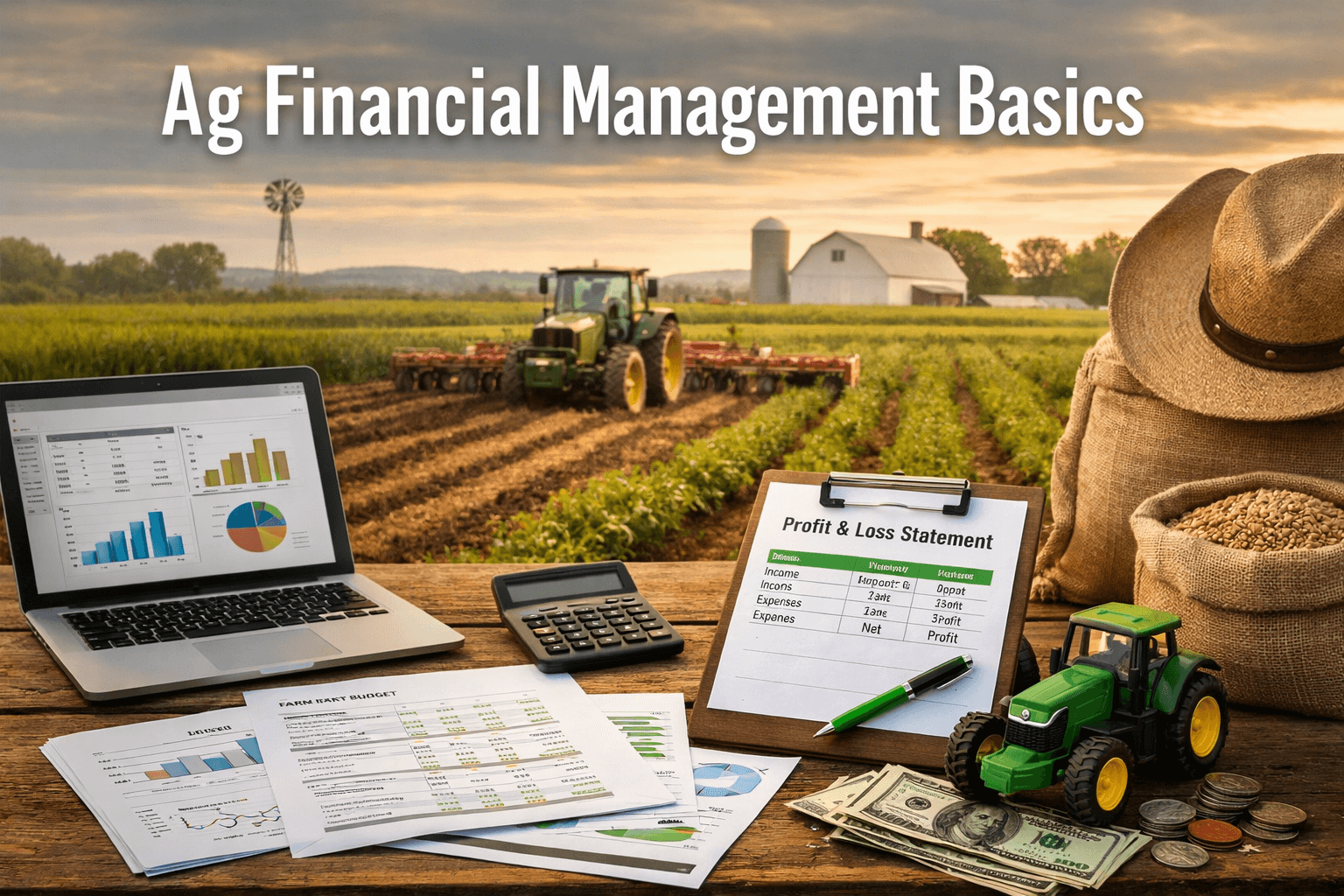
AG Financial Management Basics:
A Practical Guide for Farm Profitability
AG financial management basics are the core practices that help a farm track revenue, control expenses, manage seasonal cash flow, and make profit-focused decisions that support long-term growth. The essentials boil down to four moving parts: a realistic farm budget, reliable recordkeeping, regular cash flow planning, and consistent review of actual results against the plan. Get those right, and your farm has the financial backbone to weather bad seasons, seize good ones, and grow with intention instead of guesswork.
Here’s what I’ve learned in over 20 years leading Complete Controller and partnering with businesses across nearly every industry, including agriculture: farms rarely struggle because owners aren’t working hard enough. They struggle because money moves differently on a farm than almost anywhere else. Seasonal income, weather risk, input price swings, and heavy equipment costs can turn a “profitable” year into a cash shortage fast. In this article, I’ll walk you through the practical foundation, share a few numbers that shocked even me, and give you a rollout plan you can actually use, whether you run 40 acres or 4,000.
What are ag financial management basics and how do you get them right?
- The short answer: AG financial management basics are farm budgeting, recordkeeping, cash flow planning, and financial statement review, applied consistently.
- Budgeting and forecasting turn last year’s records into a realistic plan for income, expenses, and capital needs.
- Agricultural business accounting creates the chart of accounts and reconciliation habits that make your numbers trustworthy.
- Cash flow management solves the timing mismatch between when bills come due and when crops or livestock sell.
- Financial statement analysis shows liquidity, leverage, and profitability so decisions are based on evidence, not gut.

Why AG Financial Management Basics Matter More Than Ever
Farming has always been a numbers game, but the margin for error keeps getting tighter. According to the USDA Economic Research Service, the median farm earned negative income from farming in 2023, with median farm income sitting at -$900 while median off-farm income reached $46,500. That single data point tells you everything about why blending personal finance basics with farm budgeting isn’t optional anymore, it’s survival.
History backs this up too. During the 1980s Farm Crisis, the Federal Reserve’s policy rate peaked near 20% in June 1981, and variable-rate farm loans crushed cash flow across the country. That same lesson applies today: corporate finance fundamentals like debt structure and interest-rate exposure need to be part of every farm’s plan, not an afterthought.
Building the Financial Foundation for AG Financial Management Basics
Every strong farm finance system starts with three habits working together: budgeting, accounting, and tracking. Skip one, and the whole thing wobbles.
Budgeting and forecasting
Budgeting and forecasting tell you what your farm can afford before a single dollar leaves the account. Use prior-year tax returns and records as your baseline, then build both a whole-farm budget and enterprise-level budgets for each product line, corn, cattle, agritourism, whatever mix you run.
- Forecast monthly receipts and payments, not just annual totals
- Include realistic assumptions for yield, price, and input inflation
- Rebuild the forecast when major market or weather shifts happen
Agricultural business accounting
Good agricultural business accounting gives your numbers structure. Set up a chart of accounts that separates crop sales, livestock sales, government payments, custom work, and off-farm income. Split expenses into fixed, variable, and capital categories so you can see what actually drives profit, and reconcile bank accounts every month without exception.
Revenue and expense tracking
Revenue and expense tracking is where planning becomes measurable. Record every sale by date, product, quantity, and price. Track expenses by category and supplier so you can spot the small leaks that quietly eat margin. Then compare actuals to budget monthly and use variance analysis to figure out whether it’s a pricing issue, a volume issue, or a spending habit.
How to Manage Farm Expenses Without Losing Profitability
How to manage farm expenses is one of the most practical parts of AG financial management basics, because profit usually disappears through dozens of small leaks, not one big mistake.
Personal finance basics on the farm
Personal finance basics matter on farms because household and business spending often overlap. Separate your farm and personal bank accounts, set household spending priorities, and pay yourself deliberately so the farm isn’t quietly subsidizing family life. Treat the farm like a business first, even when family runs it. For a practical starting point, these money management tips to avoid a deficit apply beautifully to farm operations.
Corporate finance fundamentals
Corporate finance fundamentals help you think about capital, debt, and returns with discipline. Before buying that new tractor or expanding acreage, compare the expected return against the financing cost. Match debt payment timing to revenue timing, especially in seasonal operations. The 1980s crisis is a permanent reminder of what happens when you don’t.
Working capital optimization
Working capital optimization keeps your farm liquid enough to survive shocks. Maintain a monthly cash reserve target or a credit line before the season starts, time purchases to preserve cash, and review receivables and payables regularly so money isn’t trapped where it can’t help you. Liquidity is a key to SME success, and farms are no exception.
Farm Financial Planning: Cash Flow Is the Heartbeat
Farm financial planning turns bookkeeping into a growth tool. And nothing matters more here than cash flow.
AG cash flow management
Cash flow management is the operational heart of AG financial management basics, because farms can be profitable on paper and still run out of cash. Map inflows and outflows month by month. Identify the tight months, planting season, feeding cycles, tax deadlines, and plan financing or reserves before those months arrive.
A Federal Reserve Bank of Kansas City survey found that roughly 60% of agricultural bankers reported lower farm income in 2023 than the year before, and about 40% reported lower loan repayment rates. Lenders are paying close attention to cash flow and lender-ready records. So should you.
Working capital management for agriculture
Working capital management for agriculture keeps your farm flexible enough to respond to both risk and opportunity. Watch your ratio of current assets to current liabilities before taking on new growth, and don’t overcommit cash to expansion when short-term obligations are already tight.
Grow with better numbers. Get expert bookkeeping and financial clarity built for your farm with Complete Controller.
AG Business Financial Statements Explained
AG business financial statements explained should be part of every farm owner’s monthly review, because these three reports reveal health, not just activity:
- Balance sheet – what the farm owns and owes at a point in time
- Income statement – profitability over a period
- Cash flow statement – where cash actually entered and left the business
Together, they let you judge liquidity, leverage, and profitability with real evidence. For deeper background on the farm-finance landscape, the USDA’s farm finance resources and the Federal Reserve Bank of Kansas City’s Agricultural Finance Update are worth bookmarking.
A Practical Rollout Plan for AG Financial Management Basics
First 30 days
- Gather 12 months of bank statements, receipts, tax returns, and loan docs
- Separate business and personal spending
- Build a chart of accounts and a simple monthly budget
Next 60 days: Farm budgeting and cash flow
- Build a monthly cash flow forecast
- Identify negative-cash months and plan reserves or credit
- Start enterprise budgets for your top crop or livestock lines
- Set weekly transaction entry and monthly reconciliation as habits
For a real-world walkthrough, Farm Budgeting: From Planning to Profit lays out a five-step approach that mirrors what I’ve seen work: assess income, categorize expenses, build a master spreadsheet, update the budget, and analyze performance. The farms that improve fastest aren’t the biggest, they’re the ones reviewing numbers consistently and acting before small variances become expensive.
Final Thoughts
AG financial management basics come down to disciplined budgeting, accurate recordkeeping, monthly cash flow planning, and honest review of actuals against plan. In my experience, the farms that separate business from personal spending, protect working capital, and update budgets in-season make sharper decisions and stay resilient through the swings that break less-prepared operations.
Start with a simple monthly budget, a cash flow forecast, and a clean chart of accounts. Layer in enterprise analysis and financial statement review as you grow. And when you’re ready for expert help building a reliable financial system for your farm, visit the team at Complete Controller for support that fits the way agriculture actually works.

Frequently Asked Questions About ag financial management basics
What are the basics of farm financial management?
They include budgeting, expense tracking, cash flow management, financial statement review, and consistent comparison of actual results to the plan.
Why is cash flow so important in agriculture?
Because farm revenue is seasonal while expenses happen year-round, a profitable farm on paper can still run short on cash without a monthly cash flow plan.
What financial statements should a farm review regularly?
A farm should review the balance sheet, income statement, and cash flow statement together to understand liquidity, profitability, and leverage.
How do farms track income and expenses effectively?
They use a farm-specific chart of accounts, record transactions consistently, reconcile bank accounts monthly, and compare actuals to budget every month.
What’s the best first step for a new farm owner?
Gather historical records, separate business and personal finances, and build a realistic monthly budget along with a cash flow forecast.
Sources
- Agriculture Institute. “Essential Guide to Budgeting in Financial Management.” Agriculture Institute. https://agriculture.institute/
- Ag Proud. “Farm Budgeting: From Planning to Profit.” Ag Proud. https://agproud.com/
- Board of Governors of the Federal Reserve System. “Federal Funds Effective Rate (FEDFUNDS).” FRED, Federal Reserve Bank of St. Louis, June 1981. https://fred.stlouisfed.org/series/FEDFUNDS
- Complete Controller. “5 Money Management Tips to Help Avoid a Deficit.” https://www.completecontroller.com/5-money-management-tips-to-help-avoid-a-deficit/
- Complete Controller. “Liquidity Key to SME Success.” https://www.completecontroller.com/liquidity-key-to-sme-success/
- Complete Controller. “Managing Business Accounting.” https://www.completecontroller.com/managing-business-accounting/
- Federal Reserve Bank of Kansas City. “Agricultural Finance Update,” February 2024. https://www.kansascityfed.org/agriculture/agricultural-finance-update/
- Iowa State University Extension and Outreach. “Managing Farm Family Finances.” Ag Decision Maker. https://www.extension.iastate.edu/agdm/wholefarm/html/c3-14.html
- Ohio State University CFAES. “Managing Cash Flow: Essential Farm Management.” https://www.cfaes.osu.edu/news/articles/managing-cash-flow-essential-farm-management
- Todd, Jessica E., Allison A. Boruff, and Ryan N. Williams. “Highlights from the 2023 Agricultural Resource Management Survey.” USDA Economic Research Service, November 19, 2024. https://www.ers.usda.gov/publications/pub-details/?pubid=110035
- United States Department of Agriculture. “Farm Finance.” https://www.usda.gov/topics/farming/farm-finance
 About Complete Controller® – America’s Bookkeeping Experts Complete Controller is the Nation’s Leader in virtual bookkeeping, providing service to businesses and households alike. Utilizing Complete Controller’s technology, clients gain access to a cloud platform where their QuickBooks™️ file, critical financial documents, and back-office tools are hosted in an efficient SSO environment. Complete Controller’s team of certified US-based accounting professionals provide bookkeeping, record storage, performance reporting, and controller services including training, cash-flow management, budgeting and forecasting, process and controls advisement, and bill-pay. With flat-rate service plans, Complete Controller is the most cost-effective expert accounting solution for business, family-office, trusts, and households of any size or complexity.



 Brittany McMillen
Brittany McMillen
Brittany McMillen