


Secure Cloud Controller Access for SMBs:
Best Practices
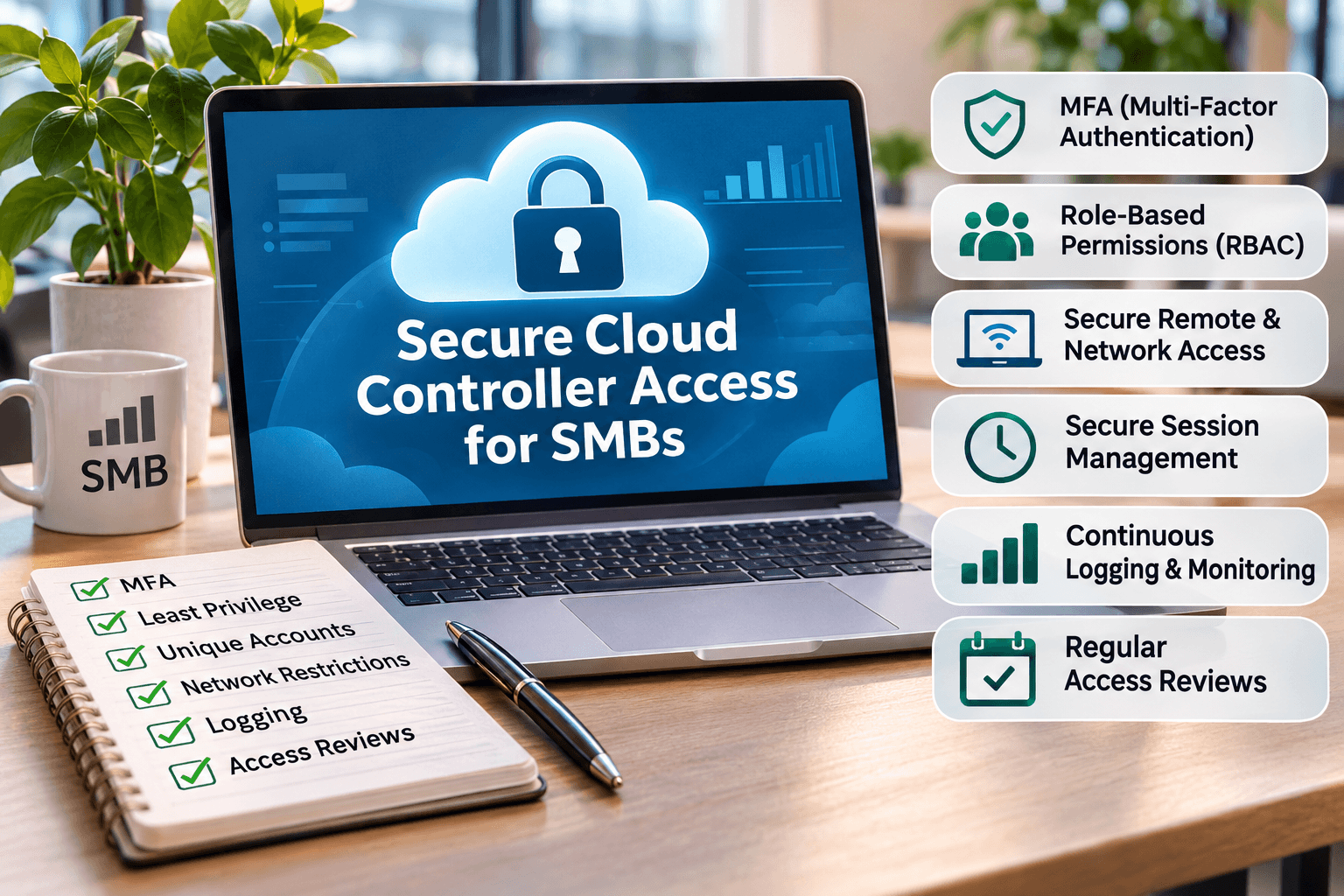
Secure cloud controller access comes down to seven essentials: phishing-resistant MFA, least-privilege permissions, separate administrator accounts, network restrictions, secure sessions, continuous logging, and regular access reviews. Get those right, and you’ve closed the doors most attackers walk through.
Here’s what I’ve learned after decades of helping small businesses manage their financial operations in the cloud: the biggest threats rarely look like Hollywood hackers. They look like a shared admin password on a sticky note, a former employee’s account that was never deactivated, or a vendor with permanent administrator rights nobody remembers granting. I’m Jennifer Brazer, Founder and CEO of Complete Controller, and I’ve watched businesses create entirely avoidable risk this way. The good news? You can fix it—without a security team or a six-figure budget.

What Is the Best Way to Secure Cloud Controller Access?
- The strongest approach combines MFA, identity management, role-based permissions, network restrictions, session controls, monitoring, backups, and recurring reviews.
- Give every person their own login—individual identities mean every action traces back to a specific human.
- Hold administrators, remote users, and contractors to stricter standards, especially accounts that can delete data or change security settings.
- Start every account with the smallest practical permission set and expand only when a documented business need exists.
- Treat access security as an ongoing routine—onboarding, offboarding, testing, and response—not a one-time setup.
Secure Cloud Controller Access for Administrators Starts with Authentication
Cloud controller authentication is your front door. Every employee, contractor, and vendor needs a unique username, strong password, and a second verification factor before touching your portal or API. Shared logins, reused passwords, and credentials stored in spreadsheets are the pitfalls I see most often—and they’re all fixable this week.
Multi-factor authentication MFA is non-negotiable
Microsoft’s own research found that MFA can block more than 99.9% of account compromise attacks. That single statistic should make MFA the default for every user, with phishing-resistant methods like passkeys or security keys reserved first for administrators. The NIST guidance on multi-factor authentication MFA is clear: SMS-only codes are the weakest option, so upgrade where your platform allows.
One more thing—protect your recovery codes. An MFA program with unprotected backup codes is a lock with the key taped to the door.
Role-Based Permissions That Limit Business Risk
Once identities are secure, the next question is: what can each person actually do? Role-based access control (RBAC) assigns access through job-based roles instead of handing out permissions one-off. The moment more than one person manages your controller, RBAC becomes essential.
Watch for “temporary” privileges that never expire and roles that mix conflicting duties—the person who approves changes shouldn’t also be the only one who configures them. AWS publishes excellent guidance on cloud controller permissions that reinforces the golden rule: begin with read-only access, then add only what a documented task requires. Review privileged accounts monthly, standard users quarterly, and remove anything unused.
How to Enable MFA for Cloud Controller Access
Setting up MFA is a process, not a toggle. Here’s the order that works:
- Configure the policy first. The primary owner sets MFA enforcement at the identity-provider level—no exceptions, no “we’ll add them later.”
- Test on a nonproduction account. Confirm the enrollment flow works before rolling it out company-wide.
- Have each user register their own device. Never register authenticators on someone’s behalf.
- Protect the root account. This is the most common gap I see—and the most dangerous.
- Document and test recovery. Keep a controlled, logged, time-limited emergency process so a lost phone never becomes a crisis.
Strong cloud controller login security extends beyond the web portal to mobile apps, command lines, and APIs. Use password managers, enable login alerts, and never approve an MFA prompt you didn’t trigger.
Keeping your financial data secure shouldn’t be complicated. Let Complete Controller help you simplify cloud-based bookkeeping, strengthen financial oversight, and manage your business with confidence.
Secure Remote and Network Access Policies
Remote work isn’t going anywhere, and neither are the risks that come with it. Any administrator connecting outside your managed network should use a trusted device, a VPN or zero-trust gateway, and device compliance checks. Public Wi-Fi, personal devices, and unattended sessions are exactly how attackers slip in. If your team works off-site, build a real policy for secure remote access to cloud controller portal systems rather than hoping everyone makes smart choices.
Network access policies add another layer: restrict IP ranges and geographies where feasible, document every exception with an expiration date, and monitor denied attempts. The classic mistake? Disabling restrictions during troubleshooting and never restoring them.
Secure Sessions, Monitoring, and the Account Lifecycle
Secure session management protects what happens after login—encrypted connections, short idle timeouts, token rotation, and forced logout after password resets. Make timeouts shorter for destructive operations and require reauthentication for sensitive changes.
Tying it all together is identity and access management (IAM): the governance layer covering provisioning, deprovisioning, logging, and access certification. CISA’s best practices for identity and access management IAM emphasize assigning a clear access owner and maintaining an inventory of every human, service, and emergency identity. Delayed offboarding and orphaned service accounts are silent liabilities—assign an owner and audit them quarterly.
Troubleshooting Unauthorized Access to Cloud Controller
When something looks wrong—a suspicious login, an unexpected permission change, an unknown device—act fast and act carefully. Revoke sessions and tokens, disable suspicious identities, and preserve your audit logs before changing anything. Deleting evidence or changing only one password are the mistakes that turn incidents into disasters. Building a habit of troubleshooting unauthorized access to cloud controller activity pairs naturally with broader fraud detection across your business.
Uber’s 2022 breach is a sobering lesson: an attacker obtained a contractor’s password, then bombarded them with MFA push requests until one got approved. Train your team to deny surprise prompts and report MFA fatigue immediately.
And the stakes are real. The 2014 Code Spaces breach saw an attacker gain AWS control-panel access and delete production resources and backups during the recovery attempt. The company shut down permanently. Valid administrative access can be as destructive as any malware when permissions and recovery controls are weak. Meanwhile, IBM reports the global average data breach cost hit $4.88 million in 2024, up 10% from the prior year—proof that prevention is the bargain of the century.
A Practical SMB Access-Review Routine
You don’t need enterprise complexity—you need consistency. Each quarter, track these measurable controls: MFA coverage (target: 100%), inactive accounts, number of privileged users, failed logins, and overdue reviews. Perform a permission review after every departure, role change, vendor swap, or system migration. Before any renewal or audit, confirm offboarding is complete, test backup restoration and session revocation, and record the owner and next action for every high-risk control.
Buying tools without assigning ownership is the most common failure I see. Security isn’t a product—it’s a routine with a name attached to it.
Conclusion
Secure cloud controller access isn’t about paranoia; it’s about building a system that protects your business while your team does its best work. Start with individual accounts and phishing-resistant MFA, layer in least-privilege permissions and RBAC, lock down remote access and sessions, and commit to quarterly reviews. My advice? Tackle your highest-privilege accounts this week, then roll the same discipline across the business. For more expert guidance from the team that pioneered cloud-based bookkeeping and controller services, visit Complete Controller, we’ve helped thousands of businesses run safer, smarter operations, and we’d love to help yours.

Frequently Asked Questions About Secure Cloud Controller Access
How can an SMB secure cloud controller access without hiring a full-time security team?
Focus on high-impact basics: enforce MFA for every user, assign individual logins, apply least-privilege roles, and run a quarterly access review. These steps block the majority of real-world attacks without specialized staff.
How do you enable MFA for cloud controller access?
The account owner enables MFA enforcement in the identity-provider settings, tests on a nonproduction account, then has each user register an authenticator app or security key. Protect the root account first and document a recovery process.
What permissions should cloud controller administrators receive?
Only what their documented duties require. Separate approval, configuration, billing, and deletion powers where practical, use a dedicated admin account distinct from daily-use accounts, and review privileges monthly.
How can an SMB troubleshoot unauthorized access to a cloud controller?
Immediately revoke all active sessions and tokens, disable suspicious accounts, preserve audit logs, check for newly created identities, and escalate if data loss or regulatory exposure is possible. Never delete logs or change just one password.
Is a VPN enough for secure remote access to a cloud controller portal?
No. A VPN encrypts the connection but doesn’t verify the user or device. Pair it with MFA, managed-device checks, session timeouts, and location restrictions for genuine protection.
Sources
- Amazon Web Services. “Security Best Practices in IAM.” AWS Identity and Access Management User Guide, 2 Oct. 2026, https://docs.aws.amazon.com/IAM/latest/UserGuide/best-practices.html.
- Cybersecurity and Infrastructure Security Agency. “Hybrid Identity Solutions Guidance.” CISA, 12 May 2021, updated 19 Oct. 2026, https://www.cisa.gov/resources-tools/services/hybrid-identity-solutions-guidance.
- Cybersecurity and Infrastructure Security Agency. “Identity and Access Management Recommended Best Practices for Administrators.” CISA, Dec. 2023, updated 25 Sept. 2025, https://www.cisa.gov/sites/default/files/2023-12/ESF%20IDENTITY%20AND%20ACCESS%20MANAGEMENT%20RECOMMENDED%20BEST%20PRACTICES%20FOR%20ADMINISTRATORS%20PP-23-0248_508C.pdf.
- IBM Security. “Cost of a Data Breach Report 2024.” IBM, 30 July 2024, https://www.ibm.com/reports/data-breach.
- National Institute of Standards and Technology. Digital Identity Guidelines: Authentication and Authenticator Management. Special Publication 800-63B-4, 23 July 2026, https://nvlpubs.nist.gov/nistpubs/SpecialPublications/NIST.SP.800-63b-4.pdf.
- National Institute of Standards and Technology. Digital Identity Guidelines: SP 800-63B, https://pages.nist.gov/800-63-4/sp800-63b.html.
- Network World. “Hacker Puts ‘Full Redundancy’ Code-Hosting Firm Out of Business.” 20 June 2014, https://www.networkworld.com/article/925992/security-hacker-puts-full-redundancy-code-hosting-firm-out-of-business.html.
- Uber. “Security Update.” Uber Newsroom, 19 Sept. 2022, https://www.uber.com/newsroom/security-update/.
- Weinert, Alex. “Your Pa$$word Doesn’t Matter.” Microsoft Entra Blog, 9 July 2019, https://techcommunity.microsoft.com/blog/microsoft-entra-blog/your-pa-word-doesn-t-matter/731984.
 About Complete Controller® – America’s Bookkeeping Experts Complete Controller is the Nation’s Leader in virtual bookkeeping, providing service to businesses and households alike. Utilizing Complete Controller’s technology, clients gain access to a cloud platform where their QuickBooks™️ file, critical financial documents, and back-office tools are hosted in an efficient SSO environment. Complete Controller’s team of certified US-based accounting professionals provide bookkeeping, record storage, performance reporting, and controller services including training, cash-flow management, budgeting and forecasting, process and controls advisement, and bill-pay. With flat-rate service plans, Complete Controller is the most cost-effective expert accounting solution for business, family-office, trusts, and households of any size or complexity.



 Brittany McMillen