


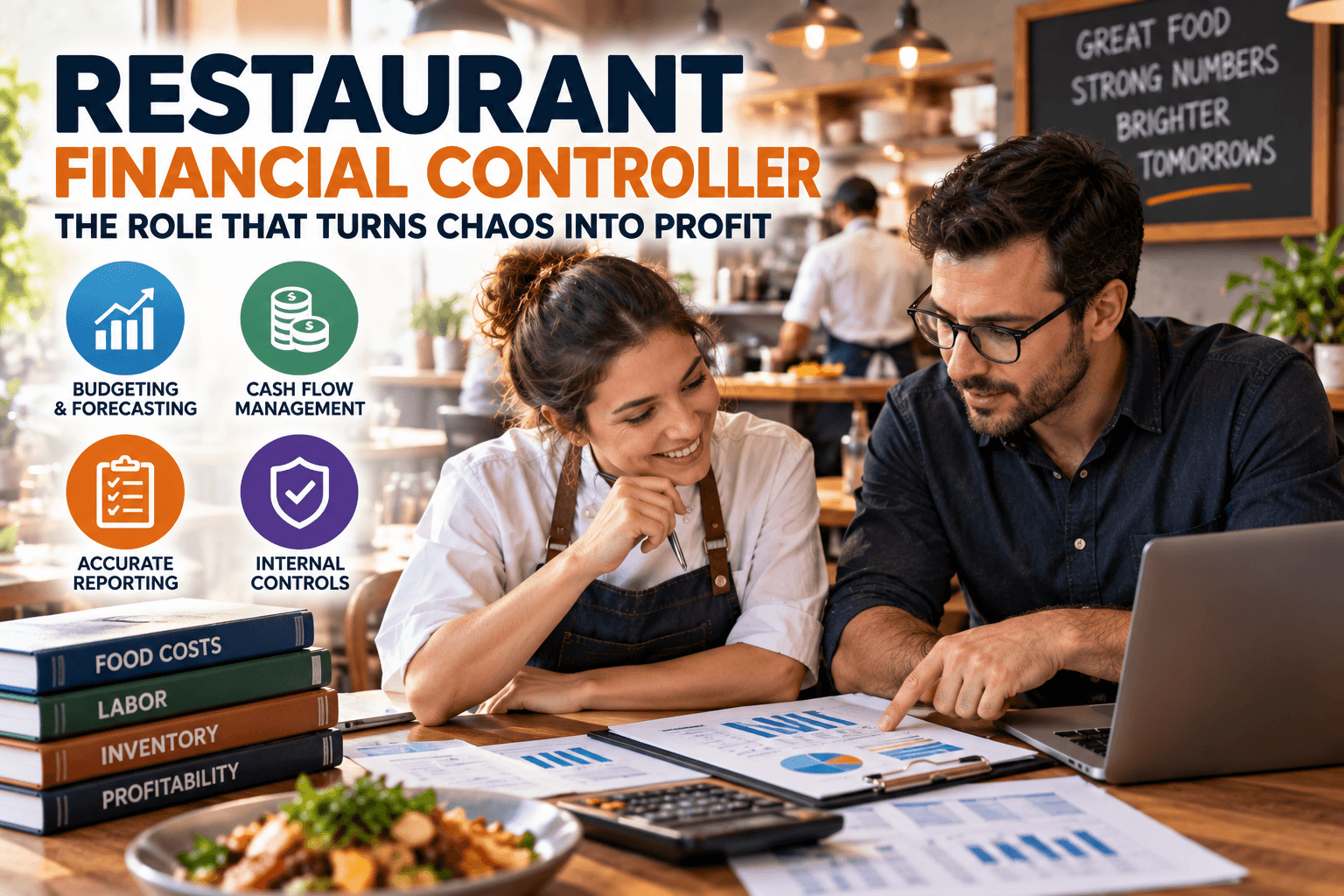
Restaurant Financial Controller:
The Role That Turns Chaos Into Profit
A restaurant financial controller is the financial leader who manages your restaurant’s accounting, budgeting, cash flow, internal controls, and reporting—so you can make decisions based on real numbers instead of gut feelings. Whether you run one location or twenty, this role transforms scattered receipts and mystery margins into a clear financial picture.
Here’s the truth most restaurant owners learn the hard way: great food doesn’t guarantee a great business. I’ve spent over two decades helping food service entrepreneurs, and the ones who thrive aren’t always the best chefs—they’re the ones who know their numbers cold. With the U.S. restaurant industry projected to hit $1.1 trillion in sales and employ 15.7 million people in 2024 (National Restaurant Association), the stakes have never been higher. Razor-thin margins don’t forgive financial blind spots.
What does a restaurant financial controller do and why does it matter?
- Quick answer: A restaurant financial controller oversees bookkeeping accuracy, cash flow forecasting, budgeting, POS reconciliation, internal controls, and financial reporting—protecting profitability and preventing fraud.
- They own the numbers, meaning daily sales, food costs, labor percentages, and vendor payments all flow through systems they design and monitor.
- They forecast the future, using historical data to predict slow seasons, plan purchases, and keep cash reserves healthy.
- They protect your business, building internal controls that catch errors and theft before they drain your accounts.
- They translate data into decisions, turning reports into actionable moves on menu pricing, staffing, and growth.

The Restaurant Financial Controller Job Description, Explained
Think of a controller as your restaurant’s financial quarterback. A bookkeeper records what happened. A controller tells you what it means and what to do next.
The core restaurant controller responsibilities include overseeing daily accounting, managing the month-end close, enforcing spending controls, preparing financial statements, and guiding budgets. According to the Bureau of Labor Statistics, financial managers—including controllers—earn strong six-figure median salaries, and you can review current restaurant controller responsibilities and salary data to benchmark your hiring plans.
Controller vs. Bookkeeper vs. Finance manager
Here’s the hierarchy in plain terms: bookkeepers record transactions, a restaurant finance manager analyzes them, and a controller owns the entire system—accuracy, compliance, controls, and strategy. For multi-location operators, a controller becomes non-negotiable, because inconsistent records across stores will quietly bury your profits.
Why Strong Restaurant Bookkeeping Is the Foundation
No controller can work magic on messy books. Daily sales tracking, vendor payment schedules, tip reporting, and payroll accuracy form the raw material of every financial decision you’ll make. Strong restaurant bookkeeping habits—recorded daily, categorized correctly, and reviewed weekly—give your controller clean data to work with.
Clean books aren’t optional—they’re also the law. The IRS requires businesses to maintain accurate records supporting income, deductions, and payroll, and solid restaurant accounting practices keep you audit-ready year-round. When your documentation is airtight, tax season becomes a formality instead of a fire drill.
Running a restaurant is hard enough without guessing at the numbers. Complete Controller gives you restaurant bookkeeping and controller-level financial clarity to manage cash flow, protect profits, and make smarter decisions.
POS Reconciliation and Internal Controls: Your Fraud Shield
This is where bookkeeping alone falls short—and where a controller earns their keep. In the ACFE’s 2024 global fraud study, the median occupational fraud loss was $145,000, and 32% of cases were tied directly to a lack of internal controls. Restaurants, with their heavy cash flow and high staff turnover, are prime targets.
A controller builds the defenses: separating duties so no single person handles cash from register to bank, reviewing voids and comps, and requiring approvals on vendor payments. Daily POS reconciliation—matching your point-of-sale totals against bank deposits and accounting records—catches discrepancies while they’re small and fixable, not after they’ve become a five-figure mystery.
The daily reconciliation rhythm
- Pull the POS end-of-day report and verify total sales by payment type.
- Match credit card batches against processor deposits.
- Count and verify cash deposits against register totals.
- Investigate and document any variance the same day.
Order matters here—skip a step, and errors compound.
Cash Flow, Budgeting, and Forecasting for Restaurants
Cash flow is oxygen. You can be profitable on paper and still miss payroll if timing goes sideways. The Federal Reserve’s Small Business Credit Survey consistently shows that uneven cash flow management is one of the top financial challenges small businesses face—and restaurants feel it more than most, with seasonal swings and weekly vendor terms.
Costs won’t sit still, either. Food-away-from-home prices rose 7.1% in 2023 after climbing 7.7% in 2022 (USDA). A controller tracks these shifts in real time, adjusting menu pricing, food cost targets, and budgets before inflation eats your margin. That’s the power of restaurant controller cash flow and forecasting—structured systems that turn financial oversight into a competitive advantage.
Financial reporting that actually drives decisions
Your controller should deliver a monthly package you can use: a P&L with prime cost percentages, a cash flow statement, a budget-versus-actual comparison, and location-level breakdowns if you operate multiple stores. Reports that sit unread are decoration. Reports that spark action are strategy.
Should You Hire a Restaurant Financial Controller—Or Outsource One?
Here’s my honest take after two decades in this industry: most independent restaurants don’t need a full-time, six-figure controller on payroll. They need controller-level expertise without the controller-level price tag. That’s exactly why I built Complete Controller—to give growing businesses access to expert financial oversight, cloud-based systems, and real-time reporting at a fraction of the in-house cost.
If you’re searching “hire restaurant financial controller near me,” widen the lens. Cloud-based controller services mean your financial expert doesn’t need a desk in your back office. They need access to your POS, your bank feeds, and your goals.
Signs you need controller-level support now:
- You can’t state your food cost or labor percentage from last month
- Your books close weeks late (or not at all)
- You’re expanding to a second location
- Cash flow surprises keep catching you off guard
The Bottom Line: Numbers Are Your Competitive Edge
A restaurant financial controller isn’t a luxury for big chains—it’s the difference between guessing and knowing. From bulletproof bookkeeping and daily POS reconciliation to fraud-fighting internal controls and forward-looking cash flow forecasting, this role protects the business you’ve poured your heart into. You didn’t open a restaurant to drown in spreadsheets. You opened it to build something that lasts.
Ready to get controller-level clarity without the full-time cost? Visit Complete Controller and connect with the team that pioneered cloud-based bookkeeping and controller services. Your numbers are trying to tell you something—let’s make sure you hear it.

Frequently Asked Questions About Restaurant Financial Controller
What does a restaurant financial controller do?
They oversee all accounting operations—bookkeeping accuracy, POS reconciliation, budgeting, cash flow forecasting, internal controls, and financial reporting—so owners can make profitable, data-driven decisions.
How much does a restaurant financial controller cost?
Full-time controllers typically earn six figures, per Bureau of Labor Statistics data. Outsourced controller services deliver the same expertise for a fraction of that cost, making them ideal for independent and multi-unit operators.
What’s the difference between a restaurant bookkeeper and a controller?
A bookkeeper records transactions; a controller designs the financial system, enforces internal controls, analyzes results, and guides strategy. Controllers work above bookkeepers in the financial hierarchy.
Do small restaurants really need a financial controller?
Yes—especially with fraud losses averaging $145,000 per case and rising food costs. Small restaurants benefit most from outsourced controller services that scale with their needs.
How does a controller help with restaurant cash flow?
They forecast weekly cash needs, time vendor payments strategically, monitor seasonal trends, and maintain reserves—so you never get blindsided by payroll or supplier deadlines.
Sources
- National Restaurant Association. (2024, February 6). National Restaurant Association Releases 2024 State of the Restaurant Industry Report. https://restaurant.org/research-and-media/media/press-releases/national-restaurant-association-releases-2024-state-of-the-restaurant-industry-report/
- U.S. Department of Agriculture Economic Research Service. (2024). Food Price Outlook, 2024 and 2025. https://www.ers.usda.gov/data-products/food-price-outlook/
- Association of Certified Fraud Examiners. (2024). Occupational Fraud 2024: A Report to the Nations. https://www.acfe.com/report-to-the-nations/2024/
- Complete Controller. Small Business Bookkeeping: 9 Tips and Tricks. https://www.completecontroller.com/small-business-bookkeeping-9-tips-and-tricks/
- Complete Controller. Importance of Reconciling Your Accounting Statements Regularly. https://www.completecontroller.com/importance-of-reconciling-your-accounting-statements-regularly/
- Complete Controller. Efficient Business Finance Management. https://www.completecontroller.com/efficient-business-finance-management/
- Bureau of Labor Statistics. Financial Managers. https://www.bls.gov/ooh/management/financial-managers.htm
- Internal Revenue Service. Recordkeeping. https://www.irs.gov/businesses/small-businesses-self-employed/recordkeeping
- Federal Reserve. Small Business Credit Survey. https://www.fedsmallbusiness.org/reports/survey
 About Complete Controller® – America’s Bookkeeping Experts Complete Controller is the Nation’s Leader in virtual bookkeeping, providing service to businesses and households alike. Utilizing Complete Controller’s technology, clients gain access to a cloud platform where their QuickBooks™️ file, critical financial documents, and back-office tools are hosted in an efficient SSO environment. Complete Controller’s team of certified US-based accounting professionals provide bookkeeping, record storage, performance reporting, and controller services including training, cash-flow management, budgeting and forecasting, process and controls advisement, and bill-pay. With flat-rate service plans, Complete Controller is the most cost-effective expert accounting solution for business, family-office, trusts, and households of any size or complexity.



 Brittany McMillen
Brittany McMillen
Brittany McMillen