


Financial Visibility Platforms:
Get Unmatched SMB Clarity
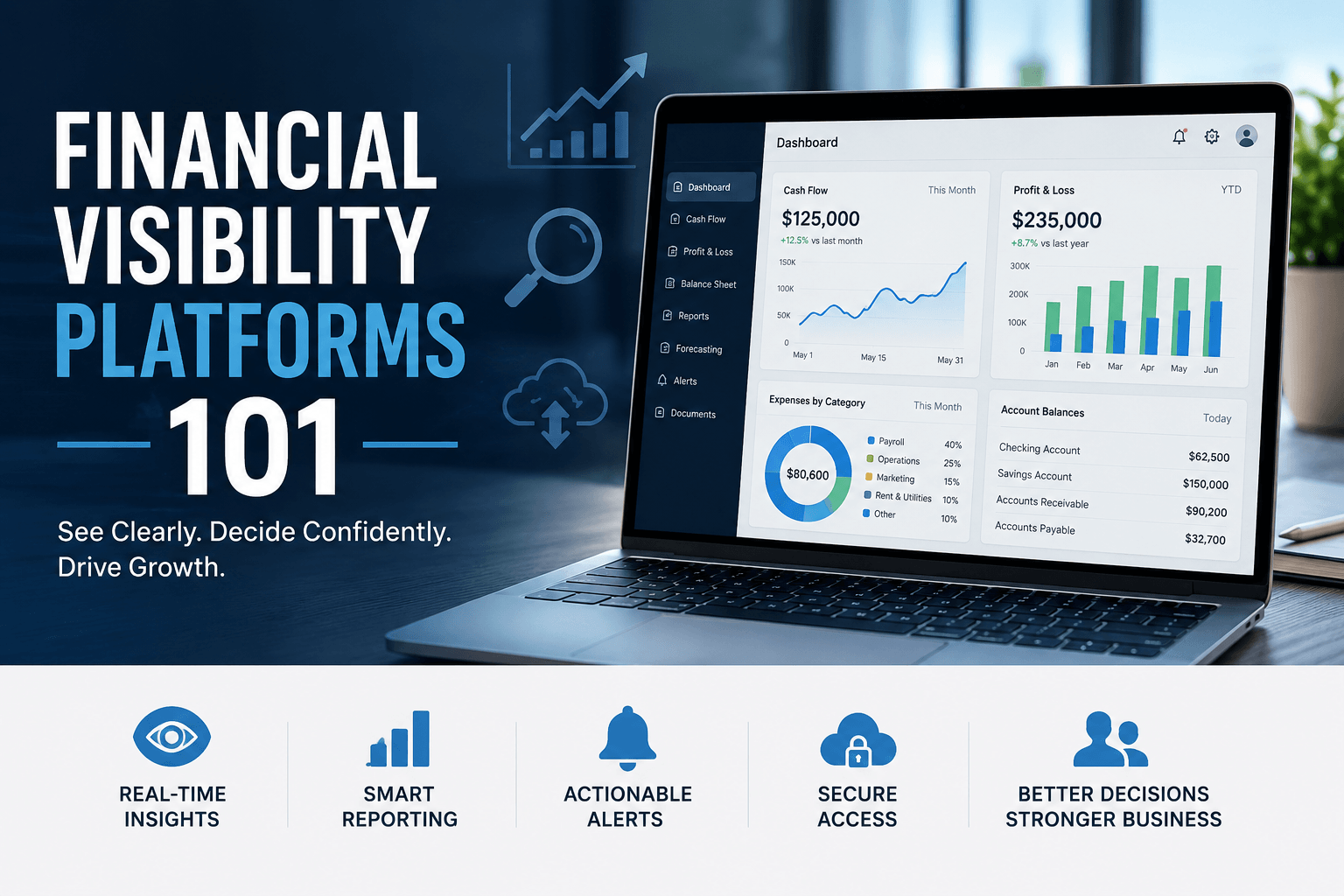
Financial visibility platforms give SMBs real-time access to consolidated financial data across accounting, banking, and operational systems—enabling faster decisions without enterprise-level overhead. These platforms transform scattered spreadsheets and outdated reports into unified dashboards showing cash flow, spending patterns, and revenue trends as they happen. This guide reveals how to select, implement, and maximize these tools for sustainable growth.
I’ve spent the last decade helping thousands of SMBs break free from financial fog, and watched them transform overnight once they had real-time visibility into their entire financial picture. The difference between guessing and knowing is everything.

What financial visibility platforms do for SMBs
- Financial visibility platforms fundamentally solve the consolidation problem—pulling data from multiple systems into one source of truth.
- They consolidate financial data from accounting software, banks, credit cards, and payroll into unified dashboards
- Automation replaces manual work by syncing transactions, categorizing expenses, and generating reports without spreadsheet gymnastics
- Forecasting capabilities predict cash positions 13-52 weeks out based on historical patterns and upcoming obligations
- Compliance controls track every transaction with audit trails, approval workflows, and policy enforcement
- Real-time access means decisions happen with current data, not last month’s numbers
Why Financial Visibility Platforms Matter for SMB Decision-Making
The speed of modern business demands instant financial insights. Gone are the days when monthly reports sufficed—today’s SMBs compete on agility, and that requires knowing your financial position right now.
How real-time financial analytics transform daily operations
Live data changes everything. When you see cash positions update throughout the day, you spot problems before they compound. During COVID, 73% of small businesses reported having less than two months of cash reserves—those with visibility tools saw the crunch coming and adjusted early. Real-time financial analytics surface trends immediately: that new customer paying late, the vendor quietly raising prices, the seasonal dip arriving two weeks early.
Cash flow forecasting platforms: Your crystal ball for growth
Smart forecasting goes beyond simple projections. Modern cash flow forecasting platforms analyze payment histories, seasonal patterns, and growth trajectories to predict positions 13-26 weeks out. You’ll know exactly when that expansion will strain working capital or when excess cash could fund new initiatives. The best platforms update predictions daily as new data flows in.
Spend visibility and control platform benefits that save real money
Hidden spending kills profit margins. A spend visibility and control platform exposes wasteful subscriptions, duplicate vendors, and policy violations before they become habits. One marketing agency discovered $8,000 monthly in forgotten software subscriptions—money instantly recovered to fund growth instead of waste.
Revenue visibility platforms show what’s really profitable
Not all revenue is equal. Revenue visibility platforms break down income by customer, product, service line, and geography to reveal true profitability. That demanding client consuming 40% of your team’s time might only generate 15% of profits—insights impossible to see in basic P&L statements.
Core Features of Modern Financial Visibility Platforms
Today’s platforms go far beyond basic reporting. They combine automation, intelligence, and integration to create comprehensive financial command centers.
Accounts payable visibility platform capabilities
Modern accounts payable visibility platform features prevent cash crunches by tracking every obligation from receipt to payment. You see aging reports, approval bottlenecks, early payment discounts, and upcoming cash requirements in one view. Smart platforms flag unusual invoices and surface duplicate payments automatically.
Invoice processing automation cuts manual work by 80%
Manual invoice entry is expensive—bottom performers spend $15 per invoice while automated organizations process for under $2. Invoice processing automation extracts data from PDFs, routes approvals based on rules, and syncs directly with accounting systems. Three-way matching happens instantly, exceptions get flagged, and your team focuses on strategy instead of data entry.
Financial reporting dashboards that actually get used
Forget static reports nobody reads. Dynamic financial reporting dashboards update continuously and let users drill into specifics. Board members see high-level KPIs while managers investigate department-level details. The best dashboards customize by role—your sales director sees revenue metrics while operations tracks efficiency ratios.
Spend analytics platforms find hidden opportunities
Spend analytics platforms categorize every transaction using AI, then surface patterns humans miss. They’ll show that office supplies cost 30% more from your current vendor, or that travel expenses spike every third Thursday (when that remote team meets). Armed with data, you negotiate better contracts and eliminate waste.
Building Your Financial Visibility Platform Strategy: Beyond Just Numbers
Implementation success requires more than picking features. You need a strategy aligned with business goals and team capabilities.
Why you must integrate financial visibility platforms with ERP
Siloed data defeats the purpose. When you integrate financial visibility platforms with ERP systems, data flows automatically between operational and financial systems. Sales orders become revenue forecasts, inventory levels inform cash planning, and project timelines predict resource needs. Start with your core accounting system, then expand to CRM, inventory, and HR platforms.
How AP automation platforms drive efficiency
Beyond basic invoice processing, AP automation platforms transform the entire payables cycle. They enforce spending policies, route approvals based on amount and category, capture early payment discounts, and provide vendors with self-service portals. The efficiency gains fund the platform investment within months.
Enterprise performance management for growing SMBs
Don’t let the “enterprise” label scare you—modern enterprise performance management scales to SMB needs. These tools connect financial results to operational metrics, enabling true performance analysis. You’ll understand why margins shifted, not just that they did.
Financial visibility platform software selection criteria
Choosing financial visibility platform software requires balancing current needs with future growth. Essential criteria include: cloud-based architecture for anywhere access, role-based permissions for security, mobile apps for on-the-go decisions, API availability for custom integrations, and SOC 2 compliance for data protection. Avoid platforms requiring IT departments to maintain.
Still making big decisions from outdated reports? Complete Controller helps business owners turn financial chaos into real-time clarity—without adding more work to your plate.
Financial Visibility Platforms for CFOs:
From Tactical to Strategic
CFOs leveraging these platforms shift from number-crunching to strategic advising—exactly where they add most value.
Real-time cash flow visibility platform advantages for CFOs
A real-time cash flow visibility platform transforms cash management from reactive to proactive. CFOs see daily cash positions, forecast accuracy improves to 95%+, and working capital optimization becomes continuous instead of quarterly. Microsoft’s case study showed Coca-Cola Bottling Company United cutting reporting time by 50% through automated dashboards, freeing finance teams for analysis instead of report building.
Spend management software that enforces policy automatically
Manual expense reviews waste time and miss violations. Modern spend management software embeds policies into workflows—blocking out-of-policy purchases, requiring documentation for exceptions, and routing approvals based on amount and category. CFOs gain confidence that spending follows strategy without micromanaging every transaction.

Financial visibility platform for CFOs: Executive-ready insights
A true financial visibility platform for CFOs translates operational data into boardroom language. It answers strategic questions like: Which customer segments drive profitable growth? Where should we invest next quarter’s capital? What scenarios threaten our cash position? The platform becomes your strategic thinking partner, not just a reporting tool.
Case Study:
Mid-Size Staffing Firm Transforms with Real-Time Visibility
A $8M staffing company struggled with cash timing—contractor payroll hit before client payments, creating regular scrambles. Their Excel-based forecasting ran 2-3 weeks behind reality. Manual invoice entry meant 8-day processing cycles and frequent errors.
After implementing spend analytics platforms and invoice automation:
- AP processing dropped from 8 days to 2 days
- Cash forecast accuracy improved from 70% to 94%
- Month-end close accelerated from 10 days to 3 days
- The CFO gained confidence to negotiate better payment terms with clients
The transformation took 90 days from selection to full adoption. Today they’re exploring advanced real-time financial analytics to predict client payment behaviors and optimize contractor scheduling.
What Real Financial Visibility Platforms Offer (and Common Coverage Gaps)
Understanding platform limitations prevents disappointment and guides realistic expectations.
Real-time dashboards typically cover P&L, balance sheet, cash flow, and AP aging beautifully. However, many platforms struggle with multi-entity consolidation or highly customized KPI tracking. If you operate multiple companies or need industry-specific metrics, verify these capabilities upfront.
AI-powered categorization works well for standard expenses but may misclassify industry-specific transactions. Plan time to train the system on your unique spending patterns. The investment pays off through better analytics, but don’t expect perfection immediately.
Integration ecosystems vary wildly. While most platforms connect to major accounting software, specialized systems often require custom development. Growing companies should prioritize platforms with open APIs and active partner networks.
Integration Mistakes That Kill Platform Adoption and How to Avoid Them
The biggest adoption killer? Choosing platforms that don’t integrate with your accounting software. Data silos persist, manual work continues, and teams abandon the “visibility” tool that blinds them to half their data.
Over-customizing workflows too early creates complexity before you understand actual needs. Start with default workflows, observe for 60 days, then adjust based on real usage patterns. Teams adopting incrementally see 3x higher success rates.
Launching without an internal champion guarantees failure. Designate a finance leader—typically the controller or CFO—as platform owner. Give them authority to enforce adoption and accountability for success metrics. Without ownership, expensive platforms become expensive shelfware.
Integrating before cleaning data multiplies problems. Bad data flowing into reports undermines trust immediately. Spend two weeks reconciling accounts, standardizing vendor names, and fixing categorization before connecting systems. Clean data in means reliable insights out.
Your Financial Visibility Platform Readiness Checklist
Before selecting a platform, audit your readiness:
Data Foundation
- [ ] Accounting records reconciled through last month
- [ ] Vendor database standardized and de-duplicated
- [ ] Historical data accessible for 24+ months
- [ ] Chart of accounts logically structured
Technical Requirements
- [ ] Current accounting software identified
- [ ] Bank accounts have API/feed access
- [ ] IT approved cloud platform usage
- [ ] Integration requirements documented
Team Readiness
- [ ] Finance team trained on new platform
- [ ] Spending policies documented
- [ ] Executive sponsor assigned
Success Criteria
- Month-end close time target: days (current: days)
- Cash forecast accuracy target: % (current: %)
- Time saved in manual reporting: ___ hours/month
Conclusion
Financial visibility platforms aren’t a “nice to have” anymore—they’re survival tools for SMBs competing against larger, better-funded rivals. When you see cash positions, spending patterns, and revenue trends in real-time, you make decisions with confidence instead of crossing fingers. The platforms exist, they’re affordable, and they’re waiting to transform how you run your business.
I’ve watched hundreds of SMB owners go from financial fog to crystal clarity. The look on their faces when they finally see their business numbers in real-time? Priceless. That transformation is waiting for you too.
Ready to see clearly? Visit Complete Controller for expert guidance on implementing financial visibility platforms that give your SMB the clarity it deserves.

Frequently Asked Questions About Financial Visibility Platforms
What’s the difference between spend analytics and financial visibility platforms?
Spend analytics platforms focus specifically on categorizing and analyzing expense patterns, while financial visibility platforms provide comprehensive views across all financial data including revenue, cash flow, AR/AP, and spending. Think of spend analytics as one component within a broader visibility solution.
How long does it typically take to implement a financial visibility platform?
Basic implementation takes 30-45 days for simple setups, while comprehensive platforms with multiple integrations require 60-90 days. The timeline depends on data complexity, number of systems to connect, and customization needs. Clean data and dedicated resources cut implementation time in half.
Can financial visibility platforms work with my current accounting software (QuickBooks, Xero, NetSuite)?
Yes, most modern platforms integrate natively with major accounting systems including QuickBooks, Xero, NetSuite, Sage, and Microsoft Dynamics. Verify specific integration capabilities during demos, and ask about API access for custom connections if needed.
How much do financial visibility platforms typically cost for an SMB?
Pricing ranges from $200-2,000 monthly depending on features, user count, and transaction volume. Basic dashboards and reporting start around $200/month, while comprehensive platforms with automation, forecasting, and advanced analytics run $800-2,000/month for mid-size SMBs.
What’s the ROI on financial visibility platform investment?
Most SMBs see positive ROI within 6-12 months through reduced manual work (20-30 hours/month), better cash management (2-5% improvement), and faster collections (3-7 days). One prevented cash crisis or captured early payment discount series can fund an entire year’s subscription.
Sources
- Paystand. (2025). Why Real-Time Data is Necessary for Enhanced Finance Visibility. https://www.paystand.com/blog/enhanced-financial-visibility
- CentSight. (2026). SMB Financial Management: Visibility, Control & Growth. https://centsight.com/smb-finance
- Nomentia. (2025). Cash Visibility: Benefits, Strategies, Challenges & Solutions. https://www.nomentia.com/blog/the-benefits-of-cash-visibility
- Rippling. (2026). Top 8 Small Business Expense Tracking Tools. https://www.rippling.com/blog/small-business-expense-tracking
- Aspire. (2026). Benefits of Achieving Real-Time Cash Flow Visibility for Your Business. https://aspireapp.com/blog/benefits-of-achieving-real-time-cash-flow-visibility-for-your-business
- Expensify. (2026). Top Financial Management Tools for Small Businesses in 2026. https://use.expensify.com/resource-center/guides/financial-management-tools
- BILL. (2026). What is Spend Visibility? (And How to Improve it). https://www.bill.com/learning/spend-visibility
- Salesforce. (2025). Beyond Bookkeeping: Financial Tools For Small Businesses. https://www.salesforce.com/blog/financial-tools-for-small-business/
- MetLife & U.S. Chamber of Commerce. (April 2020). MetLife & U.S. Chamber of Commerce Small Business COVID-19 Impact Poll. https://www.uschamber.com/small-business/metlife-us-chamber-of-commerce-small-business-covid-19-impact-poll
- Institute of Finance & Management (IOFM). (accessed 2026). AP Benchmarks: Cost to Process an Invoice. https://www.iofm.com/ap/ap-benchmarks-cost-to-process-an-invoice
- Microsoft. (2019). Coca-Cola Bottling Company United modernizes finance reporting with Power BI. Microsoft Customer Stories. https://customers.microsoft.com/en-us/story/784097-coca-cola-bottling-company-united-consumer-goods-power-bi
- Wikipedia. Invoice processing. https://en.wikipedia.org/wiki/Invoice_processing
- IBM. Business Analytics. https://www.ibm.com/think/topics/business-analytics
- Oracle. What is Enterprise Performance Management. https://www.oracle.com/performance-management/what-is-enterprise-performance-management/
 About Complete Controller® – America’s Bookkeeping Experts Complete Controller is the Nation’s Leader in virtual bookkeeping, providing service to businesses and households alike. Utilizing Complete Controller’s technology, clients gain access to a cloud platform where their QuickBooks™️ file, critical financial documents, and back-office tools are hosted in an efficient SSO environment. Complete Controller’s team of certified US-based accounting professionals provide bookkeeping, record storage, performance reporting, and controller services including training, cash-flow management, budgeting and forecasting, process and controls advisement, and bill-pay. With flat-rate service plans, Complete Controller is the most cost-effective expert accounting solution for business, family-office, trusts, and households of any size or complexity.




 Brittany McMillen
Brittany McMillen
Brittany McMillen