


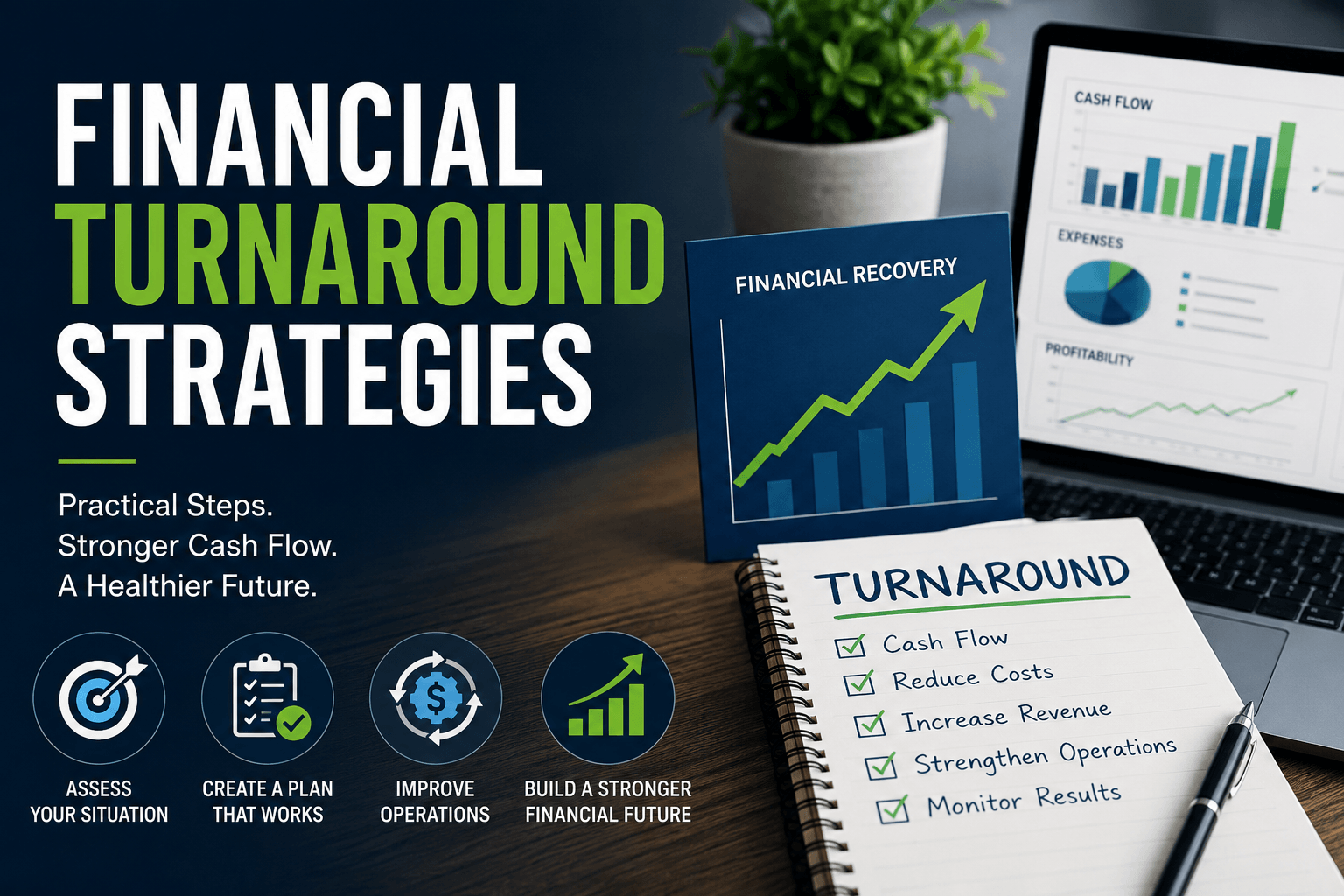
Financial Turnaround Strategies for SMB Cash Recovery
Financial turnaround strategies are the structured recovery methods that pull small businesses out of cash crises through rapid diagnostics, aggressive receivables management, strategic cost cuts, and disciplined working capital optimization. You’ll discover exactly how to assess your true cash position, accelerate incoming payments while extending outgoing ones, and build sustainable financial buffers. This guide delivers the complete playbook for transforming your business from cash-strapped to cash-strong in 30-90 days.
After guiding hundreds of SMBs through financial crises at Complete Controller, I’ve watched companies go from missing payroll to building six-figure cash reserves using these exact strategies. The difference between businesses that recover and those that fail? Speed and focus on the fundamentals that actually move the needle.

What are financial turnaround strategies and how do you execute them?
- Financial turnaround strategies combine rapid cash diagnostics, AR/AP optimization, targeted cost reduction, debt restructuring, and working capital management to restore SMB liquidity within 30-90 days
- Start with a 48-hour cash position assessment that captures all bank balances, immediate obligations, and hidden cash drains
- Accelerate receivables through early payment incentives while negotiating extended terms with suppliers to maximize your cash timing gap
- Cut overhead aggressively but protect revenue-generating functions and customer relationships
- Build a 3-month cash reserve and implement rolling 90-day forecasts to prevent future crises
Step 1: Financial Turnaround Strategies Start With Honest Diagnostics
The foundation of any successful turnaround begins with confronting reality. According to U.S. Bank research, 82% of businesses fail due to cash flow problems, making accurate diagnostics non-negotiable. You need complete visibility into where cash sits, where it’s going, and what’s blocking its flow.
Review your actual cash position (business recovery plan)
Start by gathering every bank balance and listing all obligations due within 48 hours. This immediate snapshot reveals whether you’re operating from a positive or negative position. Next, calculate expected income for the next 30 days and categorize every expense as essential versus discretionary. Document those hidden cash drains everyone misses—slow-moving inventory gathering dust, redundant software subscriptions, and receivables aging past 60 days.
Separate operating, strategic, and reserve spending (cost reduction and efficiency)
Break your expenses into four distinct buckets: operating (keeps the lights on), reserve (emergency buffer), strategic (growth investments), and restricted (contractually committed). This categorization immediately shows where to cut. Most businesses discover 20-30% of spending falls into discretionary categories that won’t impact core operations. Prioritize eliminating consultant fees, travel expenses, and nice-to-have subscriptions while protecting customer service and sales functions.
Analyze profitability by customer and product (financial performance improvement)
Your biggest customers aren’t always your most profitable ones. Run the numbers on gross margins by product line and customer segment. You’ll likely find 20% of offerings drive 80% of profits while others drain resources. Document which products, services, or customers actually make money, then plan strategic phase-outs for the rest. This analysis becomes your roadmap for where to focus limited resources during recovery.
Step 2: Accelerate Cash Inflow Through Financial Turnaround Strategies
Cash flow improvement by maintaining an ideal liquidity position requires aggressive receivables management. The Federal Reserve’s 2023 Small Business Credit Survey identified cash flow as the #1 financial challenge for SMBs, with many unable to cover operating expenses if sales stopped briefly. That’s why AR acceleration sits at the core of rapid recovery.
Optimize accounts receivable management (how to turn around a failing business)
Transform your invoicing from passive to proactive. Send invoices the moment goods ship or services complete—not days later. Electronic invoicing alone cuts payment times by up to 80%. Create a simple tracking system showing every outstanding invoice by age: 0-30, 30-60, 60-90, and 90+ days. Assign one person to own collections and follow up within 3-5 days of any missed due date. Weekly reviews of aging buckets keep receivables from slipping through cracks.
Offer early payment incentives (restructuring debt and cash flow)
The math on early payment discounts surprises most owners. A 2/10 net 30 policy (2% discount if paid within 10 days) costs you 2% but delivers an 18.25% annualized return through accelerated cash flow. Market these incentives prominently on every invoice and follow up with personalized offers to high-balance customers. Track discount usage carefully—if more than 40% take the discount, you might be leaving money on the table.
Renegotiate customer payment terms (working capital optimization)
Shift new contracts from net-30 to net-15 wherever possible. For large orders that customers might resist, offer installment options that maintain competitiveness while improving your cash position. Create a “preferred customer” program rewarding prompt payers with better terms or priority service. Modern payment platforms that enable instant transfers can shave another 2-3 days off collection times.
Step 3: Master Cash Outflow with Financial Turnaround Strategies
While accelerating inflows provides immediate relief, managing outflows creates lasting stability. Working capital optimization through better payment terms means stretching payables strategically without damaging vendor relationships.
Extend payment terms with suppliers (debt restructuring strategies)
Approach your top 10 suppliers with a simple request: extend payment windows from net-30 to net-45 or net-60. Emphasize your history of reliable payment and consistent purchase volume. Many vendors prefer keeping good customers with extended terms over losing them entirely. Consolidate purchases with fewer suppliers to increase negotiating leverage, and consider electronic payment systems that maximize the float between payment initiation and settlement.
Consolidate debt (step-by-step financial turnaround plan)
List every outstanding loan, credit line, and vendor balance with interest rates and monthly payments. Debt restructuring strategies for businesses under pressure often involve consolidating multiple high-rate obligations into a single, lower-rate facility. Even a 2% rate reduction on $200,000 in debt saves $4,000 annually. Attack the highest-rate debt first—credit cards charging 18% before equipment loans at 6%.
Pause non-essential subscriptions and discretionary spending (cost reduction and efficiency)
That software audit you’ve been postponing? Now’s the time. Most businesses find 15-25% overlap in tool functionality. Negotiate temporary discounts on non-critical services or pause them entirely. Every vendor prefers reduced revenue over cancellation. Establish a formal approval process requiring CFO sign-off for any new spending over $500.
Step 4: Optimize Working Capital with Proven Financial Turnaround Strategies
Financial turnaround strategies that master the cash conversion cycle focus on freeing trapped capital from inventory and operational inefficiencies. Working capital optimization explained by the Corporate Finance Institute shows how small improvements compound into major cash flow gains.
Liquidate slow-moving inventory (revenue growth planning)
- Run an aging report on inventory identifying items with 6+ months of supply on hand
- Price slow movers at 30-70% discounts through flash sales or bundles
- Contact your best customers directly with exclusive offers on excess stock
- Convert dead inventory to cash within 30 days rather than letting it consume warehouse space
- Document lessons learned to prevent future overstock situations
Improve inventory turnover (working capital optimization)
Shift from quarterly bulk orders to monthly just-in-time purchasing. This reduces carrying costs and prevents cash from sitting idle in warehouses. Analyze actual demand patterns, not sales projections, to guide ordering. Renegotiate supplier minimums—many will accommodate smaller, more frequent orders to retain business. Implement strict FIFO (first in, first out) practices to minimize spoilage and obsolescence.
Streamline accounts payable processes (financial turnaround strategy for SMEs)
Manual AP processes leak cash through errors and inefficiencies. Scan every invoice for billing mistakes, duplicate charges, or services you’re no longer receiving. Consolidate all payables into one system eliminating duplicate payments that plague multi-location businesses. Negotiate volume pricing with key suppliers and automate three-way matching between orders, receipts, and invoices.
Cash flow problems rarely fix themselves. Complete Controller helps SMBs uncover hidden financial leaks, improve visibility, and build smarter systems for long-term stability.

Step 5: Cut Costs Strategically Through Financial Turnaround Strategies
Cost reduction without revenue damage requires surgical precision. The goal isn’t slashing everything—it’s optimizing spend to preserve cash while maintaining competitive capabilities.
Right-size your workforce (corporate restructuring)
Evaluate every position through one lens: does this role directly generate revenue or support essential operations? Consider outsourcing functions like bookkeeping, HR administration, or customer support to specialized providers who deliver better results at lower cost. Freeze all new hiring and tie any compensation increases to measurable performance improvements. Track productivity metrics weekly to ensure remaining staff maintain output levels.
Reduce operating expenses (cost reduction and efficiency)
Start with your three largest expense categories—typically rent, insurance, and utilities. Renegotiate lease terms citing market conditions or explore subleasing excess space. Shop insurance coverage with multiple providers—switching can save 10-20% annually. Conduct energy audits identifying waste, then implement simple fixes like LED lighting or programmable thermostats. Every 5% reduction in operating expenses drops straight to your bottom line.
Leverage technology for automation (turnaround consulting)
Technology investments that seem expensive actually accelerate recovery when chosen wisely. Cloud accounting software eliminates manual entry errors while providing real-time visibility. Automated receivables management can reduce collection times by 25%. Digital payment systems cut processing costs and speed up cash flow. Focus on tools with 6-month or faster ROI through labor savings or efficiency gains.
Step 6: Build Revenue During Your Financial Turnaround Strategy
While cost cuts provide immediate relief, sustainable turnarounds require revenue growth. The key is focusing resources on high-probability wins rather than speculative ventures.
Increase prices strategically (revenue growth planning)
Research competitor pricing to identify gaps where you’re undervalued. Test 3-10% increases on your bestselling products first—demand rarely drops proportionally. Create premium bundles combining popular items at higher margins. Communicate price changes by emphasizing added value rather than apologizing. A 5% price increase on 60% of revenue often generates more cash than chasing new customers.
Expand high-margin product lines (turnaround strategies for distressed companies)
Your product mix probably follows the 80/20 rule—20% of offerings generate 80% of profit. Double down on winners by increasing marketing spend, improving availability, and creating variations. Simultaneously phase out low-margin products that consume resources without contributing profits. Survey existing customers about complementary products they’d purchase, then test small launches before scaling.
Diversify revenue streams (business recovery plan)
- Identify adjacent services your existing customers already buy elsewhere
- Pilot new offerings with your top 10 accounts before broader rollout
- Form strategic partnerships accessing new markets without adding overhead
- Consider subscription models converting one-time sales into predictable monthly revenue
- Track new revenue streams separately to measure true ROI
Case Study: Manufacturing Company’s 90-Day Financial Turnaround Success
A 50-employee manufacturer facing potential bankruptcy executed our complete turnaround playbook with remarkable results. The company’s cash had declined 35% due to customers stretching payment to net-60 while excess inventory consumed working capital. Monthly payroll was at risk.
Their 30-day sprint included: inventorying all stock and identifying $180,000 in slow-moving items, liquidating 60% through targeted customer promotions, extending supplier payments from net-30 to net-45, and offering 2/10 net 30 early payment incentives. By day 90, they had recovered $310,000 in cash, eliminated $85,000 in expensive debt, and stabilized operations enough to expand headcount by 20%.
The breakthrough insight: optimizing inventory and payment timing generated more immediate liquidity than any amount of new sales activity could have delivered. This mirrors Ford’s famous 2008 turnaround, where securing liquidity preceded operational improvements.
Source: Complete Controller Client Case Study Portfolio, 2024.
What Full Recovery Really Requires: Financial Turnaround Strategies for the Long Term
Quick wins buy time, but lasting recovery demands structural changes. Successful companies move beyond crisis mode by establishing cash reserves covering 3-6 months of expenses. They implement cash flow improvement using SBA cash flow projections with weekly updates and monthly variance analysis.
The businesses recovering fastest act within the first 30 days. They prioritize collecting receivables, renegotiating payment terms, eliminating waste, then reinvest gains into growth. Success comes from disciplined execution of fundamentals, not complex financial engineering.
Conclusion: Your Path from Crisis to Cash Flow Confidence
Financial turnaround strategies work when executed with speed and precision. Start today by assessing your true cash position, then move systematically through receivables acceleration, payables optimization, working capital improvements, and strategic cost reduction. Within 30 days, you’ll see measurable improvement. Within 90 days, you’ll have built sustainable systems preventing future crises.
Having guided hundreds of turnarounds, I know this: the companies that survive don’t wait for perfect conditions—they act decisively with the resources they have.
Ready to accelerate your financial turnaround? Visit Complete Controller for expert guidance from the team that pioneered cloud-based bookkeeping and controller services. We’ll help you implement these strategies while you focus on running your business.

Frequently Asked Questions About Financial Turnaround Strategies
When should a business seek external help for financial turnaround strategies?
Seek help immediately when you can’t make payroll within 30 days, have maxed out credit lines, or when receivables exceed 45 days on average. External advisors bring objectivity and proven playbooks that internal teams often lack during crisis periods. The cost of expertise pays for itself through faster recovery and avoided mistakes.
How quickly can financial turnaround strategies show measurable results?
Most businesses see initial improvements within 7-14 days from AR acceleration and cost cuts. Significant cash flow improvement typically appears by day 30, with full stabilization in 60-90 days. The key is starting immediately—every week of delay compounds the challenge.
What’s the difference between a cash flow problem and insolvency?
Cash flow problems mean you have profitable operations but timing mismatches between income and expenses. Insolvency means liabilities exceed assets with no path to profitability. Cash flow issues are fixable through timing optimization; insolvency may require restructuring or closure.
Should workforce reductions be the first cost-cutting measure in a turnaround?
No. Start with discretionary spending, subscription audits, and vendor renegotiations. Workforce cuts should target non-revenue generating roles only after exhausting other options. Premature layoffs often damage morale and customer service, making recovery harder.
Can small businesses implement financial turnaround strategies without consultants?
Yes, if leadership has financial expertise and emotional distance from decisions. However, experienced turnaround consultants typically accelerate recovery by 3-6 months through proven frameworks and objective analysis. The ROI usually justifies the investment for businesses over $2M in revenue.
Sources
- Complete Controller Client Case Study Portfolio. (2024).
- Corporate Finance Institute. Working Capital Cycle. https://corporatefinanceinstitute.com/resources/accounting/working-capital-cycle/
- Federal Reserve System. (2024). 2023 Report on Employer Firms: Findings from the 2023 Small Business Credit Survey. https://www.fedsmallbusiness.org/survey/2023/report-on-employer-firms
- Hagen, Jessie. (2018, September 12). 82% of Businesses Fail Because of Cash Flow Problems. U.S. Bank. https://www.usbank.com/business-banking/grow-your-business/business-financial-management/82-percent-of-businesses-fail-because-of-cash-flow-problems.html
- Investopedia. Debt Restructuring. https://www.investopedia.com/terms/d/debtrestructuring.asp
- U.S. Small Business Administration. Manage Your Finances. https://www.sba.gov/business-guide/manage-your-business/manage-your-finances
- UMB Bank. Seven Tips to Help Improve Small Business Cash Flow. UMB Blog. https://blog.umb.com/how-to-improve-small-business-cash-flow-edu-com/
- Vlasic, Bill. (2010, February 2). Ford Posts First Full-Year Profit Since 2005. The New York Times. https://www.nytimes.com/2010/02/03/business/03ford.html
 About Complete Controller® – America’s Bookkeeping Experts Complete Controller is the Nation’s Leader in virtual bookkeeping, providing service to businesses and households alike. Utilizing Complete Controller’s technology, clients gain access to a cloud platform where their QuickBooks™️ file, critical financial documents, and back-office tools are hosted in an efficient SSO environment. Complete Controller’s team of certified US-based accounting professionals provide bookkeeping, record storage, performance reporting, and controller services including training, cash-flow management, budgeting and forecasting, process and controls advisement, and bill-pay. With flat-rate service plans, Complete Controller is the most cost-effective expert accounting solution for business, family-office, trusts, and households of any size or complexity.




 Brittany McMillen
Brittany McMillen
Brittany McMillen