


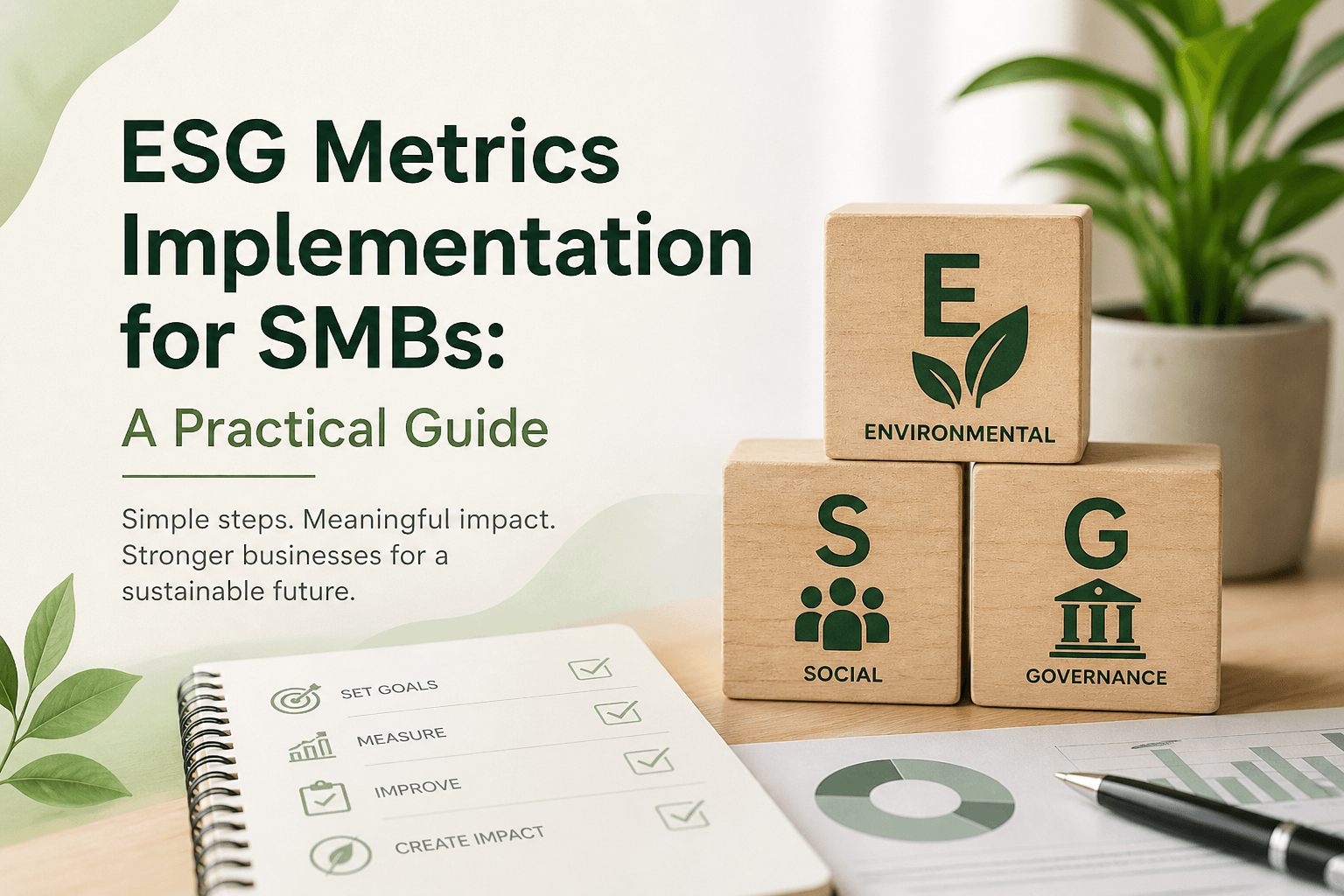
ESG Metrics Implementation for SMBs:
A Practical Guide
ESG metrics implementation involves identifying, tracking, and reporting environmental, social, and governance indicators that demonstrate your company’s sustainable practices and create measurable business value. This practical guide shows small and medium businesses how to build an ESG program without complexity or excessive cost—focusing on what actually matters to your stakeholders. You’ll learn proven frameworks, real-world approaches, and specific steps to measure progress and communicate results effectively.
I remember sitting across from a client who threw her hands up and said, “Jennifer, everyone wants ESG data from us now, but we’re not Nike—we’re 47 people trying to make payroll.” That conversation sparked my mission to demystify ESG for the 92% of SMBs who haven’t started yet, proving it doesn’t require a fortune or an army of consultants to get right.

What makes ESG metrics implementation effective for SMBs?
- ESG metrics implementation succeeds when you focus on materiality assessment, assign clear departmental ownership, and commit to realistic reporting schedules
- Environmental metrics track resource efficiency, emissions, and waste—with companies seeing up to 60% profit improvement through better resource management
- Social indicators measure workforce diversity, safety, and community impact—diverse companies generate 19% more innovation revenue
- Governance metrics monitor ethics, compliance, and risk management—companies with strong ESG scores enjoy 10% lower cost of capital
- Starting simple with 8-12 key metrics using free tools builds momentum before investing in sophisticated systems
Why ESG Metrics Implementation Works for SMBs
The business case for tracking ESG performance has shifted from “nice to have” to competitive necessity. Between 2013 and 2020, companies maintaining high ESG scores earned 2.6x greater shareholder returns compared to average performers. More importantly for cash-conscious SMBs, implementing basic sustainability practices can boost operating profits by as much as 60% through resource efficiency alone.
The market has already shifted
Consider this evolution: In 2016, only 65% of asset managers offered sustainable investing options. By 2024, that number jumped to 75%, with 73% of all investors now factoring ESG indicators into their decisions. Your customers, employees, and financial partners increasingly expect transparency about your environmental and social impact—making early adoption a strategic advantage rather than regulatory burden.
Breaking down the three pillars
- Environmental metrics go beyond carbon footprints. They encompass energy consumption, water usage, waste generation, and supply chain impacts. A regional trucking company reduced emissions by 12% in one year simply by tracking fuel efficiency and optimizing routes—no electric vehicles required.
- Social indicators measure how you treat people: employees, customers, suppliers, and communities. Gender-diverse executive teams show 2 percentage points higher revenue growth and 3 percentage points better margins than homogeneous leadership. These aren’t soft metrics—they’re predictors of innovation capacity and market responsiveness.
- Governance factors include board diversity, executive compensation alignment, data security, and ethical business practices. Strong governance correlates with lower risk premiums from lenders and insurers, directly reducing your cost of doing business.
How to Implement ESG Metrics: Your Step-by-Step Roadmap
Assess what matters most (Months 1-2)
Start with a materiality assessment—fancy words for “figure out what your stakeholders actually care about.” Survey your top customers, key employees, primary investors, and main suppliers. Ask specific questions: Which environmental impacts concern you most about our operations? What social issues affect your decision to work with us? How important is supply chain transparency?
Next, establish baselines. You can’t improve what you don’t measure, but perfect data isn’t the goal initially. Use your existing systems: utility bills for energy consumption, HR records for diversity metrics, safety incident logs, and basic supplier questionnaires. Accept that your first measurements will be estimates—consistency matters more than precision at this stage.
Build your tracking system (Months 2-3)
Design your dashboard around 8-12 core metrics aligned to stakeholder priorities. If customers care most about carbon emissions and employees prioritize workplace safety, those become your north stars. Assign each metric to a specific department: Operations owns energy and waste, HR manages diversity and safety, Finance tracks governance and compliance.
For data collection, resist the urge to buy expensive software solutions for ESG metrics implementation immediately. Start with spreadsheets and free tools like the EPA’s Simplified GHG Emissions Calculator. Build your processes first, then invest in technology once you’ve proven the value and outgrown manual methods.
Set targets and take action (Months 3-6)
Transform your baseline data into SMART goals. Instead of “reduce emissions,” commit to “decrease Scope 1 and 2 emissions by 15% within 18 months through fleet optimization and facility upgrades.” Link every target to business strategy—emission reductions save fuel costs, diversity goals expand your talent pool, governance improvements lower insurance premiums.
Pilot before you scale. Test initiatives with one facility, one department, or one supplier category before rolling out company-wide. A 25-truck logistics company started with hybrid vehicles for local routes only, proved the ROI, then expanded the program based on real data rather than projections.
Case Study: Unilever’s Scalable Approach
While Unilever operates at massive scale, their ESG metrics implementation framework offers valuable lessons for SMBs. Through their Sustainable Living Plan, they reduced operational emissions by 70% since 2020 and ensured 80% of supply chain workers receive living wages—all while growing revenue.
Their secret? Starting with double materiality assessment to identify what matters to stakeholders AND affects financial performance. They assigned clear departmental ownership, set science-based targets with interim milestones, and reported progress transparently—including failures. SMBs can adopt this same disciplined approach, scaled to their resources.
The key takeaway: Unilever didn’t try to fix everything at once. They prioritized high-impact areas, built measurement systems incrementally, and adjusted based on results. Your 50-person company can follow the same playbook—just with smaller numbers and simpler tools.
Common ESG Implementation Pitfalls (And How to Avoid Them)
The perfectionism trap
Many SMBs delay starting because they want flawless data and comprehensive coverage from day one. Reality check: Even Fortune 500 companies work with estimates and evolve their methodologies. Begin with what you have, document your assumptions, and improve accuracy over time.
Metric overload
Tracking 50 KPIs guarantees you’ll excel at none. Limit yourself to 3-5 metrics per ESG pillar initially. Quality beats quantity—it’s better to show consistent improvement on emissions and diversity than to have patchy data across dozens of indicators.
The set-and-forget syndrome
ESG isn’t a one-time project; it requires ongoing attention like financial management. Schedule monthly data reviews, quarterly target assessments, and annual strategy updates. Integrate ESG reviews into existing management meetings rather than creating separate bureaucracy.
Stakeholder disconnect
Implementing metrics that don’t align with stakeholder priorities wastes resources and erodes trust. If investors care about governance but you only report environmental metrics, you’ve missed the mark. Regular stakeholder dialogue keeps your program relevant and valued.
Sustainability is easier to measure when your numbers are clear. See how Complete Controller helps SMBs track what matters.

Technology and Tools for ESG Tracking
Starting lean: Free and low-cost options
Begin your ESG data collection journey with accessible tools:
- EPA’s GHG Calculator for carbon accounting
- Excel templates for metric tracking
- Google Forms for employee and supplier surveys
- Industry association resources and benchmarking data
These tools can manage your first 12-18 months effectively. Only consider paid solutions once you’ve established processes and proven ROI.
When to level up
Invest in dedicated ESG software when you experience: data collection taking excessive staff time, difficulty consolidating information across departments, stakeholder demands for real-time reporting, or expansion beyond 15-20 tracked metrics. The goal is integrating ESG metrics into enterprise risk management systems you already use.
Integration with existing systems
Your ESG data likely lives in current platforms—accounting software, HRIS, CRM, and operations systems. Before buying standalone ESG tools, explore whether existing vendors offer sustainability modules. Integration reduces training time and improves data accuracy.
Reporting and Communication Best Practices
Internal reporting: Building momentum
Create monthly one-page dashboards showing: current performance versus targets, trend lines for each metric, wins worth celebrating, and obstacles requiring leadership attention. Share these broadly—transparency drives accountability and engagement.
Quarterly deep-dives should examine what’s working and what isn’t. Did the recycling program actually reduce waste, or just shift it? Are diversity hiring goals creating lasting change or temporary statistics? Honest assessment beats vanity metrics.
External communication: Building trust
Annual ESG reports don’t require 100-page documents rivaling Apple’s sustainability report. A 10-15 page report covering your material topics, clear metrics with trending data, initiatives and outcomes, and future commitments resonates more than verbose prose.
Follow established frameworks like ESG reporting standards from GRI or ESG performance indicators from SASB for structure and credibility. These frameworks provide templates and guidance tailored to company size and industry.
Stakeholder engagement
Regular touchpoints maintain stakeholder confidence: investor calls including ESG updates alongside financials, customer surveys validating your focus areas remain relevant, employee town halls celebrating progress and addressing concerns, and supplier sessions explaining expectations and providing support.
Remember, stakeholders value transparency over perfection. Acknowledging where you’re struggling builds more trust than cherry-picked success stories. When implementing how to implement ESG metrics in corporate reporting, consistency and honesty matter most.
Real ROI: Making the Business Case
ESG metrics implementation delivers tangible returns beyond reputation benefits. Companies with strong ESG performance enjoy multiple financial advantages that directly impact SMB success.
Cost reduction opportunities include: 60% potential operating profit improvement through resource efficiency, 10% lower cost of capital from ESG-conscious lenders, reduced insurance premiums from better risk management, and decreased turnover costs through employee satisfaction.
Revenue growth drivers encompass: 19% higher innovation revenue from diverse teams, premium pricing for sustainable products, access to ESG-focused customers and contracts, and faster growth in ESG-conscious market segments.
The compound effect is powerful. A mid-sized manufacturer implementing basic ESG tracking saw 8% margin improvement through waste reduction, won two major contracts requiring ESG disclosure, reduced borrowing costs by 75 basis points, and improved employee retention by 22%—all within 18 months.
Building Long-Term ESG Success
First year: Foundation building
Focus on establishing baselines, implementing basic tracking systems, achieving quick wins to build momentum, and educating teams on ESG importance. Success looks like having reliable data for 8-12 core metrics and showing improvement in at least half.
Second Year: Expansion and integration
Expand metrics based on stakeholder feedback, integrate ESG into business planning, invest in appropriate technology, and formalize governance structures. By year-end, ESG should feel like a normal part of operations, not a special project.
Year Three and Beyond: Maturity and leadership
Benchmark against industry peers, pursue relevant certifications, mentor other SMBs on their journey, and innovate in your material impact areas. Mature programs influence suppliers, shape industry standards, and attract top talent through demonstrated values.
The path forward
ESG metrics implementation doesn’t require perfection or massive investment—it requires starting. The gap between companies thriving with ESG and those struggling without it widens daily. Your stakeholders already expect transparency and sustainable practices. The question isn’t whether to implement ESG metrics, but how quickly you can begin capturing the benefits.
Remember, 92% of SMBs haven’t started their ESG journey yet. By taking action now, you position your company among the forward-thinking minority creating competitive advantage through sustainability. The frameworks exist, the tools are accessible, and the business case is proven.
Conclusion
ESG metrics implementation transforms vague sustainability aspirations into measurable business advantages—from 60% profit improvements through resource efficiency to 19% innovation revenue from diverse teams. Throughout this guide, we’ve shown how SMBs can build effective ESG programs without enterprise complexity, starting with simple tools and scaling based on proven value.
The path forward is clear: assess what matters most to your stakeholders, establish baselines with existing data, set realistic targets tied to business strategy, and report progress transparently. You don’t need expensive consultants or software to begin—just commitment to measuring what matters and improving steadily.
Complete Controller pioneered cloud-based financial services because we believe every business deserves enterprise-quality insights without enterprise costs. That same philosophy applies to ESG: practical tools, clear frameworks, and expert guidance tailored to your reality. Ready to join the 8% of SMBs leading on sustainability? Visit Complete Controller for resources, templates, and support from the team that’s helped hundreds of SMBs transform good intentions into measurable impact.

Frequently Asked Questions About ESG Metrics Implementation
What is the minimum budget needed to start ESG metrics implementation?
You can begin ESG tracking with zero additional budget using free tools like the EPA GHG Calculator, Excel templates, and existing data from utility bills and HR systems. Most SMBs operate successfully for 12-18 months before needing paid solutions. Initial costs typically involve staff time (10-20% of one person’s role) rather than software or consulting fees.
How long does it take to see ROI from ESG metrics implementation?
Quick wins often appear within 3-6 months through resource efficiency improvements and cost reductions. Broader financial benefits—including revenue growth, lower borrowing costs, and new contracts—typically materialize within 12-24 months. Companies maintaining consistent ESG practices for 3+ years see the most dramatic returns, including the 2.6x shareholder value improvement documented in long-term studies.
Which ESG metrics should a small business track first?
Start with metrics that matter most to your key stakeholders and that you can easily measure: energy consumption (utility bills), waste generation (hauling invoices), employee diversity (HR data), workplace safety (incident reports), and basic governance (board composition, policy adherence). Choose 2-3 metrics per pillar initially, focusing on those with clear business impact and stakeholder interest.
Do SMBs need to follow the same ESG standards as large corporations?
No, SMBs should scale standards appropriately. While frameworks like GRI and SASB provide excellent guidance, you don’t need to adopt them wholesale. Start with simplified versions focused on your material impacts. Many industry associations offer SMB-specific templates. The key is consistency and transparency, not comprehensive coverage of every possible metric.
How do we get buy-in from leadership and employees for ESG metrics implementation?
Lead with business benefits, not moral imperatives. Show leadership how ESG tracking reduces costs (up to 60% profit improvement potential), attracts customers (73% of investors now consider ESG), and improves talent retention. For employees, emphasize how ESG initiatives often improve workplace conditions and provide skill development opportunities. Share competitor examples and pilot program results to build confidence.
Sources
- The Corporate Governance Institute. ESG for small businesses. https://www.thecorporategovernanceinstitute.com/insights/news-analysis/esg-for-small-businesses/
- Vena Solutions. ESG Reporting: The Complete Guide. https://www.venasolutions.com/blog/esg-reporting
- Alpha Sense. The ROI of ESG: Why You Should Be Prioritizing ESG in 2024. https://www.alpha-sense.com/blog/trends/roi-esg-investing/
- Alpha Sense. ESG/Sustainability: ROI Advantages For Small & Mid-Cap Companies. https://www.alpha-sense.com/blog/trends/sustainability-small-mid-cap-companies/
- McKinsey & Company. How the E in ESG creates business value. https://www.mckinsey.com/capabilities/sustainability/our-insights/sustainability-blog/how-the-e-in-esg-creates-business-value
- Growth Force. Why Diverse Workplaces Generate 19% Higher Revenue. https://www.growthforce.com/blog/business-workplace-diversity-revenue
- The Corporate Governance Institute. (October 2024). Case Study – Unilever. https://www.thecorporategovernanceinstitute.com/wp-content/uploads/2024/10/Case-Study-Unilever.pdf
- Complete Controller. From Spreadsheets to CRMs. https://www.completecontroller.com/from-spreadsheets-to-crms/
- Complete Controller. Accounting Cycle Closure. https://www.completecontroller.com/accounting-cycle-closure/
- Complete Controller. Remote Work Security Post-COVID. https://www.completecontroller.com/remote-work-security-post-covid/
- Global Reporting Initiative. GRI Standards. https://www.globalreporting.org/standards/
- Sustainability Accounting Standards Board. SASB Standards. https://www.sasb.org/standards/
- U.S. Environmental Protection Agency. Simplified GHG Emissions Calculator. https://www.epa.gov/climateleadership/simplified-ghg-emissions-calculator
 About Complete Controller® – America’s Bookkeeping Experts Complete Controller is the Nation’s Leader in virtual bookkeeping, providing service to businesses and households alike. Utilizing Complete Controller’s technology, clients gain access to a cloud platform where their QuickBooks™️ file, critical financial documents, and back-office tools are hosted in an efficient SSO environment. Complete Controller’s team of certified US-based accounting professionals provide bookkeeping, record storage, performance reporting, and controller services including training, cash-flow management, budgeting and forecasting, process and controls advisement, and bill-pay. With flat-rate service plans, Complete Controller is the most cost-effective expert accounting solution for business, family-office, trusts, and households of any size or complexity.




 Brittany McMillen
Brittany McMillen
Brittany McMillen