


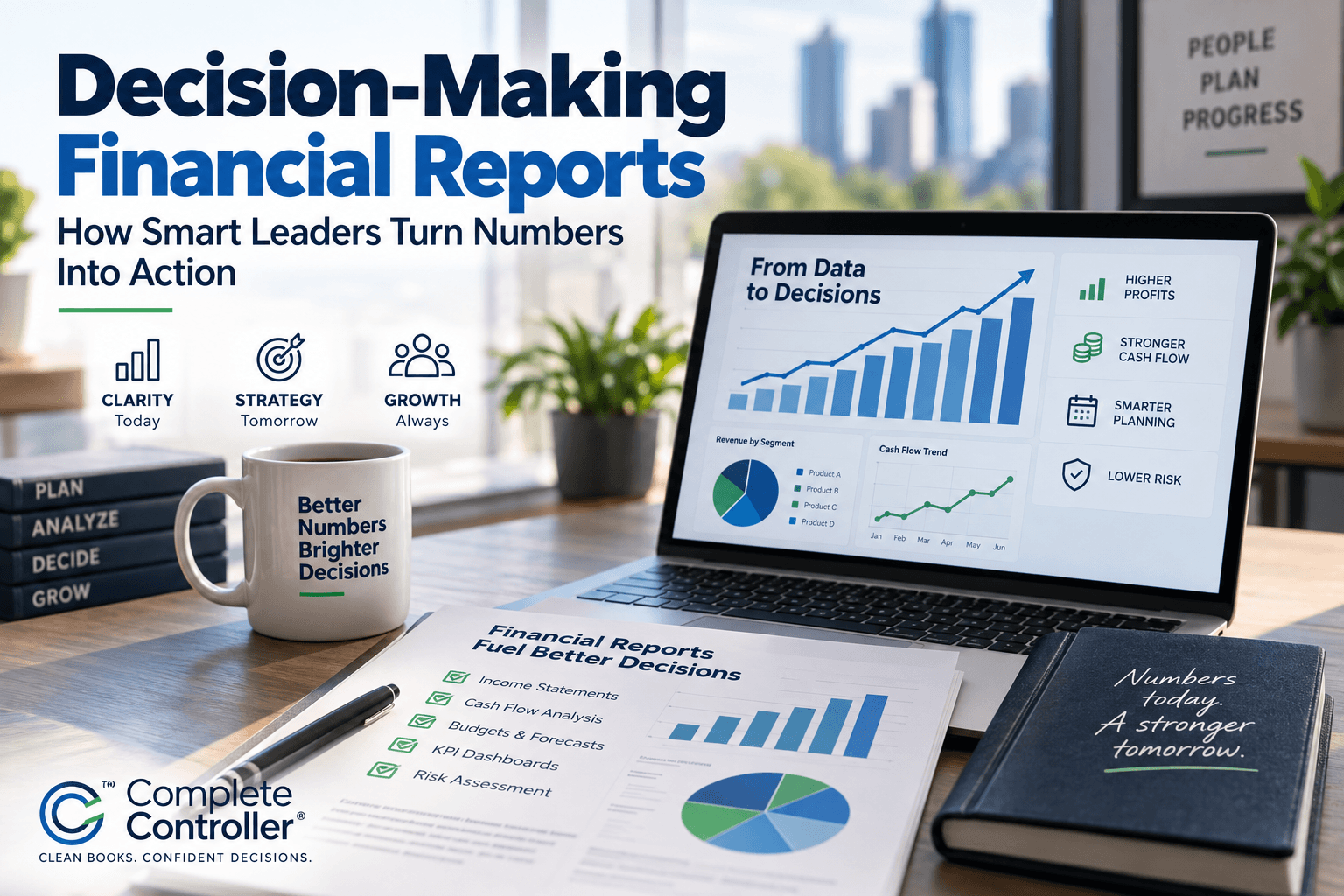
Decision-Making Financial Reports:
How Smart Leaders Turn Numbers Into Action
Decision-making financial reports are structured financial documents—like income statements, cash flow analyses, budgets, and KPI dashboards—that give business leaders the accurate, timely data they need to make confident strategic choices. When built and read correctly, these reports transform raw numbers into a roadmap for growth, profitability, and risk management.
Here’s what I’ve learned after two decades helping thousands of business owners: most leaders aren’t short on data—they’re drowning in it. The problem isn’t access. It’s clarity. If you’ve ever stared at a spreadsheet at 11 p.m. wondering whether you can afford that new hire, this article is for you. Let’s fix how you use your numbers, once and for all.
What are decision-making financial reports and how do you use them?
- Decision-making financial reports include income statements, balance sheets, cash flow reports, budgets, forecasts, and KPI dashboards—used together to guide strategy, spending, hiring, and risk decisions.
- Core statements (income, balance sheet, cash flow) show where you’ve been and where you stand today.
- Forward-looking reports like budgets and forecasts help you plan what’s next with confidence instead of guesswork.
- KPI dashboards distill everything into a handful of metrics you can check weekly, not quarterly.
- Risk and variance reports flag problems early—before they become expensive surprises.

The Big Three: Core Statements Every Leader Must Read
Before you can make great decisions, you need to speak the language of your three core financial statements. The income statement tells you if you’re profitable. The balance sheet tells you what you own and owe. The cash flow statement tells you if you can pay your bills—and yes, those are three very different questions.
Too many owners look only at the profit line and call it a day. That’s how profitable businesses run out of cash. The U.S. Securities and Exchange Commission offers an excellent primer on how to interpret financial reports for decisions, and I recommend every founder read it—not because you need to become an accountant, but because you can’t delegate understanding.
Reading between the lines
Look at trends, not snapshots. One month of declining revenue is noise. Three months is a signal. Comparing this quarter to the same quarter last year removes seasonality and shows you the truth.
Profitability Analysis: Know Which Dollars Actually Work for You
Revenue is vanity; profit is sanity. Profitability analysis reports break down your margins by product, service line, or client so you can see which parts of your business earn their keep—and which quietly drain resources.
I’ve watched business owners discover their “best” client was actually their least profitable one once time and overhead were factored in. That single insight changed their entire pricing strategy. Consider that according to U.S. Bureau of Labor Statistics data, roughly 20% of small businesses fail within their first year—and cash and margin blindness are leading culprits. Using profitability analysis reports to track net profit margin regularly keeps you out of that statistic.
The takeaway? Don’t just ask “Did we make money?” Ask “Where, exactly, did we make it—and where did we lose it?”
Cash Flow Reports: The Lifeblood Metric You Can’t Ignore
Profit is an opinion; cash is a fact. A business can post strong profits and still collapse because cash arrives too slowly to cover payroll. That’s why cash flow analysis reports deserve a permanent seat at your decision-making table.
Liquidity ratios—like your current ratio and quick ratio—tell you whether you can handle short-term obligations without scrambling. Small and midsize businesses face unique challenges here, which is why we built resources like our guide on cash flow analysis reports specifically for SME leaders. A U.S. Bank study famously found that 82% of business failures trace back to poor cash flow management. Let that number guide your priorities.
What to check weekly
Review your cash position, upcoming payables, and outstanding receivables every single week. Fifteen minutes. That’s the whole habit—and it will save you from 90% of cash surprises.
Turn financial reports into smarter decisions. Complete Controller gives you clear, accurate financials so you can act with confidence.
Budgeting and Forecasting: Planning Beats Reacting Every Time
A budget isn’t a cage—it’s a compass. Budgeting and forecasting reports turn your goals into numbers and your numbers into decisions. Should you hire in Q2? Expand into a new market? Your forecast answers those questions before you commit a single dollar.
The Small Business Administration provides solid, free guidance on budgeting and forecasting reports for strategic decisions, and it pairs beautifully with a rolling forecast approach. Here’s my recommended rhythm:
- Build an annual budget tied to your strategic goals.
- Update forecasts monthly as real numbers come in.
- Run variance analysis comparing budget to actual.
- Adjust decisions—not just numbers—based on what you learn.
Variance analysis is where the magic happens. When actuals drift from plan, the why behind the gap is your most valuable business intelligence.
Risk Assessment and Internal Controls: Protect What You’ve Built
Great decisions require knowing what could go wrong, not just what could go right. Risk assessment financial reports identify exposure—concentration risk, fraud risk, compliance gaps—before it costs you. The Committee of Sponsoring Organizations (COSO) sets the gold standard here, and their framework on risk assessment financial reports is widely used by leadership teams to build risk-aware reporting.
Strong internal controls aren’t corporate bureaucracy—they’re how you sleep at night. Segregated duties, reconciled accounts, and documented approvals turn your reports from “probably right” into “trustworthy.”
Clean Books, Clear Decisions: Why Accuracy Comes First
Every report we’ve discussed rests on one foundation: accurate, current bookkeeping. Garbage in, garbage out—there’s no dashboard sophisticated enough to fix bad data. That’s the truth I built Complete Controller on when we pioneered cloud-based bookkeeping and controller services.
Reliable management accounting reports start with disciplined daily processes: timely transaction entry, monthly reconciliations, and consistent categorization. When your books are clean, your reports become decision tools instead of decoration. When they’re not, every “insight” is a guess wearing a suit.
Conclusion: Your Numbers Are Talking—Start Listening
Decision-making financial reports aren’t paperwork; they’re power. The core statements show where you stand, profitability and cash flow reports show what’s working, budgets and forecasts show what’s next, and risk reporting protects the whole operation. Leaders who master these tools stop reacting and start steering.
You don’t have to do it alone. My team at Complete Controller has spent over two decades giving business owners the clean books, expert controller support, and clear reporting they need to make bold, confident decisions. Your best financial decision might be the one that gets you the right partner. Come see what clarity feels like.

Frequently Asked Questions About Decision-Making Financial Reports
What are the most important financial reports for decision making?
The income statement, balance sheet, and cash flow statement are essential, supported by budgets, forecasts, and KPI dashboards for forward-looking decisions.
How often should I review financial reports?
Review cash flow weekly, full financial statements and variance reports monthly, and forecasts quarterly—or whenever a major decision is on the table.
What’s the difference between financial reporting and management accounting reports?
Financial reporting follows standardized formats for external parties, while management accounting reports are customized internal tools designed to guide leadership decisions.
How do KPI dashboards improve decision making?
Dashboards condense complex data into a few key metrics—margin, cash runway, revenue trends—so leaders can spot issues and act fast without digging through spreadsheets.
Can small businesses benefit from risk assessment financial reports?
Absolutely. Even simple variance monitoring and basic internal controls help small businesses catch fraud, cash shortfalls, and budget drift before they become crises.
Sources
- CompleteController. Net Profit Margin: Why It’s Essential for Your Business. https://www.completecontroller.com/net-profit-margin-business-essential/
- CompleteController. Liquidity Ratios: Challenges for SMEs. https://www.completecontroller.com/liquidity-ratios-sme-challenges/
- CompleteController. Business Bookkeeping Essentials. https://www.completecontroller.com/business-bookkeeping-essentials/
- U.S. Securities and Exchange Commission. Beginners’ Guide to Financial Statements. https://www.sec.gov/investor/pubs/begfinstmtguide.htm
- U.S. Small Business Administration. Manage Your Finances. https://www.sba.gov/business-guide/manage-your-business/manage-your-finances
- Committee of Sponsoring Organizations of the Treadway Commission (COSO). Guidance on Enterprise Risk Management. https://www.coso.org/guidance-erm
 About Complete Controller® – America’s Bookkeeping Experts Complete Controller is the Nation’s Leader in virtual bookkeeping, providing service to businesses and households alike. Utilizing Complete Controller’s technology, clients gain access to a cloud platform where their QuickBooks™️ file, critical financial documents, and back-office tools are hosted in an efficient SSO environment. Complete Controller’s team of certified US-based accounting professionals provide bookkeeping, record storage, performance reporting, and controller services including training, cash-flow management, budgeting and forecasting, process and controls advisement, and bill-pay. With flat-rate service plans, Complete Controller is the most cost-effective expert accounting solution for business, family-office, trusts, and households of any size or complexity.



 Brittany McMillen
Brittany McMillen
Brittany McMillen