


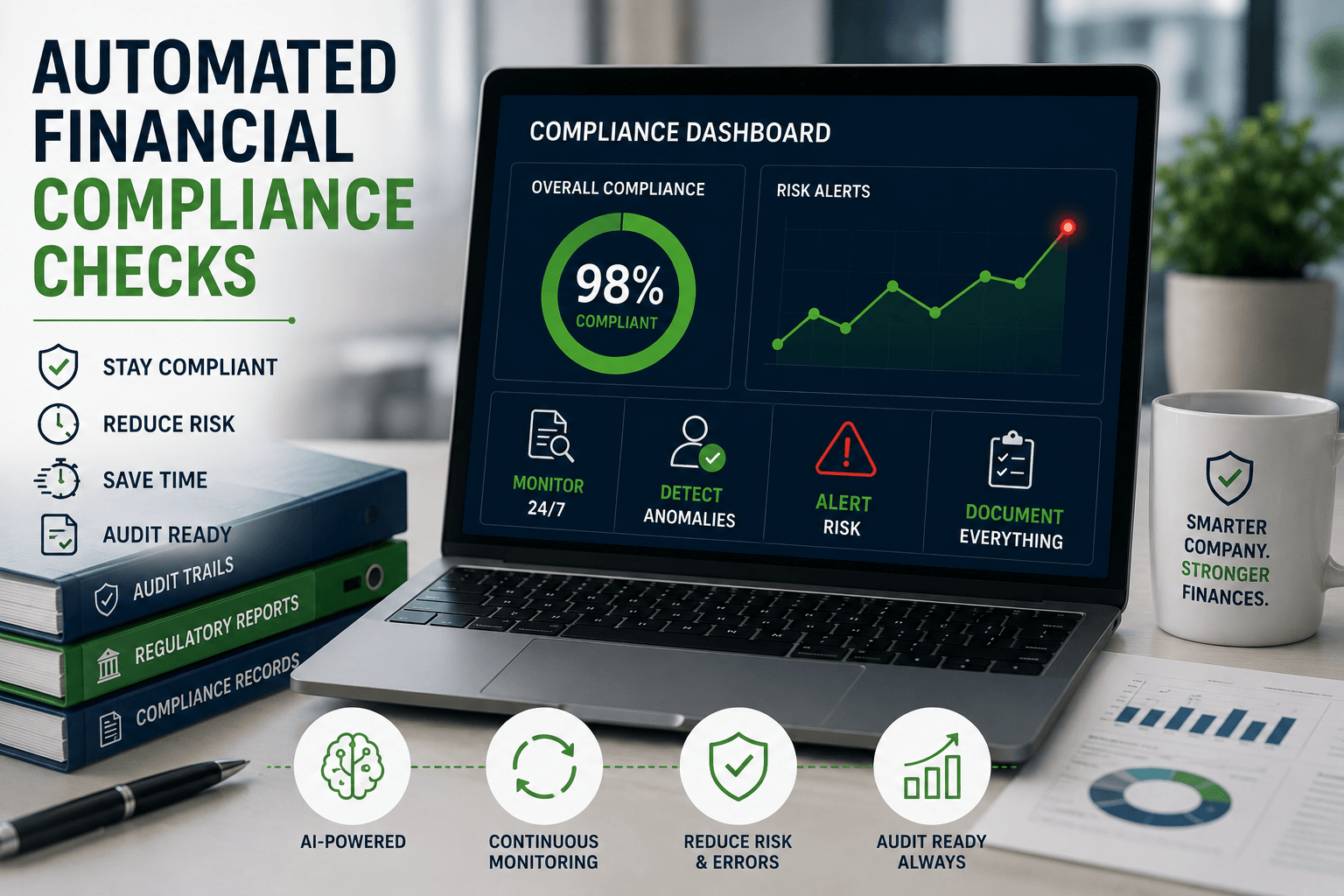
Automated Financial Compliance Checks:
Your Guide to Smarter, Safer Business Finances
Automated financial compliance checks are software-driven reviews that continuously verify your transactions, records, and reports against regulatory requirements—catching errors, flagging risks, and building audit-ready documentation without manual effort.
Here’s what most business owners don’t realize: compliance failures rarely come from bad intentions. They come from tired eyes, manual spreadsheets, and processes built for a slower era. I’ve spent over two decades helping businesses modernize their financial back office, and I can tell you this—the companies that automate compliance don’t just avoid penalties. They sleep better, close faster, and make decisions with confidence their competitors can’t match.
What are automated financial compliance checks and how do they work?
- Automated financial compliance checks use software to continuously monitor transactions, validate records, score risks, and generate regulatory reports in real time.
- They replace periodic manual reviews with continuous compliance monitoring that runs 24/7 across your financial data.
- Core functions include transaction monitoring, KYC verification automation, AML screening, and audit trail validation.
- Risk scoring and alerts prioritize what actually needs human attention, so your team stops chasing false alarms.
- The result is fewer errors, faster audits, and documented proof of compliance whenever regulators come knocking.

Why Manual Compliance Is Costing You More Than You Think
Manual compliance is like checking your smoke detectors once a year and hoping for the best. By the time a quarterly review catches a problem, the damage—duplicate payments, misclassified transactions, missed filings—has already compounded.
The math is brutal. Studies consistently show that manual data entry carries error rates around 1–4%, and in financial reporting, even a 1% error rate can cascade into material misstatements. Meanwhile, regulatory fines for AML and reporting failures have topped billions globally in recent years. That’s not a risk profile any growing business should accept.
The hidden costs beyond fines
Penalties grab headlines, but the quieter costs hurt more: staff hours burned on repetitive reviews, delayed month-end closes, and the reputational hit when an auditor finds gaps you should have caught. Automation flips that equation—your people focus on judgment calls while software handles the repetition.
How Technology Is Reshaping Compliance Workflows
The tools available today would have seemed like science fiction when I founded Complete Controller in 2004. We pioneered cloud-based bookkeeping precisely because we saw where this was heading—and AI has accelerated everything.
Modern platforms combine cloud accounting, machine learning, and rules engines to deliver financial audit automation that reviews 100% of transactions, not just samples. Traditional audits test a fraction of your records. Automated systems test all of them, continuously.
Continuous monitoring: The new standard
Federal guidance has embraced this shift. NIST’s framework for continuous compliance monitoring establishes that ongoing, automated oversight—not point-in-time checks—is the gold standard for maintaining control effectiveness. If it’s good enough for federal systems, it’s the right benchmark for your business.
Transaction Monitoring and Fraud Detection That Never Sleeps
Fraud thrives in blind spots. Automated transaction monitoring eliminates them by scanning every payment, transfer, and journal entry against behavioral baselines and risk rules. When something deviates—an unusual vendor, an off-hours transfer, a duplicate invoice—the system flags it instantly.
I’ve watched clients discover fraud schemes within days of implementing monitoring that had been running undetected for years under manual review. That’s the difference real-time oversight makes.
AML and KYC: Where automation becomes non-negotiable
For businesses handling regulated transactions, AML compliance automation isn’t optional sophistication—it’s survival. The FFIEC’s examination standards expect risk-based programs with documented suspicious activity detection. Automated KYC verification screens customers against sanctions lists and watchlists in seconds, work that once took analysts hours per case. According to industry research, automated screening reduces KYC processing time by up to 80% while improving accuracy.
Automate compliance with confidence. See how Complete Controller helps businesses stay audit-ready every day.
Building Audit Readiness with Reconciliation and Documentation
Here’s a truth I tell every client: audits aren’t scary when your records are already clean. The panic comes from scrambling to reconstruct documentation after the fact.
Using automated financial compliance checks to validate reconciliations means every account is matched, every variance explained, and every adjustment documented as it happens. Your audit trail builds itself—timestamped, tamper-evident, and complete.
What automated audit trails capture
- Who made each change, with user-level attribution
- What was changed, including before-and-after values
- When it happened, down to the second
- Why it was flagged or approved, with attached documentation
That sequence matters because auditors reconstruct events chronologically—and automation hands them the full story without a single frantic email to your bookkeeper.
Regulatory Reporting Automation: Filing Right the First Time
Reporting deadlines don’t negotiate. Whether you’re submitting financial disclosures, tax filings, or industry-specific reports, regulatory reporting automation tools validate your data against filing requirements before submission—the same rigor the SEC’s EDGAR system demands of public filers.
Automated validation catches formatting errors, missing fields, and inconsistencies that trigger rejections or inquiries. Your reports go out accurate, on time, and defensible. That consistency is what builds trust with regulators, lenders, and investors alike.
Getting Started: A Practical Path to Compliance Automation
You don’t need an enterprise budget to begin. Start where your risk is highest and your pain is loudest—usually reconciliations or transaction review. Layer in risk scoring and alerts so your team sees prioritized exceptions instead of raw data dumps. Then expand into regulatory controls testing and reporting automation as your confidence grows.
The businesses I’ve seen succeed treat this as a system upgrade, not a software purchase. Pair the right tools with expert oversight, and compliance stops being a burden—it becomes a competitive advantage.
Conclusion
Automated financial compliance checks transform compliance from a reactive scramble into a continuous, confident practice. By automating transaction monitoring, KYC/AML screening, reconciliations, and regulatory reporting, you catch problems early, document everything, and walk into audits prepared instead of panicked.
I built Complete Controller on the belief that every business deserves enterprise-grade financial controls—delivered through the cloud, backed by real experts. If you’re ready to modernize your compliance and take command of your financial operations, visit Complete Controller for guidance from the team that pioneered cloud-based bookkeeping and controller services.

Frequently Asked Questions About Automated Financial Compliance Checks
What are automated financial compliance checks?
They are software-driven processes that continuously verify financial transactions, records, and reports against regulatory rules—flagging errors, risks, and anomalies without manual review.
How does automated compliance monitoring reduce risk?
It reviews 100% of transactions in real time instead of periodic samples, catching fraud, errors, and regulatory gaps before they compound into fines or misstatements.
Can small businesses afford compliance automation?
Yes. Cloud-based tools have made automated reconciliations, transaction monitoring, and reporting validation accessible at small-business price points—often paying for themselves in recovered staff hours alone.
What’s the difference between KYC and AML automation?
KYC automation verifies customer identities against watchlists during onboarding, while AML automation monitors ongoing transactions for suspicious patterns like money laundering.
Do automated checks replace accountants and auditors?
No—they eliminate repetitive review work so financial professionals can focus on judgment, strategy, and exceptions that genuinely require human expertise.
Sources
- Complete Controller. Accounting Innovations and Trends. https://www.completecontroller.com/accounting-innovations-trends/
- Complete Controller. Fraud Detection and Prevention. https://www.completecontroller.com/fraud-detection-prevention/
- Complete Controller. The Importance of Reconciling Your Accounting Statements Regularly. https://www.completecontroller.com/importance-of-reconciling-your-accounting-statements-regularly/
- National Institute of Standards and Technology (NIST). Special Publication 800-137: Information Security Continuous Monitoring (ISCM) for Federal Information Systems and Organizations. https://csrc.nist.gov/pubs/sp/800/137/final
- Federal Financial Institutions Examination Council (FFIEC). BSA/AML Examination Manual. https://bsaaml.ffiec.gov/manual
- U.S. Securities and Exchange Commission (SEC). EDGAR Filer Manual. https://www.sec.gov/edgar/filer-information/current-edgar-filer-manual
 About Complete Controller® – America’s Bookkeeping Experts Complete Controller is the Nation’s Leader in virtual bookkeeping, providing service to businesses and households alike. Utilizing Complete Controller’s technology, clients gain access to a cloud platform where their QuickBooks™️ file, critical financial documents, and back-office tools are hosted in an efficient SSO environment. Complete Controller’s team of certified US-based accounting professionals provide bookkeeping, record storage, performance reporting, and controller services including training, cash-flow management, budgeting and forecasting, process and controls advisement, and bill-pay. With flat-rate service plans, Complete Controller is the most cost-effective expert accounting solution for business, family-office, trusts, and households of any size or complexity.



 Brittany McMillen
Brittany McMillen
Brittany McMillen