


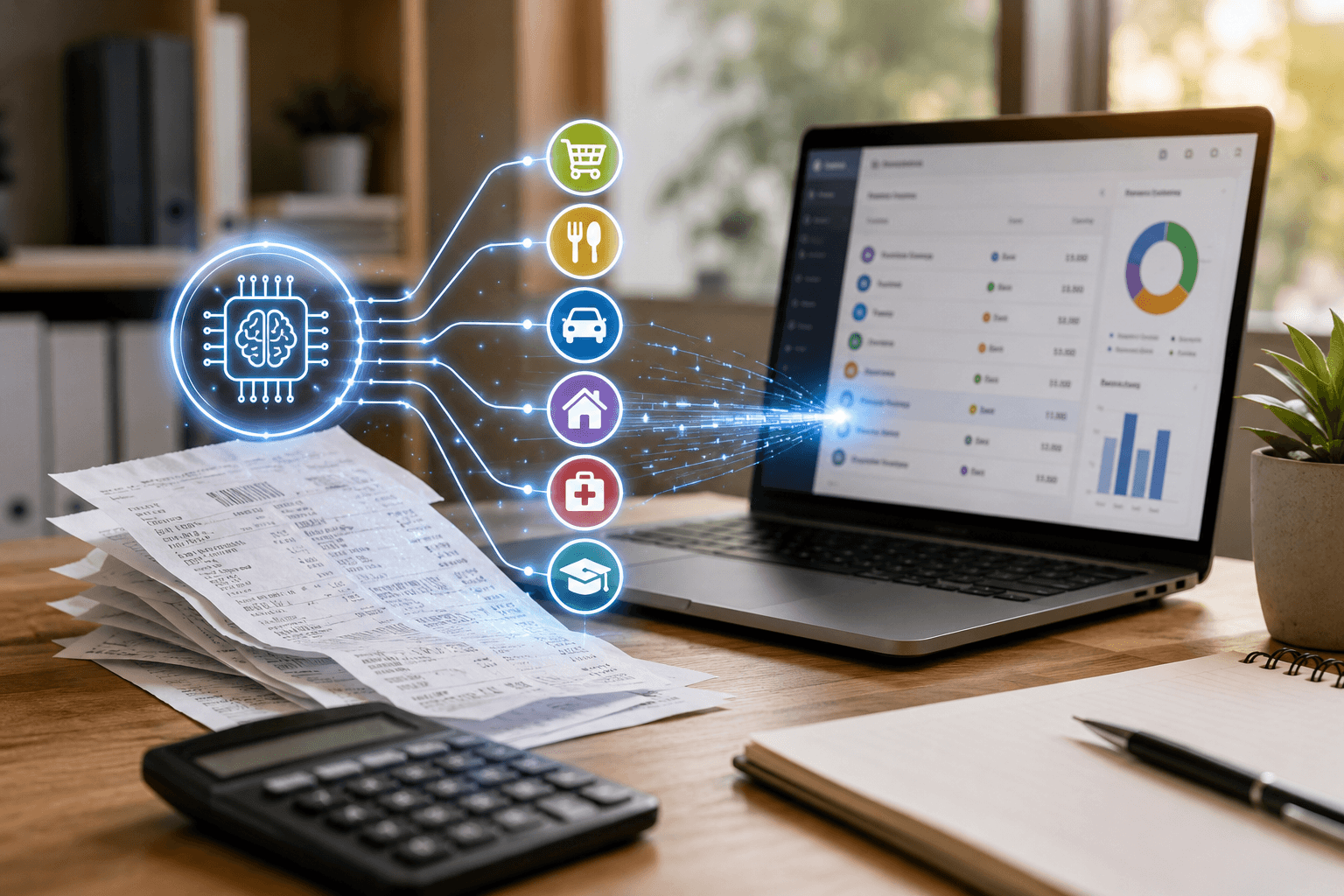
AI Bank Transaction Categorization:
How Smart Automation Transforms Your Books
AI bank transaction categorization is the process of using machine learning to automatically sort your bank transactions into accurate expense and income categories—no spreadsheets, no manual tagging, no late nights squinting at bank statements. It reads merchant names, descriptions, amounts, and patterns, then labels each transaction faster and more accurately than any human could.
Here’s what nobody tells you: the average small business owner spends hours every week categorizing transactions by hand—and still gets a chunk of them wrong. I’ve spent over two decades watching entrepreneurs drown in this exact task, and I’m here to tell you it’s completely unnecessary. The technology to fix this exists right now, and understanding how it works is your first step toward getting those hours back.
What is AI bank transaction categorization and how does it work?
- AI bank transaction categorization uses machine learning to automatically label bank transactions by analyzing merchant data, transaction descriptions, amounts, and spending patterns—improving accuracy over time as it learns from corrections.
- Machine learning models are trained on millions of transactions, so they recognize that “SQ *JOES COFFEE” is a meal expense even when the description looks like gibberish.
- Merchant data, including merchant category codes, gives the AI a reliable starting point for classification.
- Hybrid systems combine rules (“always categorize this vendor as software”) with AI predictions for maximum accuracy.
- Human review stays in the loop—the best systems flag low-confidence transactions instead of guessing blindly.

Why Manual Transaction Categorization Is Costing You More Than Time
Let’s be honest about the old way. You download a statement, stare at cryptic descriptions like “PP*8329 SVCS,” and make your best guess. Multiply that by hundreds of transactions per month, and you’ve got a recipe for errors, missed deductions, and books you can’t trust.
Miscategorized transactions aren’t just annoying—they’re expensive. They distort your profit margins, inflate or hide tax deductions, and make your financial reports unreliable. When your data is wrong, every decision built on it is wrong too.
The hidden ripple effect of bad categorization
One mislabeled recurring expense can throw off your budget forecasts for the entire year. I’ve seen business owners discover thousands in missed deductions simply because subscriptions were dumped into a generic “miscellaneous” category. That’s real money left on the table.
How Machine Learning Transaction Labeling Actually Works
Automated transaction categorization isn’t magic—it’s pattern recognition at scale. The AI examines several signals at once and assigns each transaction a category with a confidence score.
Here’s the typical sequence a smart system follows:
- Extract the merchant from messy transaction descriptions using natural language processing.
- Check merchant data, including merchant-based categorization codes assigned by card networks, which classify businesses by type.
- Analyze patterns—amount, frequency, timing—to detect recurring payments and categorize them consistently.
- Apply learned rules from your past corrections, so the system gets smarter with every review.
- Flag uncertainty so a human reviews anything the model isn’t confident about.
That last step matters more than people realize. The best systems don’t pretend to be perfect—they know when to ask for help.
Rule-Based and AI Hybrid Categorization: The Best of Both Worlds
Pure rules break easily. Pure AI can be a black box. The winning approach? Combine them.
Rules handle certainty. If you pay the same landlord every month, a rule locks that in as rent—forever, no guessing. AI handles everything else—new vendors, one-off purchases, and those cryptic descriptions that would stump a rules engine.
This is also where responsible implementation comes in. Trustworthy tools follow frameworks like NIST’s guidance to improve transaction categorization accuracy and manage AI risk with transparency. If a vendor can’t explain how their model makes decisions, that’s a red flag. Your financial data deserves systems built with accountability baked in.
Spend less time managing transactions and more time understanding your business. Meet Complete Controller.
How AI Categorization Transforms Your Bookkeeping Workflow
For small business owners, this technology isn’t a luxury—it’s leverage. When you automate expense tracking, you eliminate the most tedious part of bookkeeping and free yourself to actually run your business.
Faster, cleaner reconciliation
Monthly reconciliation used to mean hours of line-by-line matching. With bank statement categorization AI, pre-categorized transactions turn reconciliation into a quick review-and-approve process. You catch errors and fraud faster because anomalies stand out against clean, consistent data.
Recurring payment detection
AI excels at spotting subscriptions and recurring charges—including the ones you forgot about. When the system detects a payment that repeats monthly, it categorizes it automatically and gives you visibility into where your money quietly leaks out.
From Categorized Data to Smarter Business Decisions
Here’s the real payoff: categorization isn’t the goal—insight is. Clean, consistently labeled transactions become financial transaction insights that power real decisions: Which expense categories are growing? Where is cash flow tightening? What’s actually driving your margins?
This mirrors what researchers do at scale. The Federal Reserve’s Diary of Consumer Payment Choice derives financial transaction insights from payment behavior data to understand spending patterns across the economy—and notably found consumers make roughly 46 payments per month on average. Now imagine that volume across a business. Without automation, that’s an avalanche of untagged data. With it, that’s a goldmine.
You need a system that fits your business—one that turns raw transactions into a clear picture of where you stand and where you’re headed.
Choosing the Right Expense Categorization Software
Not all tools are created equal. When evaluating expense categorization software, weigh these factors:
- Accuracy and learning ability—does it improve from your corrections?
- Transparency—can you see why a transaction was categorized a certain way?
- Custom rules—can you lock in categories for known vendors?
- Integration—does it connect cleanly with your accounting platform and bank feeds?
- Human oversight—does it flag uncertain transactions instead of hiding mistakes?
The right tool doesn’t replace your judgment. It amplifies it.
Conclusion: Let the Machines Do the Sorting
AI bank transaction categorization takes the most tedious, error-prone task in bookkeeping and turns it into a fast, accurate, largely automated process. Machine learning reads the messy descriptions, merchant data anchors the classifications, hybrid rules lock in what you know, and human review keeps it honest. The result? Books you can trust and hours you get back every single month.
After 20+ years leading Complete Controller, I’ve watched this technology evolve from novelty to necessity—and I’ve seen firsthand how it changes the game for business owners. If you’re ready to stop sorting transactions and start using your financial data to grow, visit Complete Controller for expert guidance from the team that pioneered cloud-based bookkeeping and controller services.

Frequently Asked Questions About AI Bank Transaction Categorization
How accurate is AI bank transaction categorization?
Leading systems achieve high accuracy—often above 90%—and improve over time as they learn from your corrections. Hybrid systems combining rules with machine learning perform best.
Can AI detect recurring payments and subscriptions?
Yes. AI analyzes transaction frequency, amounts, and merchant names to identify recurring charges automatically, helping you track subscriptions and forecast expenses.
Is AI transaction categorization safe for my financial data?
Reputable tools use bank-level encryption and follow risk frameworks like NIST’s AI Risk Management Framework. Always verify a vendor’s security practices before connecting your accounts.
Do I still need a bookkeeper if I use automated categorization?
Yes—AI handles the sorting, but skilled professionals review flagged transactions, ensure tax compliance, and turn clean data into strategic advice.
What’s the difference between rule-based and AI categorization?
Rules apply fixed logic (a specific vendor always gets a specific category), while AI predicts categories for new or unclear transactions. The best systems use both together.
Sources
- CompleteController.com. Importance of Reconciling Your Accounting Statements Regularly. https://www.completecontroller.com/importance-of-reconciling-your-accounting-statements-regularly/
- CompleteController.com. Small Business Bookkeeping: 9 Tips and Tricks. https://www.completecontroller.com/small-business-bookkeeping-9-tips-and-tricks/
- CompleteController.com. Efficient Business Finance Management. https://www.completecontroller.com/efficient-business-finance-management/
- Wikipedia. Merchant Category Code. https://en.wikipedia.org/wiki/Merchantcategorycode
- National Institute of Standards and Technology (NIST). AI Risk Management Framework. https://www.nist.gov/itl/ai-risk-management-framework
- Federal Reserve Financial Services. Diary of Consumer Payment Choice. https://www.frbservices.org/resources/financial-services/cash/diary-consumer-payment-choice
 About Complete Controller® – America’s Bookkeeping Experts Complete Controller is the Nation’s Leader in virtual bookkeeping, providing service to businesses and households alike. Utilizing Complete Controller’s technology, clients gain access to a cloud platform where their QuickBooks™️ file, critical financial documents, and back-office tools are hosted in an efficient SSO environment. Complete Controller’s team of certified US-based accounting professionals provide bookkeeping, record storage, performance reporting, and controller services including training, cash-flow management, budgeting and forecasting, process and controls advisement, and bill-pay. With flat-rate service plans, Complete Controller is the most cost-effective expert accounting solution for business, family-office, trusts, and households of any size or complexity.



 Brittany McMillen
Brittany McMillen
Brittany McMillen