


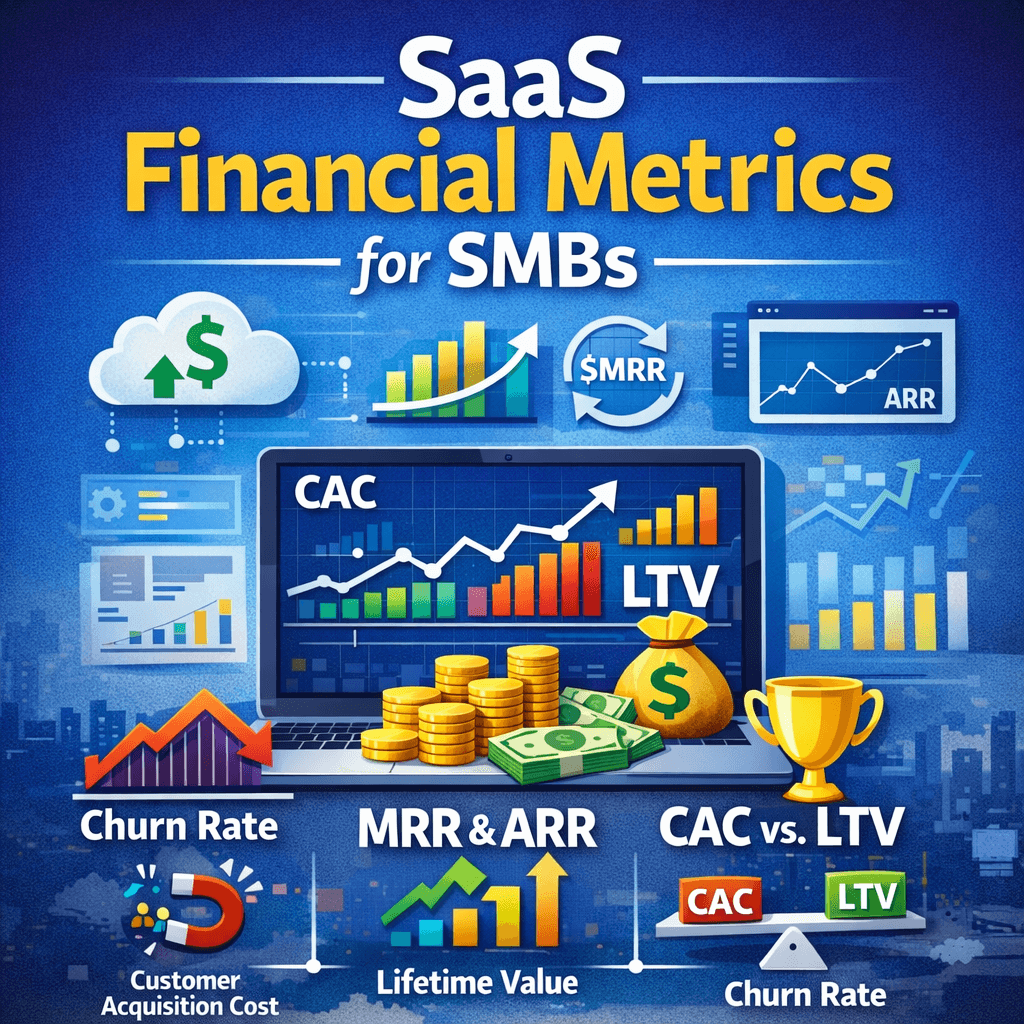
SaaS Financial Metrics:
A Practical Guide for SMBs
SaaS financial metrics are the key performance indicators that measure your subscription business’s revenue, customer acquisition, retention, and profitability—including Monthly Recurring Revenue (MRR), Annual Recurring Revenue (ARR), Customer Acquisition Cost (CAC), Customer Lifetime Value (CLTV), and churn rate. For SMBs, tracking these metrics is essential to understanding financial health, making data-driven decisions, and optimizing cash flow to fuel sustainable growth.
Over the past two decades at Complete Controller, I’ve worked with hundreds of SaaS SMBs, and I’ve seen a consistent pattern: the businesses that master their financial metrics outpace their competition. They make smarter hiring decisions, cut waste faster, and scale with confidence. Yet most SMB founders I meet are overwhelmed by the sheer number of metrics available and unsure which ones actually matter for their stage and size. This guide cuts through the noise and gives you exactly what you need—practical, actionable guidance to measure growth, reduce churn, and make better cash flow decisions.

What are SaaS financial metrics and why do SMBs need to track them?
- SaaS financial metrics measure recurring revenue, customer acquisition efficiency, retention health, and profitability—providing the data foundation for sustainable growth
- Monthly Recurring Revenue (MRR) shows predictable revenue you can count on each month for cash flow planning
- Customer Acquisition Cost (CAC) reveals how much you spend to acquire each new customer and whether that spending is sustainable
- Customer Lifetime Value (CLTV) demonstrates the total revenue a customer generates across their entire relationship with you
- Churn rate exposes how many customers you’re losing monthly, acting as an early warning system for business health
Core SaaS Financial Metrics Every SMB Must Track
Understanding the foundational metrics is where discipline begins. These four metrics form the backbone of SaaS financial management.
Monthly recurring revenue (MRR) and annual recurring revenue (ARR)
MRR and ARR represent your predictable, recurring revenue and are arguably the most critical metrics in any SaaS business. MRR is the lifeblood of cash flow planning; ARR is what investors use to value your company.
How to Calculate MRR:
Sum all recurring revenue from active subscriptions this month. Alternative calculation: (Number of active customers) × (Average monthly subscription price). For example: 500 customers × $100/month = $50,000 MRR.
How to Calculate ARR:
Multiply MRR by 12. Using our example: $50,000 MRR × 12 = $600,000 ARR.
Why It Matters for SMBs:
MRR gives you cash flow visibility month-to-month, enabling confident decisions about hiring and operational investments. ARR helps you benchmark against competitors and attracts investors who evaluate companies based on annualized revenue. Growing MRR is the primary driver of valuation—every dollar of increased MRR translates to twelve dollars of ARR, directly impacting what your business is worth.
Understanding expansion MRR and contraction MRR
Beyond base MRR, track two critical subsets: Expansion MRR (upgrades, cross-sells, add-ons) and Contraction MRR (downgrades). Many SMBs ignore these, missing opportunities to see where revenue is flowing or leaking.
Expansion MRR equals revenue gained from existing customers upgrading or buying more. Contraction MRR equals revenue lost from existing customers downgrading. Net MRR Churn represents the combined effect of churn, expansion, and contraction.
Tracking expansion separately helps you understand if your product is sticky and if customers see increasing value over time. When expansion MRR consistently exceeds churn MRR, you’ve achieved negative net churn—the holy grail of SaaS metrics where your existing customer base grows revenue without any new customer acquisition.
Customer acquisition cost (CAC)
Customer acquisition cost CAC measures how much you spend to acquire a new customer and is critical for determining if your business model is sustainable.
How to Calculate CAC:
Total sales and marketing spend (salaries, tools, campaigns) divided by number of new customers acquired. Example: $18,000 ÷ 50 new customers = $360 CAC.
CAC Payback Period:
This secondary metric shows months to recover your CAC from that customer’s MRR. Formula: CAC ÷ (Customer MRR × Gross Margin %). Benchmark: 6–12 months is healthy; under 6 months is excellent.
Why It Matters for SMBs:
CAC reveals if your sales and marketing spend is efficient. High CAC can drain cash faster than you can replace it, creating a death spiral even with strong revenue growth. This metric helps you decide whether to hire more salespeople or pause growth spending. If your CAC payback period extends beyond your cash runway, you’re essentially betting the company on every new customer.
Customer lifetime value (CLTV or LTV)
Customer lifetime value CLTV is the total revenue a customer generates across their entire relationship with you. It’s your most powerful metric for unit economics.
How to Calculate CLTV:
ARPU (Average Revenue Per User) × Gross Margin % ÷ Monthly Churn Rate. Or: Average customer MRR × Average customer lifetime (months). Example: $100 MRR × 24-month average lifetime = $2,400 CLTV.
LTV:CAC Ratio:
Divide CLTV by CAC to see unit economics health. Benchmark: 3:1 (or higher) is healthy; below 2:1 signals trouble. This ratio guides all growth spending decisions.
Why It Matters for SMBs:
CLTV shows whether your business model is viable long-term. If you’re spending $500 to acquire customers who only generate $400 in lifetime value, you’re literally paying for the privilege of having customers. A strong LTV:CAC ratio justifies investment in growth and gives you the confidence to scale aggressively.
Churn Rate: The Silent Cash Flow Killer
Churn rate is the percentage of customers you lose each month, and it’s often the metric SMBs overlook until it’s too late.
Calculating and benchmarking churn
How to Calculate Monthly Churn Rate:
(Customers lost this month) ÷ (Customers at start of month) × 100. Example: 50 lost customers ÷ 1,000 start customers = 5% monthly churn.
Annual Churn Calculation:
1 – (1 – monthly churn rate)^12. Example: 5% monthly churn ≈ 46% annual churn. This compound effect is why seemingly small monthly churn rates can devastate a business over time.
Industry Benchmarks:
- Early-stage SMBs (<$1M ARR): 5–10% monthly churn is typical
- Growth-stage SMBs ($1M–$10M ARR): 2–5% monthly churn is healthy
- Mature SaaS: <3% monthly churn is the goal
Dollar-Based Churn:
This accounts for expansion MRR, giving a more complete picture. Formula: (Starting MRR – (churned MRR – expansion MRR)) ÷ Starting MRR. Negative net churn means you’re growing revenue from existing customers despite some cancellations.
Reducing churn: Where to focus
Early warning systems can dramatically reduce churn before it happens. Track which customers are at-risk based on engagement or usage drops. Implement automated check-ins before renewal deadlines. Create segmented win-back campaigns for recently churned customers—you’d be surprised how many return with the right approach.
Product and success improvements address the root causes. Measure time-to-value: How quickly do new customers see ROI? The faster they experience success, the more likely they’ll stay. Identify where customers struggle with adoption through usage analytics and support tickets. Build case studies and success stories from your highest-retention customers, then use those patterns to guide all customers toward similar outcomes.
Net Revenue Retention (NRR): The Hidden Growth Lever
Net Revenue Retention (sometimes called Net Dollar Retention) captures whether you’re growing revenue from existing customers through expansion and renewals, even as some customers churn.
How to Calculate NRR:
(Beginning MRR + Expansion MRR – Churned MRR) ÷ Beginning MRR. Example: ($100k + $10k – $5k) ÷ $100k = 105% NRR.
What NRR Tells You:
- NRR > 100% = Expansion outpacing churn (excellent)
- NRR = 100% = No net change in revenue
- NRR < 100% = Losing more revenue than gaining (warning sign)
Why SMBs Should Care:
NRR shows whether your customer relationships are strengthening or weakening. A strong NRR allows you to grow revenue without constantly acquiring new customers—essentially creating a compound growth engine. Investors specifically ask for NRR when evaluating SaaS companies because it demonstrates product-market fit better than any other single metric. Companies with NRR above 110% command valuation premiums because they’ve proven their ability to expand within their customer base.
Drowning in spreadsheets but still can’t see your true unit economics? Let Complete Controller simplify your financial tracking.

Advanced Unit Economics: Gross Margin, Burn Rate, and the Rule of 40
Beyond the core metrics, SMBs need to understand the unit economics that determine long-term sustainability.
Gross margin: Your true operating leverage
Gross Margin is the percentage of revenue left after paying direct costs (hosting, payment processing, customer support). Gross margin SaaS benchmarks help you understand where you stand relative to industry standards.
How to Calculate:
(Revenue – Cost of Goods Sold) ÷ Revenue × 100. Example: ($100k revenue – $20k COGS) ÷ $100k = 80% gross margin.
Why It Matters:
Gross margin shows how much money is available to cover R&D, sales, marketing, and overhead. SaaS companies typically target 70–85% gross margin. Low gross margin signals either pricing problems or operational inefficiency. Every percentage point of gross margin improvement drops straight to your bottom line, making this one of the highest-leverage optimization areas.
Burn rate: Monitoring your runway
Burn rate is how much cash you’re spending monthly beyond what you’re earning. Understanding burn rate alongside managing burn rate and the cash conversion cycle ensures you maintain adequate runway.
How to Calculate:
Net operating cash outflow per month. Example: If you spend $150k/month and earn $80k, your burn is $70k/month.
Runway Calculation:
Current cash ÷ Burn rate = Months until zero. Example: $420k cash ÷ $70k monthly burn = 6 months runway.
Implications for SMBs:
Runway visibility helps you plan fundraising or profitability timelines. Track burn alongside MRR growth to understand if you’re spending efficiently. The healthy trajectory shows decreasing burn rate and increasing MRR converging toward profitability. If your burn rate isn’t declining as MRR grows, you have an efficiency problem that needs immediate attention.
The rule of 40: Balancing growth and profitability
The Rule of 40 is a simple but powerful framework: your growth rate (%) + profit margin (%) should equal or exceed 40. This framework helps balance growth investments with profit margin and SaaS unit economics.
How to Apply It:
- If growing 30% YoY, aim for 10% profit margin (30 + 10 = 40)
- If growing 50% YoY, breakeven is acceptable (50 + 0 = 40)
- If growing 20% YoY, target 20% profit margin (20 + 20 = 40)
Why SMBs Should Use It:
The Rule of 40 keeps you from chasing unsustainable growth at the expense of profitability. It helps decide whether to hire another salesperson (accelerate growth) or optimize operations (improve margin). Most importantly, it shows you’re creating a business that can survive without constant capital raising. Companies achieving Rule of 40 trade at 2x the valuation multiples of those that don’t.
Building Your SaaS Metrics Dashboard: From Tracking to Action
Knowing your metrics is only half the battle; you need real-time visibility and the discipline to act on what you see.
Essential dashboard components for SMBs
Monthly Metrics View (Your north star):
Display current MRR and month-over-month growth %, churn rate and net revenue retention, CAC and LTV:CAC ratio, and runway (cash ÷ burn rate). These four metrics tell you everything about business health at a glance.
Cohort Analysis:
Compare new customer cohorts by acquisition month to identify which cohorts have lower churn and higher LTV. This reveals your best-performing customer segments and helps you double down on what works.
Leading Indicators:
Track free trial sign-ups and conversion rates (predicts future MRR), product usage and engagement (predicts future churn), and sales pipeline (predicts future ARR). These forward-looking metrics give you time to course-correct before problems materialize.
Tools and automation for SMB tracking
Building best SaaS financial metrics dashboard workflows requires the right technology stack.
Accounting and Financial Metrics:
Use QuickBooks or Xero for base financial data, Stripe, Chargebee, or ProfitWell for subscription-specific metrics, and custom spreadsheets or Tableau for visualization.
Why Automation Matters:
Real-time metrics reduce decision lag—you can spot trends and act immediately. Automated alerts flag problems (churn spikes, cash burn acceleration) before they spiral out of control. Most importantly, automation frees your finance team from manual reporting to focus on analysis and strategy.
Common Metric Mistakes SMBs Make (and How to Avoid Them)
Obsessing over vanity metrics
- The trap: Focusing on total customer count while ignoring who’s paying what.
- The fix: Track ARPU (Average Revenue Per User) and customer value tiers. Fifty $5/month customers are not the same as fifty $500/month customers. Segment by revenue, not just count. Your top 20% of customers likely drive 80% of revenue—optimize for them.
Ignoring expansion MRR
- The trap: Treating new customer acquisition as the only growth lever while ignoring existing customers.
- The fix: Benchmark expansion MRR as a percentage of total MRR growth. Healthy SaaS companies generate 20-30% of growth from expansion. Build systematic upsell processes into your customer success workflow. Price increases, usage-based upgrades, and add-on products all contribute to expansion without the cost of new customer acquisition.
Conclusion
SaaS financial metrics aren’t just numbers on a spreadsheet—they’re the vital signs of your business. MRR tells you if you’re growing, CAC and LTV reveal if that growth is sustainable, churn shows if customers find lasting value, and NRR demonstrates whether you’ve built something that compounds over time.
The businesses that win in SaaS aren’t necessarily those with the best products or the most funding. They’re the ones that understand their metrics deeply and act on them consistently. They know when to invest in growth and when to focus on efficiency. They spot problems early and fix them before they become crises.
You don’t need to track every possible metric—start with the core five covered here and build from there. More importantly, create a culture where metrics drive decisions, not opinions. When your entire team understands how their work impacts MRR, churn, or CAC, you’ve built a data-driven organization that can adapt and thrive.
Ready to get your SaaS metrics under control and build a scalable, profitable business? Visit Complete Controller for expert guidance from the team that pioneered cloud-based bookkeeping and controller services. We’ve helped hundreds of SaaS companies master their financial metrics and achieve sustainable growth—let us show you how.

Frequently Asked Questions About SaaS Financial Metrics
What’s the most important SaaS metric for an early-stage SMB to track?
Monthly Recurring Revenue (MRR) is the foundation—it shows your real revenue momentum and helps you plan cash flow. Without accurate MRR tracking, every other metric becomes guesswork.
How do I calculate SaaS CAC if I have both self-serve and sales-assisted customers?
Calculate CAC separately for each acquisition channel. Self-serve CAC includes marketing spend divided by self-serve signups. Sales-assisted CAC adds sales salaries and commissions to marketing spend, divided by sales-assisted customers. This segmented view reveals which channel is more efficient.
What’s a good churn rate benchmark for a B2B SaaS targeting SMBs?
For B2B SaaS serving SMBs, 3-5% monthly churn is typical, though top performers achieve 2-3%. The key is showing improvement over time—if you start at 7% monthly churn but reduce it steadily, you’re on the right track.
How can I improve my LTV:CAC ratio from 2:1 to the healthy 3:1 benchmark?
Focus on three levers: reduce CAC through more efficient marketing channels and better sales qualification, increase LTV by improving onboarding and reducing churn, and raise prices or upsell existing customers to increase average revenue per user.
Should I prioritize reducing churn or increasing new customer acquisition?
For most SMBs, reducing churn provides better ROI. Cutting churn from 5% to 3% monthly has the same growth impact as increasing new customer acquisition by 67%, but usually costs far less to achieve. Fix your leaky bucket before pouring in more water.
Sources
- [1] SaaS Financial Metrics: A Practical Guide for SMBs
- [2] SaaS Financial Metrics: Essential Performance Indicators for Sustainable Growth in 2025-2026
- [3] SaaS Financial Metrics: A Practical Guide for SMBs
- [4] SaaS Financial Metrics: Essential Performance Indicators for Sustainable Growth in 2025-2026
- [5] SaaS Financial Metrics: A Practical Guide for SMBs
- Complete Controller. Managing Burn Rate and the Cash Conversion Cycle. https://www.completecontroller.com/mastering-the-cash-conversion-cycle/
- Complete Controller. Profit Margin and SaaS Unit Economics. https://www.completecontroller.com/net-profit-margin-business-essential/
- Complete Controller. Best SaaS Financial Metrics Dashboard Workflows. https://www.completecontroller.com/from-spreadsheets-to-crms/
- Investopedia. Customer Acquisition Cost CAC. https://www.investopedia.com/terms/c/customer-acquisition-cost.asp
- Wikipedia. Customer Lifetime Value CLTV. https://en.wikipedia.org/wiki/Customerlifetimevalue
- NYU Stern School of Business. Gross Margin SaaS Benchmarks. Aswath Damodaran. https://pages.stern.nyu.edu/~adamodar/NewHomePage/datafile/margin.html
 About Complete Controller® – America’s Bookkeeping Experts Complete Controller is the Nation’s Leader in virtual bookkeeping, providing service to businesses and households alike. Utilizing Complete Controller’s technology, clients gain access to a cloud platform where their QuickBooks™️ file, critical financial documents, and back-office tools are hosted in an efficient SSO environment. Complete Controller’s team of certified US-based accounting professionals provide bookkeeping, record storage, performance reporting, and controller services including training, cash-flow management, budgeting and forecasting, process and controls advisement, and bill-pay. With flat-rate service plans, Complete Controller is the most cost-effective expert accounting solution for business, family-office, trusts, and households of any size or complexity.




 Brittany McMillen
Brittany McMillen
Brittany McMillen