


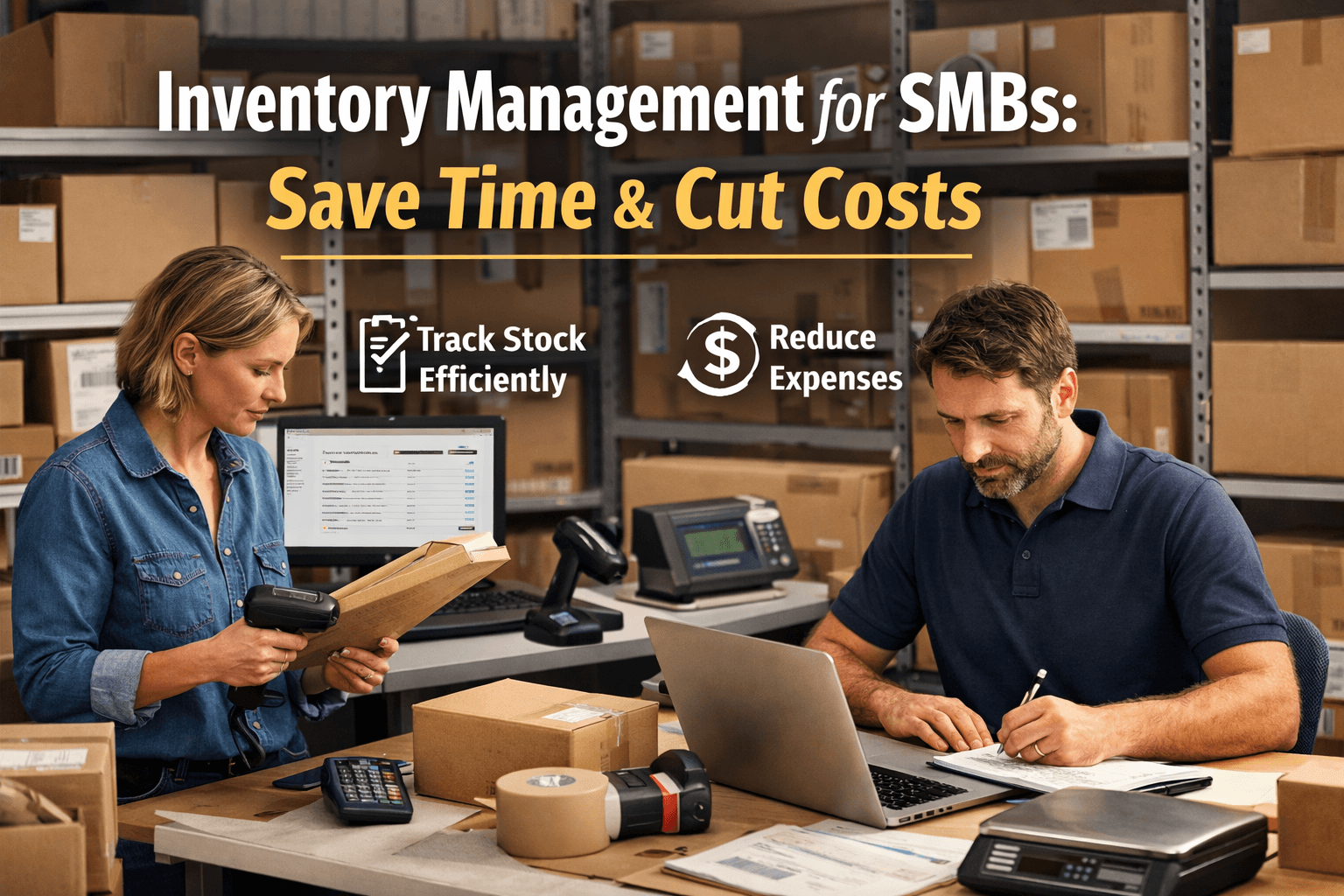
Inventory Management for SMBs:
Save Time & Cut Costs
Inventory management is the strategic process of balancing stock levels with customer demand to minimize costs while maintaining availability—and when done right, it transforms your cash flow from a constant struggle into a predictable engine for growth. But here’s what most small business owners don’t realize: poor inventory decisions are silently draining 20-30% of their working capital every single year, money that could be fueling expansion instead of gathering dust on warehouse shelves.

What is inventory management and how do you get it right?
- Right-sized inventory prevents stockouts, reduces waste, and frees up cash for growth
- ABC analysis segments your products by value, focusing effort where profits actually live
- Reorder points with calculated safety stock eliminate both excess and shortage
- Demand forecasting aligns purchases with actual customer behavior, not hopeful thinking
- Modern software automation reduces manual errors while providing real-time visibility
Core Inventory Management Principles for SMBs
Demand forecasting and planning
Let me share something that took years to learn: your gut instinct about what customers want is usually wrong. Demand forecasting isn’t about crystal balls—it’s about letting data tell you what’s actually happening in your business. Start with your historical sales data and layer in seasonal trends, because that holiday spike or summer slowdown happens like clockwork every year.
Smart forecasting means accounting for market changes and promotional activities before they hit. If you’re running a Mother’s Day promotion, your inventory needs should reflect that surge weeks in advance. The businesses winning at this game align their purchases with realistic demand patterns, not the optimistic projections we all want to believe.
Stock management fundamentals
Here’s a radical idea: stop doing annual inventory counts. They’re outdated, exhausting, and give you stale data that’s useless by February. Instead, implement regular cycle counts—checking a small portion of inventory weekly keeps your numbers accurate without shutting down operations.
Your inventory turnover ratio tells the real story of efficiency. Calculate it by dividing cost of goods sold by average inventory value. A ratio of 6 means you’re turning inventory six times yearly—healthy for most retail. Below 4? You’re sitting on dead money. The painful but necessary move is removing slow-moving items to free up both shelf space and capital for products that actually sell.
ABC analysis: Prioritize what matters
Not all inventory deserves equal attention, and ABC analysis proves it mathematically. Your A items—typically 20% of products generating 80% of revenue—need tight controls and frequent monitoring. B items get moderate oversight, while C items (high quantity, low value) can coast with minimal intervention.
The power move? Use actual sales data rather than intuition to categorize products. That “signature” item you love might actually be a C-category drain, while the boring commodity product could be your profit engine. Data doesn’t lie, even when it hurts.
Essential Inventory Control Strategies
Inventory tracking systems and technology
Manual inventory tracking is like trying to win a race on foot while your competitors drive cars. Barcode scanning eliminates data entry errors that compound into costly mistakes. When a miskeyed number shows 100 units instead of 10, you’ve just created a stockout waiting to happen.
Real-time visibility transforms decision-making from reactive scrambling to proactive management. Integration between your POS system and inventory software creates a single source of truth, eliminating the Excel gymnastics that waste hours weekly.
Setting reorder points and safety stock
The reorder point formula is deceptively simple: (Lead Time × Average Daily Usage) + Safety Stock. But nailing those variables requires attention to detail. Calculate your actual lead time from order placement to products on shelf—not the supplier’s promise, but reality including processing and receiving time.
Safety stock acts as your insurance policy against variability. A few days’ worth of average sales usually suffices, but high-value customers or seasonal peaks might justify more. The key is using automated inventory tracking with barcode systems to trigger reorders at precisely the right moment, eliminating both panicked rush orders and excess accumulation.
Inventory optimization techniques
Economic Order Quantity sounds academic, but it’s simply the sweet spot between ordering costs and holding costs. The beauty of inventory optimization using Economic Order Quantity (EOQ) is that once calculated, it gives you a number to work with rather than guessing.
Just-in-time ordering reduces storage costs dramatically but demands reliable suppliers. Before jumping in, test with one product category and iron-clad supplier agreements. Blanket purchase orders with trusted vendors lock in pricing while maintaining flexibility on delivery timing—a perfect middle ground for most SMBs.
Better inventory decisions start with clear numbers. See how Complete Controller helps business owners stay financially in control.

Advanced Inventory Management Strategies
Supply chain management and vendor relationships
Your vendors make or break your inventory strategy. Conduct honest vendor audits identifying which suppliers consistently deliver on time versus those causing constant fire drills. Document everything: reorder levels, actual lead times, payment terms, and importantly, their track record during peak seasons.
Service Level Agreements aren’t just for big companies. Even informal SLAs that outline mutual expectations around delivery windows, quality standards, and communication protocols prevent the ambiguity that creates inventory chaos. Strong supply chain management relationships become your competitive advantage when competitors struggle with stockouts.
Warehouse management and organization
Physical organization multiplies efficiency or destroys it. Group products by category, velocity, and size—your fast-movers belong in prime picking locations, not buried in back corners. This isn’t just about convenience; poor organization adds labor costs to every single order.
Space consolidation offers immediate payback. Most SMBs use warehouse space inefficiently, spreading inventory across multiple locations when thoughtful reorganization could cut storage costs by 30%. FIFO (first-in, first-out) rotation is non-negotiable for perishables but smart for any product where freshness or version control matters.
Inventory software solutions for small business
The right platform syncs inventory across all sales channels automatically, eliminating the nightmare of overselling on one channel while stock sits idle elsewhere. Look for tools generating actionable reports—not just data dumps but insights highlighting slow-movers, predicting stockouts, and calculating true profitability by SKU.
Cloud-based solutions offer scalability without massive IT investment. The best systems grow with you, starting simple but offering advanced features as needed. Integration with your accounting system is non-negotiable; when inventory movements automatically update financial records, you see the real profit impact of every inventory decision.
Real-World Inventory Management Success
A food and beverage retailer client was hemorrhaging money through 15% monthly waste on perishables, with $12,000 perpetually tied up in dead stock. After implementing ABC analysis and FIFO tracking through integrated software, they slashed waste by 40% within three months and freed up $4,800 in working capital. The lesson? Systematic tracking and categorization deliver immediate, measurable returns.
The Cost-Benefit Math: Holding Costs vs. Stockout Risk
Holding costs silently erode margins through storage, insurance, depreciation, and obsolescence—typically 20-30% of inventory value annually. Meanwhile, stockout costs hit harder through lost sales, damaged reputation, and customer defection to competitors.
The balance point requires precision inventory optimization that aligns reorder points with actual demand patterns. Here’s a quick win most overlook: reducing carrying costs through storage consolidation can improve cash flow by 10-20% without touching sales volume. That’s pure profit improvement through smarter space utilization.
Common Inventory Management Mistakes That Kill Profits
Ordering by feel instead of data leads predictably to feast-or-famine cycles. Skipping cycle counts lets discrepancies compound until they’re expensive surprises. Ignoring slow-moving inventory ties up cash indefinitely—that dusty product isn’t improving with age.
Poor handoffs between sales, fulfillment, and inventory teams create costly gaps. When sales doesn’t communicate promotions to inventory managers, stockouts are guaranteed. When fulfillment doesn’t update pick lists, duplicate orders waste capital. These aren’t technology problems; they’re communication failures with technology solutions.
Your Next Steps
Optimizing inventory management isn’t a project—it’s an ongoing discipline that compounds results over time. Start with one product category or warehouse section, measure results obsessively, then scale what works. The businesses thriving tomorrow are those aligning inventory decisions with cash flow reality today. At Complete Controller, we help SMBs see the full financial picture, integrating inventory management with comprehensive financial oversight. Ready to transform inventory from a cash drain into a competitive advantage? Visit Complete Controller for expert guidance on building systems that scale with your ambition.

Frequently Asked Questions About Inventory Management
What’s the difference between inventory control and inventory management?
Inventory control focuses on tracking current stock levels and movements, while inventory management encompasses the entire strategic process including forecasting, purchasing, optimization, and financial analysis. Think of control as today’s snapshot and management as the full movie.
How often should I perform physical inventory counts?
Ditch annual counts for weekly cycle counts covering 20-25% of your inventory. This maintains accuracy without operational disruption and catches discrepancies while they’re still fixable. High-value items deserve monthly attention.
What’s the ideal inventory turnover ratio for my business?
Retail typically targets 4-6 turns annually, restaurants need 20-30, while manufacturing might achieve 3-5. Calculate yours by dividing annual cost of goods sold by average inventory value, then benchmark against your specific industry.
How does cloud-based inventory management help e-commerce multi-channel sales?
Cloud systems provide real-time synchronization across all channels, preventing overselling on Amazon while inventory sits unsold on your website. Centralized data means accurate availability everywhere, reducing customer disappointment and emergency transfers.
What features matter most when comparing inventory management software?
Prioritize real-time syncing across channels, automated reorder points, ABC analysis capabilities, integration with accounting systems, and mobile accessibility. Scalability matters—choose software that grows with you rather than forcing future migrations.
Sources
- Smartsheet. “Inventory Control for Small Businesses: Expert Tips & Tools.” Smartsheet, www.smartsheet.com. Accessed March 2026.
- First American Bank. “Refine Inventory Management & Optimize Cash Flow.” First American Bank, www.firstambank.com. Accessed March 2026.
- BankFive. “How to Manage Inventory for Your Small Business.” BankFive, www.bankfive.com. Accessed March 2026.
- LSI Wins. “Effective Inventory Management Strategies To Improve Cash Flow.” LSI Wins, www.lsiwins.com. Accessed March 2026.
- Orderry. “Managing Inventory In Small Business: Principles And Best Practices.” Orderry, www.orderry.com. Accessed March 2026.
- Irvine Bookkeeping. “How to Optimize Your Inventory for Better Cash Flow.” Irvine Bookkeeping, www.irvinebookkeeping.com. Accessed March 2026.
- Cin7. “Inventory Management for Small Business: A Comprehensive Guide.” Cin7, www.cin7.com. Accessed March 2026.
- NetSuite. “What Is Inventory Optimization? Benefits and Techniques.” NetSuite, www.netsuite.com. Accessed March 2026.
 About Complete Controller® – America’s Bookkeeping Experts Complete Controller is the Nation’s Leader in virtual bookkeeping, providing service to businesses and households alike. Utilizing Complete Controller’s technology, clients gain access to a cloud platform where their QuickBooks™️ file, critical financial documents, and back-office tools are hosted in an efficient SSO environment. Complete Controller’s team of certified US-based accounting professionals provide bookkeeping, record storage, performance reporting, and controller services including training, cash-flow management, budgeting and forecasting, process and controls advisement, and bill-pay. With flat-rate service plans, Complete Controller is the most cost-effective expert accounting solution for business, family-office, trusts, and households of any size or complexity.




 Brittany McMillen
Brittany McMillen
Brittany McMillen